Introduction
Procurement transformation is not merely a procurement department exercise. It is a test of whether an organisation practises what it professes, and that test begins with leadership, governance and culture.
Many organisations, including well-regarded ones, have comprehensive procurement policies, clearly defined procedures and well-articulated organisational values. Yet weaknesses may persist: non-compliant purchases, questionable vendor selection, delays, cost overruns and repeated audit findings. When such problems continue despite sound policies, the underlying causes often extend beyond policy design.
This article advances four interconnected propositions:
- Leadership by example is a prerequisite. Transparent, fair and ethical practices must begin at the top.
- We cannot preach what we do not practise. Organisational standards lose credibility when they are applied selectively.
- Governance is fundamental to organisational effectiveness. Weak governance can manifest in poor procurement, financial management and programme implementation.
- The problem may be cultural, not merely procedural. Informal norms and established practices can override formal rules.
The aim is constructive: to help organisations translate their policies, values and strategic priorities into consistent practice and measurable results. The article draws on general experience across the sector and does not describe any particular organisation.
1. The Gap Between Policy and Practice
A policy prescribes behaviour; it does not guarantee it. The gap between what is written and what is practised is where procurement failures occur.
That gap is rarely closed by another policy revision, another training session or additional documentation alone. Such interventions may be necessary, but they will have limited impact if the underlying problem lies in leadership behaviour, incentives, accountability or deliberate non-compliance.
When controls are bypassed without adequate scrutiny, exceptions become routine, or documentation is completed after decisions have effectively been made, two systems emerge: the formal system prescribed by policy and the informal system that governs actual practice.
The challenge is to bring these systems into alignment. This requires understanding why the gap exists, addressing its root causes and ensuring that established policies operate as intended in everyday decisions.
2. Leadership by Example: Practising What We Preach
The credibility of procurement controls begins with the conduct of those who exercise authority. Transparency, fairness and ethical behaviour at the top are not optional additions to good governance; they are essential conditions for its effectiveness.
Leaders shape organisational culture through what they do, what they tolerate, what they reward and how they respond when standards are challenged. If those in authority bypass controls, favour particular individuals or vendors, or expect exceptions for themselves, staff may reasonably conclude that compliance is negotiable. Conversely, when leaders follow the same rules, welcome scrutiny and accept constructive challenge, they reinforce accountability throughout the organisation.
An organisation that promotes integrity, accountability and good governance externally has a particular responsibility to demonstrate those principles internally. Inconsistency between stated values and actual behaviour can undermine staff confidence, donor trust and institutional credibility.
In practice, leadership by example requires:
- One set of standards: The requirements applicable to employees should also apply to senior management.
- Justified exceptions: Where an exception is genuinely necessary, it must be justified, authorised at the appropriate level, documented and open to review.
- Conflict-of-interest management: Relevant interests must be declared and managed, with individuals recusing themselves from decisions where appropriate.
- Openness to challenge: Questions from procurement, finance, internal audit or other control functions should be treated as safeguards rather than obstacles.
- Consistent accountability: Substantiated non-compliance should be addressed fairly and proportionately, irrespective of seniority or relationships.
The credibility of organisational standards is tested precisely when following them is inconvenient or challenges established interests.
3. Governance: The Foundation of Organisational Effectiveness
Poor procurement, weak financial management and ineffective programme implementation may be symptoms of common underlying governance weaknesses. These include unclear accountability, inadequate oversight, unmanaged conflicts of interest, ineffective monitoring and inconsistent enforcement of organisational standards.
These functions are interconnected. Procurement decisions commit organisational resources; financial management determines how those commitments are controlled and accounted for; and programme management determines whether the resources are converted into planned activities, outputs and outcomes.
Weaknesses in one area can quickly affect the others. For example, a procurement decision that is influenced by inappropriate considerations may result in higher costs, inferior quality or delayed delivery. These consequences may affect programme implementation, compromise value for money and ultimately undermine strategic objectives.
Common governance weaknesses include:
- Unclear accountability and overlapping responsibilities.
- Delegation of authority without adequate oversight.
- Ineffective monitoring and management information.
- Unmanaged conflicts of interest and inappropriate influence.
- Inconsistent enforcement of policies and standards.
- Limited independent challenge of significant decisions.
- A leadership culture that tolerates avoidable control failures.
Governance is not the sole cause of every organisational failure. Technical capacity, resource constraints, process design and external conditions also matter. Effective governance, however, helps ensure that these factors are identified, addressed and monitored rather than allowed to recur.
The practical implication is important: before correcting individual functional failures, an organisation should examine whether its governance arrangements allow those failures to happen repeatedly.
Fixing individual transactions without addressing the governance weaknesses behind them risks treating symptoms while leaving the underlying causes unchanged.
4. Organisational Culture: When Informal Norms Override Formal Rules
Where poor practices persist despite sound policies, the problem may be cultural as well as procedural.
Organisational culture is reflected in everyday decisions and behaviours, particularly when oversight is limited or when doing the right thing is inconvenient. Practices that are repeatedly tolerated can gradually become accepted as normal, even when they conflict with formal policies and organisational values.
Over time, informal norms may develop around:
- Accepting exceptions as a routine way of getting things done.
- Avoiding difficult conversations with senior colleagues.
- Protecting established relationships, internally or with vendors.
- Prioritising speed and convenience over accountability.
- Treating documentation as a substitute for genuine compliance.
- Discouraging employees who question established practices.
Such norms may persist because they appear to deliver short-term results, because people fear challenging influential colleagues, or because deviations carry few consequences.
Changing this environment requires more than issuing new instructions. An organisation must understand why these behaviours persist, identify the incentives and practices that reinforce them, and establish a culture in which integrity, fairness, transparency and effective performance are mutually reinforcing.
Staff should be able to raise concerns, challenge inappropriate decisions and recommend improvements without fear of retaliation. Equally, the organisation must be willing to act when credible evidence of deliberate misconduct emerges.
The objective is not to create a culture of fear or excessive bureaucracy. It is to create an environment in which good practices are the norm, concerns are addressed constructively and accountability is consistently applied.
5. Diagnosing Root Causes: Look Beyond Individual Transactions
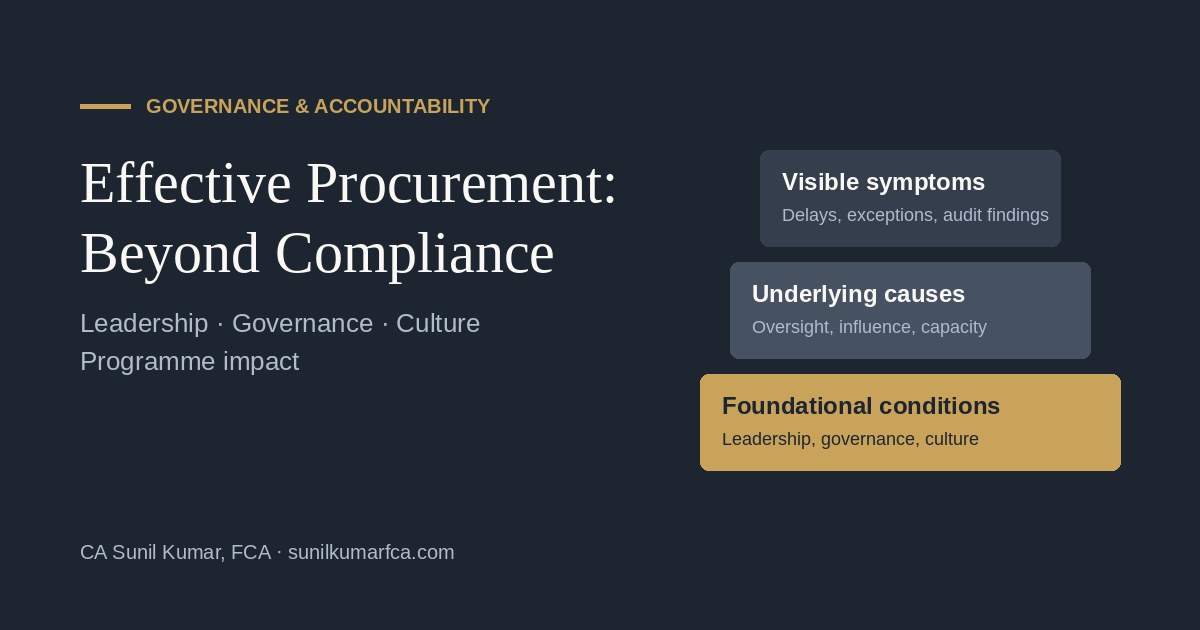
Recurring procurement failures should be examined at three interconnected levels.
| Level | What it may reveal | Appropriate response |
|---|---|---|
| Visible symptoms | Non-compliance, poor vendor selection, delays, financial irregularities and repeated audit findings | Correct individual cases and contain immediate risks |
| Underlying causes | Weak accountability, inconsistent oversight, inappropriate influence, capacity gaps and ineffective controls | Strengthen systems, oversight, processes and capability |
| Foundational conditions | Leadership conduct, governance effectiveness, organisational culture, incentives and willingness to enforce standards | Demonstrate leadership commitment and address cultural and governance weaknesses |
The response must fit the cause.
Deliberate circumvention of controls or suspected financial misconduct requires appropriate fact-finding, independent investigation where warranted, and fair accountability. Capacity gaps require training, guidance and support. Unnecessarily difficult procedures require redesign. Genuine operational constraints, such as emergencies or limited supplier markets, require clear and properly authorised alternative procedures.
It is equally important to distinguish verified facts from control weaknesses, reasonable concerns and allegations that require investigation. Premature conclusions can undermine trust and due process, while failure to act on substantiated concerns can perpetuate poor practices.
Treating every problem as a training issue will be ineffective. Treating every mistake as misconduct will be equally counterproductive.
6. Strengthening Implementation and Accountability
Where sound procurement policies already exist, the priority should be to make them effective in practice rather than automatically introduce new ones.
Five measures are particularly important.
1. Effective and independent oversight
Responsibilities for requesting, approving, evaluating, receiving and paying for goods and services should be appropriately segregated. Where full segregation is impractical, compensating controls should be established.
Significant procurement risks, exceptions and unresolved control failures should receive appropriate independent scrutiny. Concerns involving senior decision-makers must have a credible escalation route through authorised governance channels, including the relevant board committee where appropriate.
2. Transparent decision-making
The rationale for vendor selection, single-source procurement, exceptions and material contract changes should be documented when decisions are made, not retrospectively to justify decisions already taken.
Procurement plans, awards and relevant performance information should be accessible to appropriate internal stakeholders, subject to confidentiality, donor requirements, data protection and other applicable restrictions.
3. Proportionate controls
Controls should reflect the value, complexity and risk of the purchase. Excessively complicated requirements for routine, low-value purchases can create avoidable delays and encourage workarounds. Inadequate controls for high-value or high-risk procurement can expose an organisation to significant financial and reputational risks.
The objective is not maximum bureaucracy; it is effective control with efficient execution.
4. Conflict-of-interest management
Relevant personnel, including senior leaders and procurement evaluation committee members, should make appropriate conflict-of-interest declarations. These should be updated when circumstances change and, where appropriate, obtained for specific transactions.
Declared conflicts must be assessed and managed. A declaration alone is not an effective control if the person concerned continues to influence the decision without appropriate safeguards.
5. Consistent accountability and corrective action
Substantiated non-compliance should lead to proportionate corrective or disciplinary action, as appropriate. Good-faith errors, capability gaps, negligence and deliberate misconduct should be distinguished and addressed accordingly.
Organisations should also recognise and reinforce good practices. Accountability should not focus solely on identifying failures; it should encourage responsible decisions, timely escalation of concerns and consistent adherence to organisational standards.
Safe and trusted reporting channels, appropriate confidentiality and protection against retaliation are essential. Employees who raise concerns in good faith should be confident that their concerns will be assessed fairly and that appropriate action will follow.
7. Managing Resistance and Enabling Change
Where established practices have persisted for years, resistance to change is to be expected. It should be understood and managed rather than automatically interpreted as misconduct.
Some concerns may reflect genuine operational difficulties, excessive bureaucracy or insufficient resources. Others may arise from fear of losing authority, established relationships or benefits associated with the existing way of working.
Leaders should distinguish between these situations and respond appropriately.
- Involve staff in process improvement. Existing process owners and implementers possess valuable operational knowledge and should contribute to identifying bottlenecks and designing workable solutions.
- Address legitimate concerns. Where procedures are unnecessarily slow or unclear, simplify them without compromising essential controls.
- Explain the purpose of change. Connect procurement discipline to the protection of organisational resources, donor confidence, programme continuity and the communities the organisation serves.
- Establish clear expectations. Consultation should inform implementation, but it should not make transparency, integrity, conflict management or accountability optional.
- Demonstrate leadership commitment. Senior management should visibly adopt the expected practices and support their consistent application.
- Address persistent non-cooperation fairly. Where agreed responsibilities are repeatedly neglected or controls are deliberately circumvented, document the facts and use appropriate management and accountability mechanisms.
Sustainable change requires both engagement and firmness. An organisation should be open to changing inefficient processes while remaining uncompromising about ethical conduct and the proper use of resources.
8. Linking Procurement to Programme Results and Strategy
Procurement matters because it influences the resources available to deliver an organisation's mission.
Effective procurement ensures that the required goods and services are obtained at the appropriate quality, cost and time. This directly affects programme readiness, implementation schedules, output quality and the organisation's ability to contribute to intended outcomes.
Poor procurement decisions can result in avoidable costs, delays, quality compromises and lost opportunities to use resources more effectively. For a donor-funded NGO, these consequences may affect not only financial performance but also donor confidence and the achievement of commitments to communities.
To strengthen this connection, an organisation should:
- Align annual procurement plans with programme workplans, budgets, implementation schedules and strategic priorities.
- Involve programme teams in defining requirements and assessing technical suitability while preserving the independence and integrity of procurement decisions.
- Anticipate supplier-market constraints, delivery lead times, quality requirements and operational risks.
- Monitor whether procurement delays, poor-quality goods or vendor underperformance affect programme delivery.
- Identify and validate genuine savings and cost avoidance, ensuring that lower prices do not compromise quality or increase total costs.
- Make procurement performance an explicit part of management reviews of programme implementation and of the multi-year strategy.
The relationship should work in both directions. The strategic plan should inform procurement priorities, while procurement data, supplier-market constraints, cost trends and delivery risks should inform programme planning and strategic reviews.
Seen in this way, procurement is not merely a compliance function. It is an organisational capability that helps protect resources, improve operational effectiveness and advance the organisation's mission.
9. Measuring Results and Sustaining Transformation
Procurement transformation should be assessed through evidence of changed practices and improved organisational results, not simply through the introduction of new controls or completion of training.
A balanced set of indicators should cover the following areas.
| Area | Illustrative indicators |
|---|---|
| Compliance | Percentage of purchases following the prescribed method; number and value of exceptions; recurring audit findings |
| Governance | Completion and management of conflict-of-interest declarations; timely closure of audit recommendations; independent review of significant exceptions |
| Operational effectiveness | Procurement cycle times; on-time delivery; supplier quality and performance; frequency of avoidable emergency purchases |
| Financial value | Verified savings, cost avoidance, total cost of ownership and reduction in avoidable expenditure |
| Organisational culture | Staff confidence in raising concerns; perceptions of consistent treatment; evidence that reported concerns receive appropriate follow-up |
| Programme contribution | Procurement-related programme delays; availability and quality of required goods and services; delivery against programme plans |
These indicators should be established against a credible baseline, with realistic targets and clear accountability for improvement.
They must also be interpreted carefully. For example, an increase in reported concerns may indicate greater confidence in reporting rather than deteriorating conduct. Similarly, a reduction in reported exceptions does not necessarily demonstrate improvement if staff have become reluctant to report them.
Senior management should review performance regularly, and material governance issues should be reported through the appropriate oversight mechanisms. Lessons from failures, audit findings and staff feedback should inform continuous improvement.
Transformation is not a one-time project. It is sustained through consistent leadership behaviour, effective governance, reliable information, fair accountability and the reinforcement of expected standards in everyday decisions.
Conclusion: From Compliance to Organisational Excellence
Sound procurement policies become reliable practice only when leadership, governance and organisational culture are aligned behind them.
Three principles are fundamental:
- Leadership sets the standard. The credibility of organisational controls begins with the conduct of those who exercise authority.
- Governance determines whether standards are implemented and enforced. Policies require clear accountability, effective oversight, independent challenge and consistent consequences.
- Culture determines whether good practices become the norm. Lasting change requires addressing everyday behaviours and informal practices, not merely formal procedures.
Procurement transformation is therefore an opportunity to strengthen an organisation's wider governance and operating culture. It can help ensure that compliance, financial stewardship, operational efficiency, programme effectiveness and strategic impact reinforce one another.
Ultimately, the objective is not simply to make procurement compliant. It is to establish procurement as a trusted, accountable and strategically valuable organisational capability that protects resources, enables programme teams to deliver intended outputs and outcomes, and advances the organisation's long-term strategy.
An organisation's commitment to integrity and accountability is demonstrated not merely by what its policies say, but by how consistently it puts those principles into practice.
This article is general information on governance and management practice, not legal or professional advice.
Related: 68 Questions CEOs Should Ask, With CFO Insights and Governance maturity: key concepts.