Copyright & Publication Note
© 2026 Sunil Kumar, FCA. All rights reserved. This book is intended for educational and informational purposes. It is not personalised financial, legal, medical or investment advice. Readers should consider their own circumstances and seek appropriate professional advice where necessary. The examples in this book are illustrative and are intended to clarify principles rather than predict outcomes.
Dedication
For everyone who wants to become financially secure without becoming poor in the parts of life that money cannot replace.
Advance Endorsement
“What stood out to me in The Wealthy Life is its central proposition that wealth should be viewed as a portfolio, rather than simply a financial measure. By bringing together financial, physical, mental, emotional, social and spiritual dimensions, the book challenges readers to think more holistically about how wealth is created, protected and sustained. The practical examples, reflection points and application exercises make the concepts accessible and actionable. It is a thoughtful contribution to the conversation about building a truly sustainable and well-rounded life.”
— Solomon Isaac Faibil, FCA, CTP, FFA, FIPA
Founder & Principal Consultant, SIF Accounting & Tax Solutions Ltd (SIF Advisory)
Acknowledgements
This book is the outcome of a lifetime of learning—through education, professional experience, reading, reflection, and conversations with many people. Its ideas have been shaped by the people I have worked with, learned from, advised, challenged and observed over the years, and by the many books, frameworks and experiences that have influenced how I think about work, money, decisions and life. I am also grateful to everyone who contributed, directly or indirectly, to the development and finalisation of this book. Any remaining shortcomings are my responsibility.
Preface to the Signature Edition
We spend much of our lives trying to become successful. We pursue better careers, higher incomes, larger savings and greater financial security. Yet success in one dimension can quietly create poverty in another. The Wealthy Life begins with a different question: What if wealth were not simply a number, but a portfolio of resources that allows us to live a secure, capable, healthy, connected and meaningful life? This Signature Edition keeps the central wealth philosophy and financial framework of the original book, while incorporating the strongest decision-making and effort-allocation ideas from Optimise Your Return on Effort. The purpose is not to combine two books mechanically. It is to make one book more useful. The result is a practical system: define the life you want, understand your reality, decide what matters, allocate your limited effort and money deliberately, build wealth across multiple dimensions, create resilience and optionality, review what is working, and adapt when circumstances change.
How to Use This Book
Read sequentially to understand the philosophy and build the complete system.
Read by decision when you are facing a career, spending, investment, family, health or life-design choice.
Use the exercises and tests as working tools rather than examinations. There are no universal answers; the purpose is to make your own assumptions, trade-offs, priorities and next actions visible.
Return to the book periodically. A decision that was sensible at one stage of life may deserve review later.
The Wealthy Life Framework at a Glance
| Framework | Purpose |
|---|---|
| Six Dimensions of Wealth | Financial • Physical • Mental • Emotional • Social • Spiritual |
| Four Financial Levers | Increase income • Reduce unnecessary expenditure • Invest surplus • Improve appropriate returns — with protection throughout |
| SROE — Strategic Return on Effort | Deliberately invest limited time, energy, attention, money and capability where they can create worthwhile value |
| Operating Cycle | DECIDE → ALLOCATE → EXECUTE → REVIEW → ADAPT |
| Wealth Operating Cycle | DEFINE → MEASURE → PRIORITISE → ACT → REVIEW → REBALANCE |
| Future-Readiness Test | Prepare for better-than-expected, continuation and disruption scenarios |
| 10-Year Adequacy Test | If I continue as I am, will this still be adequate in ten years? |
| Central Thesis | Build wealth in every dimension—but never become rich in one dimension by becoming poor in another. |
YOUR LIFE IS THE PORTFOLIO — Effort is the capital → Decisions determine allocation → Systems compound the effort → Review creates learning → Adaptation protects the future
Your Life Is the Portfolio
PART I — UNDERSTANDING THE WEALTHY LIFE
Rethink wealth before you measure it.
1. What Does It Mean to Be Wealthy?
Why this chapter matters: We begin with a different definition of wealth: not a number to maximise, but a portfolio of resources that supports a secure, capable, healthy, connected and meaningful life. Financial wealth matters, but it is only one part of a wealthy life.
Wealth is often reduced to money. But money is only one dimension of a much larger idea. A person can have substantial financial resources and still feel poor in health, relationships, time or meaning.
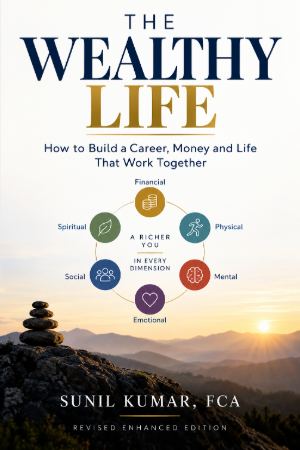
The Wealthy Life therefore treats wealth as a portfolio. Financial Wealth creates Security and Freedom. Physical Wealth creates Health, Energy and Longevity. Mental Wealth creates Knowledge and Capability. Emotional Wealth creates Resilience and Inner Stability. Social Wealth creates Relationships and Belonging. Spiritual Wealth creates Purpose and Meaning.
Financial wealth is foundational and enabling, but it is not sufficient. The purpose of wealth is ultimately to create choices about how to spend your life.
Think of your life as a wealth portfolio. You do not want to maximise one account by permanently destroying the others. The objective is balance, resilience and meaningful growth.
Example — One Career, Several Forms of Wealth Consider a senior finance professional in a mission-driven organisation. The role provides a salary, but its value is not limited to the monthly pay cheque. The work can build judgement, reputation, relationships and career capital while also creating meaning through contribution. If the professional evaluates the role only by salary, much of its real return remains invisible.
One activity can strengthen several dimensions of wealth at the same time. But the reverse is also possible: a role can increase income while steadily reducing health, relationships and freedom. Wealth is therefore a portfolio, not a single number.
Income is not wealth. Consumption is not success. Status is not achievement. A high income can disappear through high spending; a modest income can create substantial wealth when converted consistently into productive assets.
Being rich means having substantial financial resources. Being wealthy means having a rich portfolio of resources that support a meaningful, secure and fulfilling life.
Financial independence is different from being rich. Independence is about the degree to which your life can continue without being completely dependent on earned income.
Example — The Appearance of Success Imagine two professionals with similar incomes. One spends almost all of the additional income on a larger home, a more expensive car, frequent upgrades and higher fixed commitments. The other keeps lifestyle growth modest and converts a meaningful portion of income into financial assets. Their incomes may look equally successful from outside, but their future choices are very different.
The difference is not how impressive the present looks. It is how much of today's income becomes tomorrow's security and freedom.
Example — Two Hours, Many Good Choices
Imagine a Finance Manager who has only two reasonably free hours on a weekend. Those two hours could be used to strengthen a professional skill, learn more about investing, study for a qualification, exercise, pursue a personal passion, spend time with family or help with a child’s learning. None of these choices is obviously wrong. In fact, several may be highly valuable. The decision therefore cannot be reduced to “Which activity is best?” The more useful question is: “What is the incremental value of my next two hours, given my current reality?” If a new role is likely to require a skill that the Finance Manager currently lacks, professional development may have unusually high marginal value. If health has been neglected, the same two hours may create more value through recovery or exercise. If family circumstances require attention, time with family may have a return that cannot be replicated later.
The answer may also change from one weekend to the next. The point is not to find a permanent winner among career, money, health, family, learning and enjoyment. The point is to recognise that limited effort must be allocated deliberately, based on current priorities, likely future value and what is being displaced. This is the essence of Return on Effort: the value of an hour depends not only on what the activity is, but on what that hour could create here and now.
In Practice
Write down what you currently mean by wealth. Then list one thing you want to strengthen in each of the six dimensions.
Compare your current income, net worth, lifestyle and degree of salary dependence. Identify which measure is improving and which may only look impressive.
Pause & Reflect
Which dimension of wealth are you currently strongest in? Which one are you quietly becoming poor in?
Are you optimising for appearing successful, or for becoming more secure and free?
Apply It
Write your own definition of a wealthy life in one paragraph.
Name one form of wealth you want to strengthen without weakening another.
Key takeaway: Wealth is a portfolio, not a single number. The objective is a life in which the important dimensions are sufficiently strong and mutually supportive.
2. Your Life Is a Portfolio
Why this chapter matters: Once wealth is seen as a portfolio, the central problem changes. The question is no longer how to maximise one dimension, but how to allocate limited resources across several dimensions that matter.
The six dimensions form the central life framework of this book: Financial, Physical, Mental, Emotional, Social and Spiritual Wealth.
Financial wealth creates security and freedom. Physical wealth provides energy and longevity. Mental wealth develops capability. Emotional wealth builds resilience. Social wealth creates belonging. Spiritual wealth provides purpose.
These dimensions compound. Better health can improve career performance. Better relationships can improve emotional resilience. Better financial security can create time for learning and contribution. The objective is not perfection in every dimension, but conscious rebalancing.
Example — The Return on the Same Hour Can Change
Return on effort is not a fixed number. The same two hours can create very different value at different points in a person's life. Return to the Finance Manager in the previous example. Suppose the person is considering a professional qualification. Before starting it, two hours spent studying may have high future value because the qualification could open a new role or increase credibility. Once the qualification is completed, however, the same study time cannot be invested in that particular qualification again. The marginal return from that activity falls.
Similarly, immediately after changing jobs, spending every weekend preparing for another job change may have limited value. The priority may temporarily shift toward learning the new organisation, building credibility, understanding the role and strengthening relationships. A year later, the situation may be different again. This means priorities should be reviewed rather than inherited. Demand, circumstances, urgency, opportunity and personal capacity change. A good allocation today can become a poor allocation later without the original decision having been wrong. The practical lesson is simple: do not ask only, “Where did I invest my effort last year?” Ask, “Where is the next unit of effort likely to create the greatest worthwhile value now?”
In Practice
Score each dimension from 1–10 based on your present reality, not your aspiration. Circle the two largest weaknesses and one area you may be over-optimising.
Pause & Reflect
Where is your portfolio of life resources most unbalanced?
Apply It
Score Financial, Physical, Mental, Emotional, Social and Spiritual Wealth from 1–10 based on your present reality.
Identify one dimension you may be over-optimising and one you may be underfunding.
Key takeaway: Every life is an allocation problem. You cannot maximise everything at once; you can deliberately rebalance what receives your limited resources.
3. Start With Reality — and Know Yourself
Why this chapter matters: Before optimising anything, understand the life you are actually living and the person who is making today’s decisions.
Begin with your personal financial dashboard: annual income, essential expenses, total spending, annual surplus, financial assets, physical assets, liabilities, net worth, liquidity and reliable non-salary income.
Net worth is a photograph; wealth creation is a movie. Track savings rate, lifestyle cost and your financial independence coverage.
Think in layers: liquidity, protection, stability, growth and optionality. Your salary is a concentrated asset if it is your only major source of income. Your lifestyle is a recurring claim on future cash flow.
Complete a Personal Wealth Statement and score yourself across the six dimensions. The purpose is not judgement. It is clarity.
Example — A Considered Decision Is Not Necessarily a Perfect Decision
Imagine a professional who is choosing between two jobs while facing incomplete information. One role appears to offer higher compensation; the other offers greater stability and learning. The professional has some reliable information, some personal experience, several assumptions and a few unknowns. Recency bias may make the latest conversation seem more important than it is. Confirmation bias may make the preferred option appear better. It is unrealistic to expect a person to remove every bias completely. The practical objective is different: identify the relevant facts, challenge important assumptions, compare the meaningful alternatives and consciously recognise what remains uncertain. The professional may ultimately choose the option that is not objectively optimal in hindsight. That does not automatically make it an ignorant decision. It can still be a considered decision if the person understood the alternatives and made the best judgement reasonably available at the time. This distinction matters. “It was my decision” is not enough. A decision should be supported by a process. At the same time, “I could not know everything” is not an excuse for failing to think. A considered decision is therefore not necessarily a perfect decision. It is a decision made consciously, with relevant evidence, explicit trade-offs and an honest understanding of uncertainty.
In Practice
Complete the Personal Wealth Statement in Appendix A. Treat it as a baseline, not a judgement.
Pause & Reflect
What does your current balance sheet tell you that your feelings do not?
Apply It
Separate your current reality into facts, strong beliefs, assumptions and unknowns.
Write one sentence describing the person you are trying to become—not merely the outcome you are trying to achieve.
Key takeaway: Do not optimise what you have not first understood—and do not optimise a life you have not examined.
4. Decide What Matters Now
Why this chapter matters: Values can remain stable while priorities change. A wealthy life therefore requires both a clear sense of purpose and a willingness to reallocate effort when circumstances change.
Knowing what matters is not enough. The practical question is what deserves effort now.
Priority is the bridge between values and allocation. Ask three questions: Does this matter? Does it need attention now? What happens if I ignore it? The answers often reveal that something important can be maintained while something vulnerable requires immediate attention. A useful distinction is between protection and growth. Protection prevents deterioration; growth creates future value. During a crisis, protection may dominate. During stability, growth and exploration may deserve more space. This is why priorities should not be treated as permanent rankings. Life has seasons. A person's professional, financial, family and health circumstances can change substantially over a decade. Inherited priorities are particularly dangerous. A goal can become so familiar that we stop asking whether it is still ours. Ambition can quietly become comparison. The concept of “enough” provides a boundary. Without an enough point, optimisation can become endless. More income, more status, more qualifications or more responsibility may produce diminishing value after a certain point. A Personal Priority Map can classify commitments as Protect, Grow, Maintain and Explore. Review it periodically rather than trying to perfect it once. What matters can change. What deserves your effort can change. Changing your priority is not changing your values. It is responding to reality.
Financial wealth answers how much. Purpose asks what it is for. Without purpose, wealth can become an endless accumulation game.
Purpose does not need to be grand. It can be found in family, excellent work, teaching, creation, service, community or living with integrity.
Financial, physical, mental, emotional, social and spiritual wealth come together when resources are directed toward a meaningful life.
The deeper question after building wealth is what wealth is for. Money can create security, freedom, time, experiences, health, learning, family support, creation, contribution and legacy.
Define an enough point. Create a joy budget, freedom budget and meaning budget. Do not wait until rich to live.
The purpose of wealth is not to maximise what you can possess. It is to maximise the quality, freedom and meaning of the life your resources can support.
Example — What Matters Now Can Change
Consider a 25-year-old professional who has recently married and is beginning to build a career. At this stage, professional capability may deserve significant attention because the next few years could materially influence earning capacity and career trajectory. A qualification, a demanding assignment or deliberate skill development may therefore have high future value. But imagine that the same person later has a young child, significant financial commitments or a health issue. The marginal value of another qualification may then be lower than the value of protecting health, strengthening family relationships or stabilising finances. This does not mean the person has become less ambitious. It means the decision environment has changed. A useful priority process is therefore not simply “important versus unimportant” or “urgent versus non- urgent.” Ask four questions: What must I protect? What should I grow? What needs only a sustainable minimum? What is worth exploring for the future? The answer should be based on current reality, not on what was important two years ago. Priorities are allocations, not identities. A temporary shift in effort toward family, health or financial stability does not mean career ambition has disappeared. It means the person is responding to the season of life they are actually in.
In Practice
Finish this sentence: 'I want wealth because it will allow me to ______.'
Define your 'enough' number and the experiences, time and choices you want wealth to make possible.
Pause & Reflect
What is the life purpose behind the wealth you are building?
What would 'enough' allow you to stop chasing?
Apply It
List what matters generally and what needs attention now.
Classify your next-period priorities as Protect, Grow, Maintain or Explore.
Key takeaway: Importance does not mean equal priority. Give the right things the right attention at the right time.
5. The Wealth Trade-Off
Why this chapter matters: Every important choice is an exchange. The complete exchange includes money, time, energy, health, relationships, risk and opportunity cost.
Every decision has a cost. A career decision can cost time. A lifestyle decision can create permanent expenses. A financial decision can reduce liquidity. A work commitment can consume health or relationships.
Every yes contains a no. The wealthy life therefore requires deliberate allocation of money, time, energy and attention.
Use the irreversibility test: if this decision goes wrong, what can I recover—and what can I never get back?
Do not ask only, What will make me richer? Ask, What will make my life richer?
Example — The Hidden Price of a Better Job Suppose one job pays ₹24 lakh a year and another pays ₹21 lakh. The higher-paying job requires longer office hours, regular work at home and a much longer commute. The lower-paying job leaves substantially more time and energy for health, family and development. The ₹3 lakh difference is real, but so are the hours and energy required to earn it.
The right question is not whether the higher salary is better. It is whether the complete exchange is worth it.
Example — The Hidden Cost of Saying Yes
Suppose a professional is offered a demanding assignment that could improve visibility and increase the probability of promotion. The assignment looks attractive when viewed through salary and career progression alone. But accepting it may also require late evenings, additional travel and weekend availability. Those hours have a cost even though no invoice is received for them. They may displace exercise, family time, learning, rest or another professional opportunity. If the assignment lasts for three months and creates a meaningful career advantage, the exchange may be worthwhile. If it continues indefinitely and produces only marginal additional value, the same trade-off may become unattractive. The important point is not to avoid demanding opportunities. It is to make the complete exchange visible before saying yes. Before accepting, ask: What will I gain? What will this require? What will it displace? What happens if I decline or delay? Is the commitment reversible? The best decision may still be “yes,” but it becomes an intentional yes rather than an automatic one.
Opportunity cost is therefore not a reason to avoid choices. It is a discipline for understanding the price of choices.
Example — Compare the Job, Not Just the Salary
Suppose a professional receives two job offers. Job A pays ₹24 lakh a year and requires about nine hours in the office each day, plus an average of one hour of work at home and a 90-minute daily commute. Job B pays ₹21 lakh but requires eight hours in the office, very little work at home and a 30-minute commute. At first glance, Job A appears clearly better because the annual salary is higher. But the comparison changes when total effort is considered. The professional is not selling only office hours. The job consumes working time, commuting time, attention and energy, and may affect exercise, family responsibilities and recovery. The purpose of calculating an effective hourly return is not to reduce a career decision to a spreadsheet. It is to make hidden trade-offs visible. Salary, designation, role, learning, company quality, future opportunities and stability still matter. But so do the additional hours required to earn the salary. A useful comparison therefore asks: What is the annual compensation? How much total time does the job consumes? What career capital will it build? What will it displace? What risks and future options does it create? A higher salary can be the better choice. It can also be the more expensive choice. The answer depends on the whole exchange.
In Practice
Take one important current decision and list its financial, time, energy, health, relationship and opportunity costs before deciding.
Pause & Reflect
What is the hidden price of a decision you are currently considering?
What does your preferred option give you, and what does it require you to give up?
Apply It
For one major decision, write what you gain, what you give up, what it displaces, what happens if you do nothing, and whether it is reversible.
Key takeaway: Every yes contains a no. Make the complete exchange visible before you commit.
PART II — EFFORT, RETURN AND BETTER DECISIONS
Choose what matters, then decide where your limited effort should go.
6. Your Effort Is Capital
Why this chapter matters: Money is only one form of capital. Your time, energy, attention, emotional capacity and capability are also finite resources that can be invested, wasted, protected or compounded.
scarce resources. Effort is scarce capital. EFFORT CAPITAL Time + Energy + Attention + Emotional capacity + Capability → Invest deliberately. A day contains a finite amount of usable time, attention and energy. Treating all hours as interchangeable hides an important truth: the quality and value of effort vary. Effort includes at least five forms of capital: time, energy, attention, emotional capacity and capability capital. Your calendar is therefore similar to an investment statement. It shows where your resources are actually being deployed. Not every activity needs a measurable return. Rest, relationships and enjoyment can be valuable in themselves. The danger is not non-economic activity; the danger is unconscious allocation. Four effort types are useful: Maintenance — keeping important things functioning. Growth — increasing future capability or value. Exploration — discovering possibilities. Recovery — restoring capacity. Recovery is not the opposite of productive effort. It protects future capacity. Leverage changes the economics of effort. Technology, systems, delegation, processes, reusable content, intellectual property, relationships, reputation and capital can allow one unit of effort to create value repeatedly. A useful leverage ladder is: Do → Improve → Delegate → Systemise → Automate. The first question is whether the activity should exist at all. Protect your best attention for work where judgement matters. Reduce attention leakage from low-value interruptions. An effort audit should ask what to stop, simplify, delegate, automate, maintain, grow and explore. Effort is not a moral measure. Working harder does not automatically create more value. Your effort is limited. Your possible returns are almost unlimited. The next question is unavoidable: where should your limited effort go?
Example — Small Efforts Can Become Larger Assets
A professional may spend time writing articles, contributing to professional discussions, publishing useful posts and investing in selected learning. Each activity may appear small and may produce little immediate return. Yet the same effort can create several forms of capital: knowledge, communication capability, professional visibility, intellectual property and future opportunities. The important point is not that every post or course will become valuable. It is that effort can create assets beyond the immediate task. When a person deliberately builds knowledge and shares it, the effort can strengthen capability and reputation while creating a reusable base for future work. The SROE question is therefore: “What kind of capital am I building through the effort I am investing?”
Example — Knowledge Sharing as Effort Capital A professional may regularly share knowledge and provide informal, pro bono guidance to people in a
professional network, including people who are not personally known to them. The questions may range
across finance, legal matters, personal finance, career development, fundraising and organisational
challenges.
At first, this can look like effort with no direct return. But each conversation can expose the professional to
new problems, different options, innovations and practical constraints. Over time, those interactions build
a broader library of experience and patterns. The professional may become more knowledgeable and
resourceful, while the network itself becomes stronger.
That knowledge can then be applied in the person's organisation, shared with others, developed into
useful content or converted into reusable frameworks and toolkits. The return is therefore not necessarily
immediate or financial. It can include learning, relationships, reputation, professional judgement and
future creative output.
The lesson is not that every act of generosity should be justified by a future benefit. It is that effort can
create several forms of capital simultaneously when it is aligned with a meaningful long-term purpose.
In Practice
Audit one week of your effort and identify one activity to stop, simplify, delegate or automate.
Pause & Reflect
Which effort in your week is consuming scarce attention without creating proportional value?
Apply It
Audit one week of your calendar. Mark time as maintenance, growth, exploration or recovery.
Ask which effort is consuming scarce attention without creating proportional value.
Key takeaway: Your effort is capital. Treat time, energy, attention and capability as resources worthy of deliberate investment.
7. Return Is More Than Money
Why this chapter matters: A wealthy life requires a broader definition of return. An effort can return money, capability, health, relationships, freedom, resilience, meaning or future options.
build. The word “return” often makes people think of money. But a life contains many investments whose returns are not financial. Return may be financial, career-related, personal, physical, relational, future-oriented or meaningful. Money can provide security, choices and freedom, but its marginal value changes. An additional amount of income may be transformative at one stage and almost irrelevant at another. Career return includes learning, experience, reputation, relationships, capability and future options. Life return may include time, flexibility, freedom and experiences. Health return includes preserving physical and mental capacity. Relationship return includes trust, belonging and mutual support. Future return includes resilience and optionality. Returns also have timing. Some are immediate; others arrive years later. A useful return profile considers: Immediate return; Future return; Compounding return; Optionality return A low immediate return can be attractive when future value is high. Conversely, a high immediate return can be unattractive if it creates substantial future costs. Maintenance and recovery also create return by preventing deterioration. The key is to avoid optimising the wrong return. A professional may maximise salary while sacrificing health and freedom beyond what they actually value. Enough matters here too. If additional effort produces very little additional value, its marginal return has fallen. A personal return scorecard can ask what an investment creates across financial, career, life, health, relationships, future and meaning dimensions. The underlying equation remains: Return on Effort = Value Created ÷ Total Effort Invested. The objective is not maximum activity. It is worthwhile value from chosen effort.
A Repeatable SROE Method
SROE becomes most useful when it is applied consistently. It is a decision aid, not a mathematical law and not a claim that every form of value can be measured objectively. The purpose is to make the complete exchange visible, especially when a decision involves scarce time, energy, attention, money or future options.
The SROE Method — Five Steps
1. Define the decision — State the choice, objective and time horizon.
2. Map the returns — Identify financial, career, health, relationship, time, learning, freedom, meaning and future-option returns.
3. Map total effort — Include time, energy, attention, emotional capacity, capability and money, plus what the effort displaces.
4. Test risk and assumptions — Separate facts from assumptions; identify downside, reversibility, survivability and the conditions that would change the decision.
5. Decide, experiment and review — Where uncertainty is high, consider the smallest sensible next step; set a review trigger and update the assessment when reality changes.
How to Assess the SROE Profile
Use five dimensions as decision aids rather than as an objective score: Return, Effort, Risk, Strategic Fit and Optionality. Rate each from 1–5 using your current assumptions and record the evidence beside the rating. Return asks what worthwhile value may be created; Effort captures time, energy, attention, emotional capacity, capability and money; Risk captures downside and uncertainty; Strategic Fit asks whether the option supports what matters now; Optionality asks whether it creates or preserves future choices.
Indicative SROE Assessment
High SROE profile — meaningful value is expected across one or more dimensions, effort is proportionate, downside is survivable, and the option fits current priorities or creates useful future choices.
Medium SROE profile — value is plausible but depends on important assumptions, or effort and risk are significant; a smaller experiment or explicit review point may be useful.
Low SROE profile — expected worthwhile value appears limited relative to total effort, the option conflicts with current priorities, or downside and opportunity cost are difficult to justify.
These are decision prompts, not universal thresholds.
Example 1 — Comparing Two Career Options
Consider two roles. Role A offers higher compensation but requires materially more commuting and after-hours work. Role B pays less but provides greater flexibility and time for health, family and capability building. The SROE comparison records financial return, career return, time cost, energy cost, relationship impact, risk, learning and future options. The purpose is not to declare one role universally better; it is to make the complete exchange visible for the person making the decision.
Example 2 — The Second Economic Engine
An executive considers spending 80 hours over four months developing a small product or side business. The immediate return may be zero. Possible returns include learning, a second income stream, optionality and intellectual property. The effort also carries execution risk and competes with recovery and family time. SROE does not require immediate income; it requires the expected value and future options to be considered against total effort, risk and what that effort displaces.
Example 3 — Learning for Future Capability
A professional is considering a six-month qualification requiring 120 hours of study and a meaningful fee. The immediate financial return is uncertain. Potential returns include stronger capability, credibility, access to different roles and greater adaptability. If the qualification remains relevant for several years, future and compounding returns may justify the effort. If the same capability can be acquired through a shorter, lower-cost route, the assessment changes because total effort and opportunity cost are different.
The key is not to manufacture a precise number. It is to make assumptions, returns, effort, risk and future consequences explicit enough that a decision can be reviewed and improved.
Example — Return Can Be Financial, Professional and Social
Health itself illustrates why return should not be defined too narrowly. A person may think of health as only physical fitness, but wellbeing can also include financial stability, emotional resilience, mental capacity and social connection. Similarly, the return from professional effort can include much more than salary. Consider a Finance Manager working in a mission-driven organisation. The person earns a livelihood, but the quality of financial management can also affect how effectively the organisation delivers its mission. Strong controls can reduce leakage and errors. Timely payments can help employees and vendors function effectively. Good financial planning can help programmes use scarce resources more effectively. Sound compliance can protect the organisation's ability to continue operating. The professional therefore receives a financial return through salary, a career return through experience and credibility, and potentially a meaning-related return through contributing to a social purpose. This is not an argument that non-financial value should be used to justify poor compensation or unsustainable work. It is an argument for measuring the full return. The same effort can create several
types of value, and a decision can be misunderstood if only the most visible financial number is considered. Return on Effort becomes more useful when the question is not “How much money did this create?” but “What worthwhile value did this effort create, for whom and over what period?”
In Practice
Pause & Reflect
What kind of return matters most in the decision or activity you are currently considering?
Apply It
For one major commitment, list the financial, career, health, relationship, time, learning, freedom and meaning returns it could create.
Key takeaway: Return is broader than money. A worthwhile return can be capability, health, relationships, freedom, resilience, meaning or future options.
PART III — BUILDING FINANCIAL AND CAREER WEALTH
Turn earning power and capital into financial resilience and choice.
8. Build the Financial Foundation: Income, Surplus and Spending
Why this chapter matters: Financial wealth begins with a simple conversion: income becomes surplus, surplus becomes capital, and capital—given time and appropriate returns—creates increasing freedom.
Income gives you the ability to build wealth. Surplus gives you the capacity. Assets give you the wealth.
The journey is Income → Surplus → Capital. Your Wealth Gap is Income minus Spending. Career development is wealth creation because human capital can be converted into financial capital.
Build Career Capital through Capability, Credibility, Relationships, Experience and Adaptability. Move from selling hours toward creating outcomes and using leverage through skills, technology, people, capital, intellectual property and distribution.
The core relationship is Wealth = Surplus × Time × Return × Discipline.
This is a conceptual wealth-creation model, not a mathematical equation or prediction formula. It is intended to show that surplus, time, appropriate return and disciplined behaviour interact in the process of building financial wealth.
Spending is not the enemy. Unconscious lifestyle expansion is. Separate one-time spending from permanent spending, because permanent spending creates recurring claims on future cash flow.
Classify spending as Essential, Important, Discretionary or Destructive. Spend more on what genuinely matters rather than simply spending less on everything.
Use the enough number, automate saving, and apply the life-value test: does this expenditure improve financial, physical, mental, emotional, social or spiritual wealth?
Do not spend everything because you can afford it. Do not save everything because you are afraid of spending. Spend deliberately. Save intentionally. Invest consistently.
Wealth creation begins with the gap between what you earn and what you spend. Savings Gap =Income − Expenditure.
The savings rate measures how effectively income is converted into future capital. A higher income is valuable only if some of the increase becomes surplus.
Focus on recurring expenses rather than obsessing over tiny savings. A permanent reduction in annual lifestyle cost can be economically powerful.
The real question is: how much of what I earn am I converting into my future?
Example — The Savings Gap Matters More Than Tiny Optimisation Imagine a household that spends almost all of a rising income. It spends considerable time trying to improve investment returns by a small percentage while its lifestyle absorbs most of every increment in pay. Another household earns the same amount but deliberately widens the gap between income and recurring expenditure and invests the surplus consistently.
Before searching for marginal return, create enough surplus for capital to exist in the first place.
Example — Treat income as a resource that must last across the whole planning horizon
Mary, a Grant Manager, asks Sushil, a CFO, why he does not spend more despite earning a good salary. Sushil compares salary with donor funding. A grant received for several years is intended to support approved activities across that period; spending the entire amount quickly may create problems later. He views salary similarly. Income received during working life has to support living costs, education, family responsibilities, investment, leisure and future security over a long period. The lesson is not simply to spend less. It is to allocate income across today's needs, protection, future assets and meaningful choices so that current consumption does not weaken future resilience.
In Practice
Calculate your annual surplus and savings rate. Then ask how much of that surplus is being converted into productive assets.
Identify three recurring expenses that buy little long-term value and one area where spending more would materially improve your life.
Calculate your savings gap and ask whether a change in income, spending or both could widen it without damaging the quality of your life.
Pause & Reflect
What percentage of your income is becoming future capital?
Which recurring expense is buying the least value relative to the life it consumes?
How large is your current savings gap, and what would widen it sustainably?
Apply It
Calculate annual income, essential expenditure, annual surplus and savings rate.
Identify one recurring expense to reduce and one area where spending more would materially improve your life.
Key takeaway: Income creates the capacity to build wealth; surplus creates the investable gap; assets create durable financial value.
9. Protect, Invest and Compound What You Build
Why this chapter matters: Creating wealth is only half the task. The system must also protect capital, invest it intelligently and give compounding enough time to work.
Wealth creation and preservation are inseparable. Losses are asymmetric, so build protection around the wealth engine.
Liquidity
Insurance
Debt control
Diversification
Legal and estate planning
The five core protection layers are:
Ask what could financially destroy you and make that downside survivable. One thing going wrong should not make everything go wrong.
Build. Protect. Compound. Repeat.
Investing begins with purpose, not product. Give money different jobs for today, emergencies, near-term goals, long-term wealth and financial independence.
Understand the investment triangle of return, risk and liquidity. Understand what you own, the source of return, costs, taxes, inflation and the possibility of permanent loss.
Build an investment policy and review it without becoming emotionally reactive to daily prices. Your portfolio should answer one question clearly: Why do I own this?
First create capital. Then optimise capital.
Example — The Return You Cannot See in a Bank Statement A professional invests time in learning a difficult new capability. There is no immediate financial return. Over the next few years, however, the capability improves the quality of decisions, opens better assignments, increases credibility and makes the person more adaptable when the market changes.
Some returns arrive as capability, reputation, resilience or future options rather than as money.
Wealth is ultimately about ownership. For every asset, ask how it creates value, how it generates return, what can cause it to fall, how liquid it is, what it costs, what tax applies and what role it plays.
Consider cash, fixed income, equity, real estate, gold, business ownership and intellectual property according to your goals and risk capacity.
Think about your whole balance sheet. A diversified investment portfolio can still sit inside a highly concentrated overall financial life.
Compounding is capital plus return plus time plus behaviour. Starting early matters because delay removes years of potential compounding.
Contributions matter especially in the early years. Later, the capital base may become an increasingly powerful contributor.
Compounding also works negatively through debt, lifestyle inflation, poor habits, poor health and dependence. The best thing to compound first is your ability to make good decisions.
Example — Today's Effort as Tomorrow's Asset A professional writes a useful article after spending several hours researching a topic. The immediate audience may be small. Later, the article becomes the basis for a presentation; the presentation becomes a workshop; recurring questions become a checklist; and accumulated ideas eventually become a framework or toolkit.
This is compounding effort: the original work becomes an asset that can be reused, improved and combined with future work.
Wealth can be understood through a few simple relationships. Wealth = Surplus × Time × Return × Discipline.
Compounding, inflation, taxes, costs, loss asymmetry, savings rate and lifestyle commitments all affect outcomes.
The mathematics is simple. The difficult part is starting, continuing, avoiding unnecessary losses and staying disciplined through changing markets and life circumstances.
Example — Wealth Has Mathematics and Behaviour Two people may have the same income, the same starting capital and access to similar investments. One consistently saves, avoids unnecessary lifestyle inflation and stays invested through difficult periods. The other repeatedly increases commitments, changes strategy and reacts to short-term movements. Their outcomes can diverge dramatically.
Wealth mathematics describes what can happen. Behaviour determines how consistently the mathematics gets a chance to work.
Investing becomes dangerous when it starts with products rather than purpose. Begin with objectives, time horizons and liquidity needs.
Use the investment triangle of return, risk and liquidity. Build appropriate asset allocation and diversification, understand what you own and establish a written investment policy.
Do not confuse the highest possible return with the highest appropriate return. The best investment is one that fits the system.
Example — The Best Investment Depends on the Person A young professional with strong earning potential but weak financial reserves may need liquidity and protection before taking significant investment risk. Another person with stable finances and a long horizon may reasonably place more emphasis on growth. A third person approaching a major life transition may value flexibility more than maximum expected return.
There is no universally best portfolio. A sound investment strategy begins with purpose, time horizon, risk capacity and the life the money is intended to support.
Money is mathematical, but financial behaviour is emotional. Family history, status, fear, greed, comparison and the need for certainty all influence decisions.
Your behaviour is part of your investment return. Create rules before markets become emotional and use systems to reduce the role of impulse.
Real financial confidence comes from understanding what you own, what you need, what can go wrong and how you will respond.
Example — Preventing the Same Problem From Returning
Monica, a Finance Manager, noticed that the same types of errors were recurring in her regional finance function. Each individual error required time to investigate, explain, correct and sometimes defend during an audit or review. Instead of treating every incident as a separate problem, she focused on the system behind the recurrence. Where possible, she strengthened controls, clarified processes and documented the steps that would prevent the same error from appearing again. The objective was not merely to correct the current issue but to reduce the probability of repetition. Over time, the finance team spent less effort managing avoidable chaos. Documentation improved, controls became more consistent and audit and assessment processes became easier to manage. The value of the original effort therefore extended beyond the day on which the control was introduced. This is what compounding effort can look like in an organisation. Solving a problem once creates a result. Understanding why it recurs and changing the process can create an asset. Building a system that prevents recurrence can create value repeatedly. The question for any recurring problem is therefore: “Am I repeatedly spending effort to fix the symptom, or can I invest effort once to change the system?”
Example — Consistency Turns Small Outputs Into Larger Assets A professional may spend years writing articles, contributing to discussions, completing selected learning
and sharing ideas. Each individual activity may appear too small to matter. Over time, however, the
outputs can be reused. An article can become a chapter, a presentation can become a workshop, a
recurring question can become a checklist, and accumulated learning can become a framework or toolkit.
The return is therefore not limited to the value created on the day the work was done. Consistent effort
can build an asset base that makes later work easier and creates value more than once.
The lesson is not that every small effort will compound. It is that deliberate consistency increases the
chance that today's work becomes tomorrow's raw material.
In Practice
Test your liquidity, insurance, debt, diversification and legal/estate protection against a realistic setback.
For every major investment, write one sentence answering: 'Why do I own this?'
Map your assets by purpose: safety, growth and opportunity. Look for concentration across your entire balance sheet.
Identify one financial or life habit where starting earlier would have meaningful long-term value. Start now rather than waiting for a perfect time.
Run a simple five-, ten- and twenty-year trajectory using realistic assumptions rather than optimistic forecasts.
Write a one-page investment policy covering objectives, time horizon, asset allocation, risk, liquidity, diversification, costs and review rules.
Identify your strongest money trigger—fear, comparison, greed, FOMO, status or certainty—and create one rule that protects you from it.
Pause & Reflect
What realistic event could seriously damage your financial position?
Do you understand the job each major investment is supposed to perform?
Where is your balance sheet more concentrated than you realise?
What would improve if you gave time a longer runway?
Which assumption matters most to your wealth trajectory?
Could you explain your investment strategy simply to someone you trust?
What emotion most often changes your financial behaviour?
Apply It
Map your liquidity, protection, debt, diversification and investment structure.
For one asset, write: “Why do I own this?”
Key takeaway: Build, protect, compound and review. Do not chase return without considering risk, liquidity, costs and purpose.
10. Build Your Earning Power and Career Capital
Why this chapter matters: For most working people, the first major wealth engine is the ability to create valuable income. Career wealth is therefore an asset-building exercise.
Your earning power is an economic asset. Treat your career as an asset that can appreciate or depreciate.
Build Career Capital through capability, credibility, relationships, experience and adaptability. Solve scarce, valuable problems and move from activity to outcomes.
Evaluate jobs by their five-year value, not only today's salary. A strong career can become the first engine that funds financial capital.
Your first fortune may not be money. It may be your ability to create money.
Example — Two Finance Managers, Two Kinds of Experience Ramesh and Pankaj are both capable Finance Managers and both work hard. Ramesh becomes the person who knows the history of every issue in his organisation. Pankaj deliberately converts experience into transferable skills, judgement, systems knowledge, communication capability and reputation. Both accumulate years, but they are accumulating different kinds of career wealth.
Experience becomes career capital when it increases what you can reliably do, solve or lead. Ten years of experience can become ten years of growth—or one year repeated ten times.
Capability
Credibility
Relationships
Experience
Adaptability
Career capital is built from:
Develop expertise around important, difficult and scarce problems. Move from hours to outcomes and use technology, people and systems as leverage.
Maintain a career balance sheet of assets and liabilities. Your first fortune may be your ability to generate income for decades.
Example — A Finance Controller Considering the CFO Role A Finance Controller with substantial experience hesitates to apply for a CFO role because he does not know every issue a CFO might face. A better test is whether he can structure unfamiliar problems, assess risk, obtain the right information, involve specialists and make sound decisions under uncertainty. Some capabilities can only be developed fully by taking on broader responsibility.
Career wealth is not the absence of gaps. It is the combination of capability, judgement, reputation, adaptability and the willingness to grow into responsibility.
Example — A favourite job is not necessarily a growing career
Dipti, a Finance Manager, performs her current role well and expects strong performance to lead naturally to the next promotion. However, she is not keeping up with legal developments relevant to her industry, strengthening the functional and soft skills required for the next level, or building relationships outside her organisation to learn from sector practices and understand future opportunities. When the next Assistant Vice President — Finance position becomes available, the organisation appoints an external candidate. Dipti feels disappointed and blames her manager and the organisation. Her disappointment is understandable, but the situation highlights an important distinction: performing a job well creates current value; building a career also requires investing in capabilities, reputation and relationships that create value beyond the current job. The lesson is not to leave a good job unnecessarily. It is to make sure today's effort is also building tomorrow's career capital.
Example — Context can increase the value of a skill
Seema and Anil are both strong finance professionals. Seema is selected for a Finance Manager role partly because she has experience of programme and field operations. That context helps her understand programme teams' requests, interpret operational realities and provide finance guidance in the right context. The lesson is not that one background is always superior. It is that skills become more valuable when combined with relevant context. A finance professional can strengthen career capital by understanding the organisation, sector and operating environment in which finance decisions are used.
Example — Reputation travels before you do
Arun, a Finance Director, understands that a person's reputation often reaches a new organisation before the person does. He therefore pays close attention to his behaviour, work ethic, relationships and the decisions he is willing to support. He is prepared to say no to actions that conflict with his professional standards. When Arun considers his next role, he is carrying not only qualifications, experience and skills, but also the accumulated trust attached to his name. Reputation is part of career capital, and it is built through repeated behaviour long before it is needed.
In Practice
List the capabilities, reputation, relationships and experience that would remain valuable if your current employer disappeared tomorrow.
Choose one scarce, valuable problem you can become significantly better at solving over the next 12 months.
Pause & Reflect
If your job disappeared tomorrow, what valuable assets would remain yours?
What valuable problem could you become unusually good at solving?
Apply It
List the career assets that would remain yours if your current employer disappeared tomorrow.
Identify one capability, relationship or reputation asset to strengthen over the next 12 months.
Key takeaway: Your first fortune may be your ability to create money. Build career capital that travels with you.
11. Build a Second Economic Engine
Why this chapter matters: The objective is not to collect side hustles. It is to reduce dependence on one economic engine by gradually creating another source of value.
A second economic engine can come from investments, business ownership, consulting, intellectual property, rental assets, royalties or other legitimate sources.
Do not chase multiple income streams merely for the appearance of diversification. Build one strong secondary engine without damaging your primary income.
The objective is not five income streams. It is reduced dependence on one source of income.
Example — Turning Knowledge Into a Second Economic Engine A professional regularly writes, shares knowledge and helps others solve practical problems. Initially, the effort produces little direct income. Over time, accumulated knowledge becomes articles, checklists, frameworks, workshops and reusable intellectual property.
Knowledge can become expertise; expertise can become a service; a service can become a product; and a product can become a system or asset. The objective is not to create a second job, but to create value that can travel beyond the next hour of work.
Passive income is often delayed income created through capital, systems or intellectual property. It is not effortless money.
Build financial capital, business systems or intellectual property that can create value without proportional dependence on future hours.
Do not create five side jobs. Build one strong secondary engine that can eventually become an asset.
Example — Do Not Build Five Side Hustles A professional tries consulting, content creation, online courses, trading and a small business simultaneously. Each activity demands attention and none becomes strong enough to create meaningful value. A better approach is to identify one capability that can be converted progressively from expertise to service to product to system.
Multiple income should increase resilience, not create five new jobs.
Example — Financial resilience can create career optionality
Jamie, a Communication Manager, saves part of her salary and invests the savings with a long-term goal of becoming less dependent on employment income. She wants the freedom to work in the social sector through employment, consulting or another form of contribution without being forced to remain in a role that conflicts with her values. Her objective is not to stop working. It is to increase her ability to choose. Financial resilience therefore becomes a source of optionality: the ability to leave, change direction or pursue meaningful work without making a decision under financial pressure.
In Practice
Choose one secondary economic engine that uses an existing strength and could eventually create value without being entirely dependent on hours.
Focus on one secondary engine rather than collecting multiple side projects. Ask whether it can eventually become a system or asset.
Pause & Reflect
Are you building another job—or an economic engine?
Which income source could become less dependent on your direct time?
Apply It
Choose one secondary economic engine that uses an existing strength.
Ask whether you are building another job or an asset that can create value beyond your direct hours.
Key takeaway: The objective is not five income streams. It is reduced dependence on one source of income.
PART IV — BUILDING THE OTHER WEALTHS
Build the forms of wealth that money alone cannot provide.
12. Time, Energy and Attention: Allocate Your Life Capital
Why this chapter matters: A wealthy life cannot be built from money alone. Time, energy and attention are finite, and the calendar reveals where they are actually being invested.
Money is measurable, but time is finite, energy fluctuates and attention is scarce. A wealthy life allocates all four deliberately.
Your calendar reveals your actual priorities. Review where your time goes and ask what creates value, joy, health, learning, relationships or meaning.
Create margin. A completely full calendar is fragile. Money can sometimes buy back time through systems and delegation, but the recovered time should be used meaningfully.
Example — Your Calendar Is a Wealth Statement A professional says that family, health and learning are important, but most discretionary hours disappear into meetings, messages, commuting and low-value tasks. The stated priorities and actual allocation tell different stories.
Your calendar reveals where your life capital is actually being invested. The objective is not to optimize every hour, but to protect scarce attention for what matters.
Example — A Young Professional With Several Competing Priorities
Consider a 25-year-old professional who has recently married and is beginning to build a career. The person has several legitimate choices for discretionary time: improve professional skills, take an additional course, invest more effort in the current job, build a social life, exercise, spend time with family or simply enjoy life. There is no universal allocation that can be prescribed. If the professional has a weak career foundation, some additional learning may create high future value. If work is already consuming excessive energy, recovery may have higher marginal value. If the relationship is being neglected, time with a spouse may protect something that cannot easily be repaired later. The important point is to decide deliberately. Some discretionary time can be allocated across several priorities, but that allocation should reflect what matters now rather than simply becoming unplanned screen time, low-value activity or passive busyness.
The professional can ask: What am I protecting? What am I growing? What am I maintaining? What am I exploring? Then allocate the next block of effort accordingly. There is no need to optimise every hour. But when an hour is scarce, it is worth knowing what it is being asked to accomplish.
Example — Turning a Finance Function Into a System
Pankaj, a Finance Director, faced a familiar problem: too much depended on the senior finance team, and the CFO was drawn into activities that others could perform. He began by breaking the finance function into identifiable activities and preparing a responsibility matrix. Each activity was mapped to an appropriate team member, while only selected responsibilities remained with the CFO. The change was more than delegation. Team members could see who was responsible for what, understand how roles connected and identify when an issue needed escalation. Exception reporting allowed the CFO to monitor important matters without reviewing every transaction or activity personally. Pankaj also worked on digitising documents and processes and making better use of existing ERP and software capabilities. But the transformation did not happen immediately. Processes first had to be simplified, documented and streamlined. The team also had to understand and accept the new way of working. It took time to build the system, but once established it changed the economics of effort. The CFO had more capacity for higher-value work such as finance transformation, strategic planning and organisational improvement. The lesson is important: leverage is rarely created by simply telling people to “do more.” It is created by redesigning work so that responsibility, process, information and technology allow the right people to handle the right work.
In Practice
Audit your calendar. Label time as maintenance, growth, exploration or recovery. Protect recovery as capacity-building rather than wasted time.
Pause & Reflect
Where does your attention leak most?
What recurring work could be stopped, simplified, delegated or automated?
Apply It
Audit your calendar and identify one task to stop, simplify, delegate or automate.
Identify one recurring problem where a system could eliminate future effort.
Key takeaway: The highest-return effort often changes the economics of future effort through leverage, systems and delegation.
13. Physical, Mental and Emotional Wealth
Why this chapter matters: Health, capability and resilience are productive forms of wealth. They protect the capacity to earn, learn, relate, recover and enjoy the life being built.
Financial wealth without physical capacity to enjoy it is incomplete. Health affects earning capacity, energy, longevity, healthcare costs and independence.
Good habits compound, as do bad ones. Focus on sustainable fundamentals such as movement, strength, sleep, nutrition, preventive care and stress management.
Do not sacrifice decades of future health to maximise a few years of present income unless the trade-off is truly necessary.
Example — Recovery Is Productive A person repeatedly sacrifices sleep and exercise to meet short-term work demands. Output may increase for a period, but concentration, mood, judgement and resilience eventually decline. Time that appeared to be saved was actually borrowed from future capacity.
Health is not the opposite of productivity. It is productive capital.
Mental wealth is the ability to learn, think, adapt and solve problems. Emotional wealth is the ability to handle uncertainty, recover from setbacks and maintain perspective.
Improve decision-making through critical thinking, probability thinking and reflection. Protect mental bandwidth by reducing unnecessary information and noise.
Resilience does not mean the absence of stress. It means the capacity to recover and continue.
Example — Courses Are Not Yet Capability A professional completes several courses every year but rarely applies the learning. Another completes fewer programmes but deliberately uses new knowledge in real work, explains it to others and turns it into repeatable practice.
Learning creates mental wealth when it changes capability and judgement. Collecting certificates without application can create the appearance of development without equivalent growth in capability.
In Practice
Identify one health behaviour where a small consistent improvement would protect future earning capacity, energy or independence.
Choose one capability to deepen and one mental or emotional habit to strengthen.
Pause & Reflect
What future capability are you protecting by investing in health today?
What are you learning that will still matter five years from now?
Apply It
Choose one health, learning or emotional habit where a small consistent improvement could compound over years.
Key takeaway: Health, learning and emotional resilience are forms of productive capital. They protect future capacity.
14. Social Wealth: The People You Invest Your Life In
Why this chapter matters: Relationships are not networking assets to be maximised. They are part of the life itself. Yet they still require deliberate allocation of time, attention and presence.
Make Life Rich Chapter purpose: Build relationships as a form of life wealth rather than treating them only as networking.
Relationships are wealth. Social wealth is deeper than networking; it is the quality of connection, trust and belonging.
Relationships require investment through time, attention, listening, reliability and presence. Family financial transparency can reduce stress and strengthen trust.
Contribution creates connection. Mentoring, teaching, volunteering and helping others can produce social wealth that money alone cannot buy.
Example — Why a strong team needs different perspectives
Anand, a project director, is ambitious and likes to move quickly. Some team members cannot match his pace in either capability or intent. Ramesh, a team member close to Anand, discusses the situation with Reeta, another team member. Reeta offers a different perspective: a strong team does not necessarily consist of people with identical competence, mindset or background. A mix of capabilities and perspectives can support more balanced decisions and more sustainable implementation. A team made entirely of people who think and work in the same way may move quickly at first, but it can also become vulnerable to groupthink, blind spots and weak challenge. The lesson is relevant to SROE: the highest-performing team is not always the fastest team; it is the team that can make sound decisions and sustain execution.
In Practice
Identify the relationships that deserve more deliberate time and attention. Put at least one relationship investment on the calendar.
Pause & Reflect
Which relationships are receiving less attention than their importance deserves?
Apply It
Put one relationship investment on your calendar.
Ask whether your calendar reflects the people you say matter most.
Key takeaway: Relationships are part of the wealth itself. Invest in them deliberately, without turning them into transactions.
15. Purpose, Meaning and the Definition of Enough
Why this chapter matters: Without an enough point, optimisation can become endless. Wealth becomes meaningful when resources are directed toward a life that is genuinely valued.
Financial wealth answers how much. Purpose asks what it is for. Without purpose, wealth can become an endless accumulation game.
Purpose does not need to be grand. It can be found in family, excellent work, teaching, creation, service, community or living with integrity.
Financial, physical, mental, emotional, social and spiritual wealth come together when resources are directed toward a meaningful life.
The deeper question after building wealth is what wealth is for. Money can create security, freedom, time, experiences, health, learning, family support, creation, contribution and legacy.
Define an enough point. Create a joy budget, freedom budget and meaning budget. Do not wait until rich to live.
The purpose of wealth is not to maximise what you can possess. It is to maximise the quality, freedom and meaning of the life your resources can support.
Example — A change in context can change the benchmark
Sumit, a Finance Manager, works in a state office where his salary provides a comfortable standard of living. When he moves to the organisation's head office in New Delhi, his salary increases by 15%, but higher living costs reduce his purchasing power and lifestyle flexibility. The lesson is that a benchmark is contextual. A decision can look attractive against an old benchmark and become less attractive when surrounding costs, expectations and responsibilities change. The same principle applies across organisations and sectors: what is attractive in a state-level NGO may not be equally attractive in a national organisation or an INGO, and vice versa. Good judgement therefore compares the whole situation rather than a single measure such as salary or title. Benchmarks are contextual. What is attractive in one organisation, sector, location or stage of life may not be equally attractive in another. A move from a state-level NGO to a national organisation, or from a national organisation to an INGO, may improve some dimensions while reducing others. The same is true of career, income, freedom and relationships. Good judgement therefore compares the whole situation, not a single benchmark.
In Practice
Finish this sentence: 'I want wealth because it will allow me to ______.'
Define your 'enough' number and the experiences, time and choices you want wealth to make possible.
Pause & Reflect
What is the life purpose behind the wealth you are building?
What would 'enough' allow you to stop chasing?
Apply It
Complete: “I want wealth because it will allow me to ______.”
Define your personal enough point in income, responsibility, recognition, consumption or work.
Key takeaway: Without an enough point, optimisation has no natural stopping mechanism. Wealth needs a purpose.
PART V — DESIGNING A LIFE THAT CAN ADAPT
Design a life that can adapt as priorities and circumstances change.
16. Make Better Decisions: Reality, Options and Trade-Offs
Why this chapter matters: Major life and financial decisions deserve a process. Start with reality, identify genuine options, make assumptions visible, understand trade-offs and decide when you know enough.
Small decisions matter, but big decisions often have disproportionate impact. Major decisions are large, recurring, irreversible, leveraged or multi-dimensional.
Evaluate housing, cars, education, career changes, entrepreneurship, marriage, family support, children, debt and concentrated investments through opportunity cost and six-dimensional wealth.
Use the 24-hour rule, ten-year test, worst-case test and family test. Do not spend your greatest thinking effort on your smallest financial decisions.
Example — Make the Whole Exchange Visible Consider a demanding assignment that could increase visibility and improve the probability of promotion. It may also require late evenings, travel and weekend availability. The assignment may be worth accepting for a defined period if the career return is meaningful. If the same burden becomes indefinite while the incremental value falls, the decision may need to be revisited.
A major decision should be evaluated across money, career, time, health, relationships, learning, risk, reversibility and future options.
Example — The Options You Cannot See Until You Need Them
When a person is comfortable, the visible options can feel like the complete set of options. A professional who is reasonably secure in a job may think the choice is simply to stay or leave. If the job is suddenly lost, however, pressure can force a broader search. The person may discover opportunities that were previously invisible: an adjacent role, consulting work, a different industry, a smaller organisation, a portfolio career, a new geography, independent work or a capability that can be monetised in another way. The uncomfortable lesson is that some options become visible only when circumstances force us to look for them. That does not mean someone should live in permanent anxiety or keep every possible door open. It means option creation should begin before the need arises. Building transferable skills, maintaining professional relationships, understanding adjacent roles and preserving financial flexibility can increase the number of realistic choices available later. Once the options are visible, they still need to be tested. An option may look attractive but fail on feasibility, financial value, family compatibility, time requirement, risk or personal fit. The sequence is therefore: expand the option set, eliminate unrealistic choices, compare the meaningful alternatives, test where possible, choose and then commit. The quality of the final decision depends partly on the quality of the options that were visible before the decision was made.
Example — Separate Facts From Assumptions
Imagine a Finance Manager evaluating a new job. Some information is known: the salary, location, reporting line, role description and notice period. Some information is reasonably likely but not guaranteed: the organisation's growth prospects, the workload and the quality of the team. Other points are assumptions: that a promised promotion will happen within a year, that the manager will remain in the role, or that the organisation will expand into a new market. If all of these are treated as facts, the decision may look much more certain than it really is. A better approach is to classify the information. What is known? What is likely? What is merely assumed? What remains unknown? Then ask which assumption could actually change the decision. For example, if the decision depends heavily on a promised promotion, the professional could ask whether there is evidence of similar promotions, what criteria apply and who controls the decision. If the promotion is uncertain but the role is attractive even without it, the assumption may be less critical. The objective is not to remove every assumption. That is impossible. It is to make important assumptions visible and monitor them after the decision. When a critical assumption changes, the person should be willing to adapt rather than defend the original decision simply because it has already been made.
Example — When Is It Time to Decide?
Imagine a professional considering a job change. They have researched the employer, spoken with current and former employees, compared compensation and evaluated career prospects. They are still tempted to spend another three months collecting information. What would those additional three months actually provide? If there is a specific unanswered question that could materially change the decision, waiting may be valuable. If the additional research will mainly produce more opinions that confirm what is already known, the return from further information may be low. There is also a cost to delay. The preferred role may no longer be available. Another opportunity may disappear. The person may spend three months in a role they already know they want to leave. Or they may simply continue researching because making the decision feels uncomfortable. Indecision is therefore not neutral. Neither is haste. A useful test is: What exactly am I trying to learn? If the answer were different, would I change my decision? What is the cost of waiting? When the next piece of information is unlikely to change the decision materially, the rational choice may be to decide. The objective is not to decide quickly. It is to decide when the expected value of more information is lower than the cost of waiting.
In Practice
Use the Major Wealth Decision Checklist before your next irreversible or high-impact financial decision.
Pause & Reflect
What is the worst realistic consequence of your next big financial decision?
What does your preferred option give you, and what does it require you to give up?
Apply It
For a major decision, write the facts, assumptions, options, trade-offs, risks and what would make you reconsider.
Key takeaway: Good decisions begin with reality, options, assumptions, trade-offs and risk—not with the answer you already prefer.
17. Risk, Uncertainty and the Quality of a Decision
Why this chapter matters: A good decision does not guarantee a good outcome. Decision quality must be separated from execution and external events.
that followed. A good decision does not guarantee a good outcome. DECISION ≠ OUTCOME Decision quality × Execution × External factors → Outcome. This is one of the most important principles in the entire book because people naturally judge decisions by what happened afterward. If the outcome was good, we assume the decision was good. If the outcome was bad, we assume the decision was bad. That reasoning is unreliable. Imagine two people making decisions under identical uncertainty. One makes a well-reasoned choice and experiences an unfortunate external event. Another makes a careless choice and happens to get lucky. The outcomes do not tell us enough about decision quality. There are four combinations: Good decision → good outcome. Good decision → bad outcome. Bad decision → good outcome. Bad decision → bad outcome. A good decision is based on the reality known at the time, the objective being pursued, the options available, the trade-offs, assumptions, risks, future possibilities and quality of information. Execution also matters. A useful mental model is: Outcome = Decision × Execution × External Factors. This is not a mathematical forecasting formula. It is a reminder that outcomes contain variables outside our control. A decision journal can reduce hindsight bias. Record the decision, alternatives, assumptions, expected outcome, confidence, risks and what would make you reconsider. Review it later. When a result is disappointing, ask what actually failed. Was the decision poor? Was execution weak? Wasan assumption wrong? Did an external event overwhelm a reasonable plan? This distinction prevents two opposite mistakes. You should not abandon good decision-making merely because a reasonable decision produced a poor outcome. Nor should you repeat a poor decision simply because it happened to work. Persistence is valuable when the underlying reasoning remains sound. It becomes stubbornness when evidence has changed. You cannot control the outcome of every decision. You can control the quality of the decision you make. Decision quality and outcome quality are different. Review decisions without hindsight bias. Adapt when evidence changes.
pursuing. Risk and uncertainty are related but different. Risk is uncertainty whose likelihood or consequences can be estimated to some degree. Uncertainty is harder to quantify. RISK LENS Risk appetite ≠ Risk capacity Reversible → Experiment | Irreversible → Analyse carefully. Pretending that uncertainty can always be reduced to a precise probability creates false confidence. A useful mental model is: Risk = Probability × Consequence But probability is only part of the story. Two people facing the same probability may have very different risk capacity. A person with financial reserves and transferable skills may recover from a career shock more easily than someone without them. Risk appetite is what you are willing to accept. Risk capacity is what you can actually survive. Reversibility is therefore powerful. Reversible decisions can often be tested through small experiments. Irreversible decisions deserve greater analysis. Four broad categories help: Low uncertainty + high reversibility: act relatively quickly. High uncertainty + high reversibility: experiment. Low uncertainty + low reversibility: analyse consequences carefully. High uncertainty + low reversibility: proceed cautiously and improve information where possible. Do not ignore the risk of doing nothing. Delay can cause skill depreciation, missed opportunities, financial deterioration or relationship damage. A pre-mortem asks, “Imagine this failed. What might have caused it?” A reverse-success question asks, “What would have to be true for this to work?” The goal is not to eliminate risk. It is to take risks whose potential value is worth their consequences—and whose downside you can survive.
Small decisions matter, but big decisions often have disproportionate impact. Major decisions are large, recurring, irreversible, leveraged or multi-dimensional.
Evaluate housing, cars, education, career changes, entrepreneurship, marriage, family support, children, debt and concentrated investments through opportunity cost and six-dimensional wealth.
Use the 24-hour rule, ten-year test, worst-case test and family test. Do not spend your greatest thinking effort on your smallest financial decisions.
Example — A Reasonable Decision, an Unexpected Outcome
Most important decisions are made with incomplete information. Imagine a professional choosing between two career opportunities after comparing compensation, role, learning potential, family implications, risk and future prospects. At the time of the decision, one employer appears financially stronger and the role appears to offer better long-term development. The professional accepts the offer. Six months later, the organisation faces an unexpected business shock and the promised growth does not materialise. Looking backward, it is tempting to say, “I made the wrong decision.”
But that conclusion may be unfair. The relevant question is what information was reasonably available when the decision was made. If the professional had evaluated the alternatives carefully and the adverse event could not reasonably have been known, the decision may have been sound even though the outcome was disappointing. The next question is execution. Could the outcome have been improved by acting differently after the circumstances changed? Could the professional have adapted sooner, sought additional information, changed responsibilities or reconsidered the original choice? This is why a decision should be reviewed through three lenses: the quality of the decision when it was made, the quality of execution afterward, and the external events that affected the result. Learning from the outcome is essential; blaming the original decision simply because the outcome was poor is not.
Example — Can You Survive the Downside?
Consider a professional who is offered an opportunity with an attractive upside: a substantially higher salary, a larger role or a move into a promising new sector. The opportunity looks compelling. But suppose it also carries a meaningful risk that the organisation may not perform as expected. The right question is not only, “How attractive is the upside?” It is also, “What is the worst realistic outcome, and could I recover from it? “A professional with financial reserves, transferable skills, a strong reputation and a supportive network may be able to absorb a period of uncertainty. Another person facing high fixed commitments, limited savings and narrow career options may experience the same external risk very differently. This is the distinction between risk appetite and risk capacity. You may be willing to take a risk that you cannot actually afford to survive. The decision should therefore consider the upside, downside, probability where it can reasonably be estimated, reversibility, recovery capacity and the cost of doing nothing. If the downside would cause damage that cannot realistically be absorbed, an attractive upside may not justify the decision. The objective is not zero risk. It is a risk level whose downside you can survive and whose potential value is worth pursuing.
In Practice
Use the Major Wealth Decision Checklist before your next irreversible or high-impact financial decision.
Pause & Reflect
What is the worst realistic consequence of your next big financial decision?
For a decision you are considering, what is the worst realistic outcome—and could you recover from it?
Apply It
Think of a disappointing outcome. Separate decision quality, execution quality and external factors.
Write one decision rule you will use to reduce hindsight bias.
Key takeaway: Decision quality and outcome quality are different. Learn without hindsight bias, and adapt when evidence changes.
18. Stop, Simplify, Delegate, Automate — Build Leverage
Why this chapter matters: The highest-return effort is often effort that changes the economics of future effort. Systems, delegation and automation can turn recurring work into leverage.
Principles need systems. Build a personal dashboard, weekly review, monthly review, quarterly review and annual review.
Automate savings and investing. Create rules for major decisions. Protect attention. Build a personal wealth constitution: earn more by becoming more valuable; spend deliberately; invest consistently; protect what you build; never sacrifice the whole life for one dimension.
A strong system should survive bad years.
Example — Stop Fixing the Same Problem A finance team repeatedly spends time correcting the same class of errors. One response is to keep adding effort whenever the problem appears. A better response is to identify the recurring cause, strengthen the process, clarify responsibility and build a control that prevents recurrence.
One well-designed system can save thousands of future hours. The highest-return effort often creates an asset that reduces future effort.
In Practice
Build a one-page Personal Wealth Operating System with numbers, priorities, rules, automations and review dates.
Pause & Reflect
Would your wealth system still work during a difficult year?
What recurring work could be stopped, simplified, delegated or automated?
Apply It
Choose one recurring activity to stop, simplify, delegate or automate.
Identify one piece of work that could become a reusable asset, process or system.
Key takeaway: Stop, simplify, delegate and automate before simply adding more effort.
19. Design the Life You Want to Sustain
Why this chapter matters: Do not optimise harder before deciding what is worth optimising. Design the life first, then let money, career and effort support it.
Chapter purpose: Design the life you want first, then make your financial and career choices support it.
Most people inherit rather than deliberately design their lives. Start with the life you want, then design the money required to support it.
Your calendar is a life-allocation statement. Build a time portfolio across work, family, health, learning, relationships, rest, contribution and reflection.
Define non-negotiables, understand seasons of life, protect margin, and use the future-self and regret-minimisation tests. Design beats drift.
Example — The Same Person, Different Season of Life At 25, a professional may rationally allocate significant discretionary effort to building career capability. A decade later, the same person may have young children, greater financial commitments or a different health reality. The marginal value of another qualification may then be lower than the value of protecting health, family relationships and financial resilience.
Changing the allocation of effort is not abandoning ambition. It is responding intelligently to a different season of life.
In Practice
Describe your ideal ordinary week. Then identify which financial or career commitments currently make that week impossible.
Pause & Reflect
Does your current calendar resemble the life you say you want?
Apply It
Describe your ideal ordinary week.
Identify which current financial, career or time commitments make that week impossible.
Key takeaway: Design the life you want to sustain, then make your money and career serve that design.
PART VI — FREEDOM, RESILIENCE AND FUTURE READINESS
Build freedom, resilience and options for an uncertain future.
20. Financial Independence: From Salary to Choice
Why this chapter matters: Financial independence is not simply retirement. It is the gradual reduction of compulsory dependence on one salary and the expansion of meaningful choice.
Employment income can be the beginning of financial independence. The journey is Human Capital→ Employment Income → Surplus → Financial Capital → Investment Income and Growth → Reduced Salary Dependence → Financial Independence.
Salary is a powerful asset, but it creates concentration if it is your only economic engine. Build the bridge gradually through liquidity, debt control, investment and additional income.
Financial independence is not retirement. It is the ability to choose work rather than being forced to work solely for survival.
Example — Salary Dependence Is a Concentration Risk A professional may have a good salary, substantial expertise and a comfortable lifestyle, yet almost every essential expense depends on continued employment. A career disruption can therefore affect the entire financial system at once. Building savings, investments and another economic engine gradually reduces that concentration.
Financial independence is a gradual reduction in the degree to which one employer or one salary determines every major life choice.
Becoming a millionaire is a milestone, not the meaning of the journey. The meaningful target is enough productive wealth to reduce financial dependence.
Move through stability, capital formation, capital compounding, financial optionality and financial independence. Celebrate progress by expense coverage and increasing independence, not only bynet-worth numbers.
Earn more. Keep enough. Invest the difference. Protect the capital. Give it time. Repeat.
Employment is not the problem. Exclusive dependence on employment income is the concentration risk.
Strengthen the salary engine first by building career capital, then build a second economic engine through investments, business or intellectual property.
Track the Income Independence Ratio: Reliable Non-Salary Income ÷ Essential Annual Expenses. The goal is not to stop working but to stop being forced to work.
Example — The Salary Trap Can Be Comfortable A professional remains in a comfortable role for years because the salary is reliable. Meanwhile, skills become narrower, professional relationships outside the organisation weaken and alternative income sources never develop. Nothing appears wrong until the need for change arrives.
Salary is valuable. Salary dependence is the risk. Career wealth increases when skills travel, reputation travels, relationships travel and financial capital gradually creates options.
Your Freedom Number is the level of financial resources that gives you meaningful choice. It differs from income, net worth and investment wealth.
Define a minimum freedom number, a comfortable freedom number and an aspirational freedom number. A simplified planning relationship is desired annual portfolio-supported spending divided by a sustainable withdrawal assumption, but actual independence depends on inflation, returns, taxes, longevity, asset allocation and spending flexibility.
Freedom is a ladder, not a switch. The objective is to move from survival to stability, resilience, optionality and independence.
Financial independence changes the relationship with work. It does not eliminate work; it makes work increasingly voluntary, meaningful and flexible.
Evaluate work through income, learning, career capital, autonomy, health, relationships, purpose and future opportunity. The highest-paying job is not always the highest-return career.
The ultimate career asset may be the ability to say, I can walk away—not because you will, but because you can.
In Practice
Estimate how much of your essential annual expenses could currently be supported without salary. Track the ratio over time.
Treat the millionaire milestone as a capital target. Define what financial freedom looks like beyond the milestone.
Calculate your dependence on your current employer. Then identify one action that increases your ability to walk away if circumstances require it.
Define your minimum, comfortable and aspirational Freedom Numbers.
Ask whether your current work would still be worth doing if you did not need the income. Use the answer to clarify what you want from work.
Pause & Reflect
How much freedom have your assets already purchased?
What does becoming a millionaire change—and what does it not change?
If salary were temporarily unavailable, how much choice would you have?
What amount of financial security would materially change your choices?
If work became optional, what would you still choose to do?
Apply It
Calculate how much of your essential annual expenses could currently be supported without salary.
Identify one step that would increase your financial or career optionality.
Key takeaway: Financial independence is a ladder from survival to stability, security, freedom and choice.
21. Financial Resilience and the Income Shock Test
Why this chapter matters: Resilience is flexibility. The question is not whether income will always rise, but whether the financial system can absorb a setback without destroying the future.
Wealth creation and preservation are inseparable. Losses are asymmetric, so build protection around the wealth engine.
Liquidity
Insurance
Debt control
Diversification
Legal and estate planning
The five core protection layers are:
Ask what could financially destroy you and make that downside survivable. One thing going wrong should not make everything go wrong.
Build. Protect. Compound. Repeat.
Major wealth destroyers include lifestyle inflation, consumer debt, concentration, return chasing, speculation, complexity, taxes and costs, inadequate liquidity, insufficient protection, poor health, career stagnation and emotional decisions.
Build a wealth firewall around liquidity, protection, debt discipline, diversification, legal structure and behavioural rules.
Do not casually risk your health, your family's essential security, your financial survival capital, your reputation or your freedom.
In Practice
Test your liquidity, insurance, debt, diversification and legal/estate protection against a realistic setback.
Create a personal Wealth Firewall: liquidity, protection, debt limits, diversification and decision rules.
Pause & Reflect
What realistic event could seriously damage your financial position?
Which single event could undo years of progress, and what protection would reduce that risk?
Apply It
Run an Income Shock Test: small, medium and large shock. What would you protect first?
Key takeaway: Financial resilience is flexibility: the ability to absorb a shock without destroying the future.
22. The 10-Year Adequacy Test
Why this chapter matters: A powerful way to test a life trajectory is to ask whether today’s pattern would still be adequate if repeated for the next ten years.
Life stages change priorities. In the twenties, human capital often dominates. In the thirties, capital formation accelerates. The forties often require acceleration and protection. The fifties increasingly focus on optionality. Later life emphasises utilisation and legacy.
Age is context, not destiny. Late starters should strengthen the Four Levers without becoming reckless.
At every major transition, rebalance all six dimensions of wealth.
Example — Priorities Must Be Allowed to Change A person spends several years aggressively building career and financial capital. Later, a change in family circumstances or health makes time and flexibility more valuable. Continuing the old allocation simply because it worked before can become irrational.
Life has seasons. The wealthy life is not perfectly balanced every day; it is reasonably balanced over time, with deliberate reallocation when circumstances change.
Example — Test today's finance function against tomorrow's technology
The emergence of generative AI creates a practical question for finance leaders: which current processes, documents, tasks and team requirements are likely to remain valuable over the next decade, and which may be redesigned or automated? The timing will differ across sectors and organisations, but the underlying lesson is broader than AI. A leader should periodically examine whether today's operating model will remain adequate. Early adaptation can reduce disruption; adapting well ahead of the curve may also create an advantage. The objective is not to adopt technology for its own sake, but to remain capable, efficient and relevant as the operating environment changes.
The 10-Year Adequacy Test is therefore a question about today's effort “Am I investing enough effort today to make my future life reasonably capable, resilient and meaningful?”
In Practice
Identify your current life stage and the two wealth dimensions that need rebalancing as responsibilities or priorities change.
Pause & Reflect
What should be rebalanced because your life has changed?
If you continued your current trajectory for ten years, what would likely become stronger—and what might become inadequate?
Apply It
Run the 10-Year Adequacy Test across health, finances, career, relationships, growth and life quality.
Key takeaway: The 10-Year Adequacy Test reveals trajectories that look acceptable today but may become fragile over time.
23. Prepare for Multiple Futures
Why this chapter matters: The goal is not to predict which future will arrive. It is to build enough resilience and optionality to respond to more than one plausible future.
The future is uncertain. Technology, careers, markets, longevity and family structures change. The answer is not perfect prediction but adaptability.
Build human capital, financial capital, social capital, intellectual capital, physical capital, emotional capital and purpose capital. Maintain liquidity and avoid fragile fixed commitments.
The future belongs not necessarily to the person who predicts it correctly, but to the person who can adapt without destroying what has already been built.
Example — Do Not Predict the Future; Build Capacity for It No one can know exactly how technology, careers, markets or institutions will change. But a person can build financial reserves, durable skills, relationships, health, reputation and optionality. These resources make several different futures more manageable.
Future readiness is not prediction. It is the capacity to remain capable, resilient and adaptable when the future differs from the plan.
Example — Preparing for an unknown future
Meeta enrolled her daughter in a school whose principal described its vision as preparing children for an unknown future. The underlying idea was that many of today's facts, tools and skills may become less relevant over the next 10–15 years. The school therefore emphasised the ability to learn, adapt and manage change rather than dependence on any fixed body of knowledge. The school's vision and reality were not always the same, but Meeta retained the principle. She continued to help her daughter develop the ability to learn and adapt so that she would not be dependent on one institution, one method or one set of skills when circumstances changed.
Example — Scenario thinking can reduce surprise without pretending to predict
Sonia, a traditional CFO, and Reema, a future-ready CFO, both work hard. Reema also uses scenario analysis to consider how different plausible events could affect her organisation. She cannot prevent every event, but she can identify vulnerabilities, prepare responses and reduce potential impact. Scenario thinking does not require knowing which future will occur. Its value is in improving preparedness across more than one plausible future.
A future-ready decision can be tested through ten questions: What do I know? What could change? Which futures are plausible? What survives? What is the downside? What is the upside? How reversible is the decision?
What would make me reconsider? What is the best decision today? What should I monitor? Do not build three lives. Build one life with enough resilience and optionality to respond to different futures. Prepare for success as well as disruption. Positive change can also create new demands. The future-ready mindset is curious, humble, practical, patient, decisive, flexible, resilient and opportunistic. You do not need to predict which future will arrive. You need to be reasonably prepared for more than one.
In Practice
Run the three-scenario test: better than expected, continuation and disruption. Identify capabilities and buffers that remain useful across all three.
Pause & Reflect
Which capabilities and buffers would help you across several possible futures?
Apply It
Run the Three-Future Test: better than expected, continuation and disruption.
Identify the assets that remain useful across all three scenarios.
Key takeaway: Prepare for multiple futures without trying to live multiple lives.
24. Build Optionality Before You Need It
Why this chapter matters: Optionality is the ability to choose among meaningful paths when circumstances change. It comes from skills, resources, relationships, reputation, health and financial resilience.
Employment is not the problem. Exclusive dependence on employment income is the concentration risk.
Strengthen the salary engine first by building career capital, then build a second economic engine through investments, business or intellectual property.
Track the Income Independence Ratio: Reliable Non-Salary Income ÷ Essential Annual Expenses. The goal is not to stop working but to stop being forced to work.
In Practice
Calculate your dependence on your current employer. Then identify one action that increases your ability to walk away if circumstances require it.
Pause & Reflect
If salary were temporarily unavailable, how much choice would you have?
Apply It
List your current sources of optionality: skills, resources, relationships, reputation, health and time.
Identify one option worth building before you need it.
Key takeaway: Build enough good options to respond when circumstances change—but do not sacrifice present focus to keep every door open.
PART VII — BUILDING YOUR WEALTHY LIFE
Turn the framework into a repeatable system for living and reviewing your wealthy life.
25. The Wealthy Life Operating System
Why this chapter matters: A wealthy life is not a perfect plan. It is a repeatable system for defining, measuring, prioritising, acting, reviewing and rebalancing.
Principles need systems. Build a personal dashboard, weekly review, monthly review, quarterly review and annual review.
Automate savings and investing. Create rules for major decisions. Protect attention. Build a personal wealth constitution: earn more by becoming more valuable; spend deliberately; invest consistently; protect what you build; never sacrifice the whole life for one dimension.
A strong system should survive bad years.
Chapter purpose: Bring the financial, life and decision frameworks together into one personal master plan.
Convert philosophy into a practical plan. Define your wealthy life statement, enough number, financial independence target, income, expenditure, surplus, assets, liabilities, liquidity and non-salary income.
Use the Four-Lever annual review and a six-dimension scorecard. Set one-year, five-year and ten-year intentions.
The Wealthy Life Operating Cycle is Define → Measure → Prioritise → Act → Review → Rebalance →Compound → Repeat.
Example — Build a Wealth System, Not a Perfect Plan A person creates a detailed five-year wealth plan but never reviews it. Another uses a simpler system: define goals, measure the baseline, prioritise the next actions, execute, review progress and rebalance when circumstances change.
A Wealth Operating System is more resilient when it helps you adapt without abandoning the long-term direction.
The practical playbook is simple: define wealth, know your numbers, use the Four Levers, protect before optimising, build productive assets, treat your career as an asset, build a second engine, control permanent expenses, spend on what matters, protect time, health and relationships, keep learning, build emotional resilience, know enough, make big decisions slowly, measure independence, rebalance and build margin.
The operating cycle is Define → Measure → Prioritise → Act → Protect → Compound → Review →Rebalance → Repeat.
If you remember nothing else: earn more by becoming more valuable; spend deliberately; create surplus; invest productively; protect what you build; reduce dependence; invest in your health, knowledge and relationships; define enough; measure all dimensions; never become rich in one dimension by becoming poor in another.
Example — Use the Book as a Working System A useful annual review can ask: What created the most value? What consumed disproportionate effort? What should stop, simplify, continue or start? What has become more or less important? Where am I stronger, and where am I more vulnerable?
The book becomes useful when these questions change decisions, not merely when they are read.
In Practice
Build a one-page Personal Wealth Operating System with numbers, priorities, rules, automations and review dates.
Complete your Personal Wealth Master Plan. Do not optimise what you have not first decided is important.
Keep the book as a working reference. Schedule a quarterly Wealth Review rather than relying on motivation.
Pause & Reflect
Would your wealth system still work during a difficult year?
What are the three most important commitments in your master plan?
Which part of your wealth system needs a recurring review rather than a one-time fix?
Apply It
Create a one-page Wealth Operating System: numbers, priorities, rules, automations and review dates.
Key takeaway: A wealthy life is a system, not a one-time plan. Define, measure, prioritise, act, review and rebalance.
26. The 100-Day Wealth Reset
Why this chapter matters: Use the first 100 days to change the system, not merely motivation: establish the baseline, stop leakage, protect the base, strengthen earning power, invest, build a second engine and systemise.
Use 100 days to change direction. Days 1–10 establish the baseline; 11–20 stop leakage; 21–30build the financial firewall; 31–40 strengthen earning power; 41–50 improve spending; 51–60improve investing; 61–70 review returns and risk; 71–80 build a second engine; 81–90 rebuild the life portfolio; 91–100 systemise.
Track net worth, surplus, savings rate, investments, debt, liquidity, non-salary income and the six dimensions.
The reset succeeds if your system changes, not merely your motivation.
In Practice
Start the 100-Day Wealth Reset. Choose the first action that improves clarity or reduces a major source of leakage.
Pause & Reflect
What can you change in the next ten days that would make the next ninety easier?
What recurring work could be stopped, simplified, delegated or automated?
Apply It
Begin the 100-Day Reset with the first action that improves clarity or reduces a major source of leakage.
Key takeaway: The 100-Day Reset succeeds when the system changes, not merely the motivation.
27. The 12-Month Wealthy Life Challenge
Why this chapter matters: A year is long enough to create measurable change and short enough to manage deliberately. Use a twelve-month cycle to convert philosophy into evidence.
Use one year to create measurable progress. Month by month, focus on wealth measurement, cash flow, protection, earning power, career capital, investment strategy, a second engine, physical wealth, mental and emotional wealth, social wealth, purpose and annual rebalancing.
At year-end review net-worth growth, savings rate, investment growth, debt, income independence, career capital and all six dimensions.
The test is simple: if you repeated this year ten times, would you have the life you want?
In Practice
Choose one measurable objective for each quarter of the next year across money, career and the wider six dimensions.
Pause & Reflect
If you repeated the next year ten times, would you like the life you were building?
If you continued your current trajectory for ten years, what would likely become stronger—and what might become inadequate?
Apply It
Choose one measurable objective for each quarter of the next year across money, career and wider wealth.
Ask: if I repeated this year ten times, would I want the life I was building?
Key takeaway: A year becomes powerful when it is reviewed as a trajectory: if repeated, would it create the life you want?
28. Wealth Through Life Stages
Why this chapter matters: A wealthy life is not perfectly balanced every day. It is deliberately rebalanced across the seasons of life.
Life stages change priorities. In the twenties, human capital often dominates. In the thirties, capital formation accelerates. The forties often require acceleration and protection. The fifties increasingly focus on optionality. Later life emphasises utilisation and legacy.
Age is context, not destiny. Late starters should strengthen the Four Levers without becoming reckless.
At every major transition, rebalance all six dimensions of wealth.
In Practice
Identify your current life stage and the two wealth dimensions that need rebalancing as responsibilities or priorities change.
Pause & Reflect
What should be rebalanced because your life has changed?
Apply It
Identify your current life stage and the two wealth dimensions that need rebalancing.
Key takeaway: Life has seasons. A wealthy life is not perfectly balanced every day; it is reasonably balanced over time.
29. Wealth, Family, Legacy and Contribution
Why this chapter matters: The final value of wealth is not what is accumulated but what it makes possible for the people and purposes that matter.
Wealth eventually raises the question of what happens to what you have built. Family wealth is a system involving income, spending, assets, liabilities, expectations and responsibilities.
Teach children capability rather than merely transferring money. Discuss family finances openly. Use boundaries when supporting relatives. Estate planning is a form of care because it reduces uncertainty for those who remain.
Legacy includes financial, intellectual, relational, institutional and human dimensions. Money can be transferred in a day; wisdom cannot.
In Practice
Have one family conversation about money, expectations, support, protection and legacy.
Pause & Reflect
What do you want your wealth to make possible for people beyond yourself?
Apply It
Have one conversation about money, expectations, support, protection and legacy.
Write what you want your wealth to make possible for people beyond yourself.
Key takeaway: Legacy includes financial, intellectual, relational, institutional and human wealth.
30. The Final Measure of Wealth
Why this chapter matters: The life is the asset. The final test is whether the resources, capabilities and relationships we built helped us live a life we value—and whether that life was sustainable.
At the end of life, the spreadsheet is not the whole balance sheet. The real balance sheet includes financial assets, physical health, mental capability, emotional resilience, relationships and purpose.
The final return on wealth is not how much you accumulated but what your resources allowed you to become, experience, protect, create and contribute. Build wealth. But remember what the wealth is for. Because in the end, the life is the asset.
Example — The Final Test Imagine reaching the financial milestone you once considered the definition of success. If the achievement has come at the cost of health, family connection, freedom and meaning, would you call the outcome wealthy?
The final measure of wealth is not the size of one account. It is whether the resources you built helped you live a life you value—and whether that life remains sustainable.
In Practice
Write your own final life balance sheet. What would you want to be able to say about the financial, physical, mental, emotional, social and spiritual wealth you built?
Pause & Reflect
If money were removed from the final score, how wealthy would your life still be?
Apply It
Write your own final life balance sheet.
If money were removed from the final score, how wealthy would your life still be?
Key takeaway: The life is the asset. Build wealth, but remember what the wealth is for.
Conclusion — The Wealthy Life Manifesto
A wealthy life is not a life in which every dimension is maximised. It is a life in which the important dimensions are sufficiently strong, resilient and mutually supportive.
Financial wealth gives you security and freedom. Physical wealth gives you energy and longevity. Mental wealth gives you capability. Emotional wealth gives you resilience. Social wealth gives you belonging. Spiritual wealth gives you purpose.
Your life is the portfolio. Your effort is the capital. Your decisions determine where that capital goes. Your systems determine whether today’s effort can become tomorrow’s asset. Your reviews determine what you learn. Your adaptability determines whether you can continue investing wisely as circumstances change.
Do not try to future-proof your life. Build a future-ready life.
And do not ask only, “How much am I achieving?” Ask the more important question: “Is the effort I am investing creating the life I actually want?”
Build wealth. But remember what the wealth is for. Because in the end, the life is the asset.
Turn the framework into practical reviews, decisions and repeatable habits.
PART VIII — THE WEALTHY LIFE TOOLKIT
How to Use the Toolkit
Use these tools as working instruments. They turn the ideas in the book into decisions, reviews and repeatable habits.
Tool 1 — Personal Wealth Statement
| Measure | Your Entry | |
|---|---|---|
| My definition of a wealthy life | ||
| My enough number | ||
| My financial freedom number | ||
| My annual income | ||
| My annual essential expenses | ||
| My annual surplus | ||
| My net worth | ||
| My reliable non-salary income | ||
| My Income Independence Ratio | ||
| My primary income goal | ||
| My second economic engine | ||
| My biggest financial risk | ||
| My three non-negotiables | ||
| Dimension | Score / 10 | Priority for Next Period |
| Financial Wealth | ||
| Physical Wealth | ||
| Mental Wealth | ||
| Emotional Wealth | ||
| Social Wealth | ||
| Spiritual Wealth | ||
| Question | Notes | |
| What am I trying to create? | ||
| What do I know? | ||
| What am I assuming? | ||
| What are my real options? | ||
| What do I gain? | ||
| What do I give up? | ||
| What is the opportunity cost? | ||
| What are the key risks? | ||
| Is the decision reversible? | ||
| What happens in a better-than-expected future? | ||
| What happens in a continuation future? | ||
| What happens in a disruption future? | ||
| What would make me reconsider? | ||
| What is the next unit of effort most likely to create worthwhile value? | ||
| How will I review the decision? | ||
| Stage | Questions | Output |
| DEFINE | What does a wealthy life mean at this stage? What has changed? | Current priorities |
| MEASURE | What do income, spending, assets, health, career, relationships and purpose show? | Baseline |
| PRIORITISE | What matters most? What is underfunded? What should stop? | Top 3 priorities |
| ACT | What one or two actions have the highest expected value? | Commitments |
| REVIEW | What happened? What was decision quality, execution and circumstance? | Learning |
| REBALANCE | What should receive more, less or different effort? | Next-period allocation |
Tool 2 — Six-Dimension Wealth Scorecard
Use this scorecard to assess your present reality—not your aspiration—and identify where deliberate rebalancing is needed.
| Dimension | Current Score (1–10) | Priority | Next Action |
|---|---|---|---|
| Financial | |||
| Physical | |||
| Mental | |||
| Emotional | |||
| Social | |||
| Spiritual |
Tool 3 — SROE Decision Test
Use this test for a meaningful decision where time, money, energy, attention or opportunity cost matters. SROE asks whether the complete exchange is worthwhile—not whether an option is simply attractive.
1. What decision am I actually making?
2. What matters most in this decision?
3. What are the realistic alternatives—including doing nothing or delaying?
4. What will I gain across money, career, health, relationships, time, learning, freedom and meaning?
5. What will the decision require, consume or displace?
6. What facts do I know, what assumptions am I making, and what remains uncertain?
7. What is the downside, how reversible is it, and could I survive the downside?
8. What would make me review or reverse the decision later?
Tool 4 — Whole-Life Test
Career — What does this do to my professional trajectory?
Money — What does this do to financial resilience?
Health — What does this require from my capacity?
Relationships — What does this require from people I care about?
Time — What does it do to freedom?
Learning — What capability does it create?
Future — How does it affect my options?
Meaning — Does it contribute to something I value?
Sustainability — Could I live this way for several years?
Tool 5 — Wealth Review Cycle
The Wealth Review Cycle turns the book into a recurring management system. Review the numbers, the six dimensions, the allocation of effort and the decisions that shaped the period.
1. Define — Reconfirm the wealthy life you are trying to build and what matters now.
2. Measure — Update income, spending, surplus, assets, liabilities, liquidity, reliable non-salary income and the six dimensions.
3. Prioritise — Decide what to protect, grow, maintain and explore.
4. Act — Make the next small set of deliberate changes.
5. Protect — Check liquidity, risk, health, relationships and other vulnerabilities.
6. Compound — Identify effort, assets, skills, systems or relationships that can create value repeatedly.
7. Review — Ask what created value, what consumed disproportionate effort and what assumptions changed.
8. Rebalance — Change the allocation when reality changes; then repeat the cycle.
Tool 6 — 100-Day Wealth Reset
1. Days 1–10 — Establish the baseline
2. Days 11–20 — Stop leakage
3. Days 21–30 — Build the financial firewall
4. Days 31–40 — Strengthen earning power
5. Days 41–50 — Improve spending
6. Days 51–60 — Improve investing
7. Days 61–70 — Review return and risk
8. Days 71–80 — Build the second economic engine
9. Days 81–90 — Rebalance the life portfolio
10. Days 91–100 — Systemise and review
Tool 7 — 12-Month Wealthy Life Challenge
1. Month 1 — Wealth measurement
2. Month 2 — Cash flow and surplus
3. Month 3 — Protection and resilience
4. Month 4 — Earning power
5. Month 5 — Career capital
6. Month 6 — Investment strategy
7. Month 7 — Second economic engine
8. Month 8 — Physical wealth
9. Month 9 — Mental and emotional wealth
10. Month 10 — Social wealth
11. Month 11 — Purpose, enough and contribution
12. Month 12 — Annual review and rebalancing
Glossary
Adaptability — The capacity to change appropriately when circumstances, evidence or priorities change.
Career Capital — The combination of capability, credibility, relationships, experience and adaptability that increases a person’s ability to create value and access future opportunities.
Compounding Effort — Effort that creates assets or capabilities whose value continues or grows after the original effort is completed.
Decision Quality — The quality of the reasoning and process used to make a decision, judged using the information and context available at the time.
Effort — The resources invested in an activity, including time, energy, attention, money, emotional capacity, complexity, risk and opportunity cost.
Effort Capital — The finite pool of time, attention, energy, emotional capacity, money and capability that can be invested.
Effort Allocation — The deliberate distribution of limited effort across competing priorities.
Enough — A personally meaningful threshold at which additional effort, consumption or achievement produces insufficient additional value relative to its cost.
Future Readiness — The capacity to remain capable, resilient and adaptable when circumstances change.
Opportunity Cost — The value of the best realistic alternative given up when a choice is made.
Optionality — The ability to choose among meaningful paths when circumstances change.
Return on Effort — The value created relative to the total effort invested.
Risk Appetite — The level of risk a person is willing to accept.
Risk Capacity — The amount of downside a person can realistically absorb without unacceptable damage.
SROE — Strategic Return on Effort—the framework for deliberately investing limited effort where it can create worthwhile value.
Trade-off — The exchange inherent in a decision—what is gained, what is given up and what consequences follow.
Trajectory — The direction in which a person’s position is moving over time, rather than simply the current position.
Wealth Portfolio — The combined set of financial, physical, mental, emotional, social and spiritual resources that support the life a person wants to live.
Index
Adaptability — Ch. 10, 23, 24
Career Capital — Ch. 10, 16, 20
Compounding — Ch. 9, 18
Decision Quality — Ch. 3, 17
Effort as Capital — Ch. 6
Effort Allocation — Ch. 2, 4, 6, 12
Enough — Ch. 4, 15, 30
Financial Independence — Ch. 20, 24
Financial Resilience — Ch. 9, 20, 21, 24
Future Readiness — Ch. 17, 21–24
Health Wealth — Ch. 1, 13
Leverage — Ch. 6, 12, 18
Opportunity Cost — Ch. 5, 16
Optionality — Ch. 11, 20, 23, 24
Return on Effort / SROE — Ch. 2, 6, 7, 16
Second Economic Engine — Ch. 11, 20, 24
Six Dimensions of Wealth — Ch. 1, 2, 13–15
Surplus — Ch. 8, 9
Time, Energy and Attention — Ch. 6, 12
Trade-offs — Ch. 5, 16, 17
Wealth Operating System — Ch. 25–27
10-Year Adequacy Test — Ch. 22, 27
About the Author
Sunil Kumar, FCA is a Chartered Accountant, Strategic CFO and governance leader with 25+ years of experience helping organisations build financial strength, effective governance and long-term resilience. He is the author of The Strategic CFO — Building Future-Ready Organisations through Governance, Strategic Finance & Institutional Resilience and The Resilient Institution — Building Trust, Governance and Sustainable Impact, in addition to other executive books, publications and practical governance toolkits.
He has led large donor-funded programmes for organisations including CRS, The Union and Population Foundation of India, strengthened governance and internal controls across institutions, and driven ERP, analytics and AI-enabled finance transformation. A career milestone was the successful closure of a USD 60 million donor-funded programme with zero disallowance.
Sunil is the creator of the IGMA™ (Institutional Governance Maturity Assessment) framework, including the IGMA™ Institutional Governance Maturity Toolkit and IGMA™ FCRA Governance Toolkit. His books and toolkits translate practical governance and finance experience into executive guides, decision frameworks and assessment tools.
His work is built around a simple principle: frameworks should help leaders ask better questions, make better decisions and build stronger institutions.
Website: sunilkumarfca.com | Gumroad: sunilfca.gumroad.com
Contact: casunilkumarfca@gmail.com
Author's Other Publications & Resources
Governance Lessons from the Field — 18 Real Governance Stories — Case-based governance lessons for Boards and leaders, focused on practical institutional failures, risks and decision-making.
The Governance Health Check — Executive Handbook — A comprehensive executive self-assessment for Boards, CEOs and CFOs, built around governance questions, case stories and the IGMA™ framework.
IGMA™ FCRA Governance Maturity Framework — A practical guide for boards and senior leaders building mature FCRA compliance governance.
The Nonprofit Resilience Health Check — Governance & Reserves Sustainability Toolkit — A framework for testing whether an organisation can withstand major funding disruption and strengthen financial resilience.
The Resilient Institution — Building Trust, Governance and Sustainable Impact — A practitioner-oriented guide to governance, financial sustainability, adaptability and institutional resilience.
The Strategic CFO — Building Future-Ready Organisations through Governance, Strategic Finance & Institutional Resilience — A practical leadership guide to the evolving CFO role, financial resilience, regulatory complexity and future-ready finance.
IGMA™ Toolkits & Free Resources
IGMA™ Institutional Governance Maturity Toolkit — full automated Excel assessment — 60-question governance maturity assessment with scoring, weighting, override logic and dashboard generation.
IGMA™ FCRA Governance Toolkit — 8-pillar, 200-point assessment — Automated FCRA governance assessment for nonprofits and advisors.
IGMA™ DPDP Compliance Assessment Toolkit — Assessment of data protection governance maturity under India’s DPDP Act.
Explore the full library: sunilkumarfca.com/publications.html
Also available through:
Gumroad | Eloquens | Amazon Author page | Pothi.com
If this book was useful to you, consider buying the complete edition, or exploring the IGMA™ toolkits and other free books on this site.
Want new chapters, governance notes and free resources by email? Subscribe free on Substack.
Read the article: Why wealth is more than money — building wealth that lasts beyond success.