DISCLAIMER
This book is an evolving professional work intended for educational, institutional strengthening, governance, leadership development, and strategic finance purposes within the social sector ecosystem.
The perspectives, interpretations, frameworks, governance reflections, and strategic insights presented in this book are based upon:
- professional experience,
- institutional observations,
- sector practices,
- governance discussions,
- publicly available legal and regulatory frameworks,
- strategic finance principles,
- and leadership reflections developed over years of engagement with social impact institutions.
The regulatory environment relating to FCRA, Income Tax, CSR, ESG, GST, FEMA, data governance, AI, cyber laws, nonprofit governance, and institutional reporting continues to evolve.
Readers are strongly advised to seek independent legal, accounting, tax, governance, regulatory, and professional advice before taking decisions based on any interpretation discussed in this book.
Nothing in this manuscript should be interpreted as legal opinion, tax opinion, investment advice, regulatory certification, or professional assurance.
The objective of this book is not merely compliance awareness. It is institutional strengthening.
DEDICATION
To all mission-driven institutions, finance leaders, Boards, program professionals, governance stewards, development practitioners, philanthropists, donors, social entrepreneurs, and institution builders who quietly protect trust while enabling social impact at scale.
And to every professional who understands that sustainable impact is not built merely through intention, but through disciplined institutions capable of carrying mission responsibly across uncertainty.
ACKNOWLEDGEMENTS
This book has benefited from professional experience, institutional conversations, sector practice, governance discussions, and the work of many practitioners, researchers, regulators, donors, Boards, finance leaders and social-sector professionals. I acknowledge the wider community of people whose experience and thinking continue to strengthen the practice of strategic finance and institutional governance. The frameworks in this book are presented as practical reflections and working tools, and readers are encouraged to verify current legal and regulatory requirements against authoritative primary sources.
PREFACE
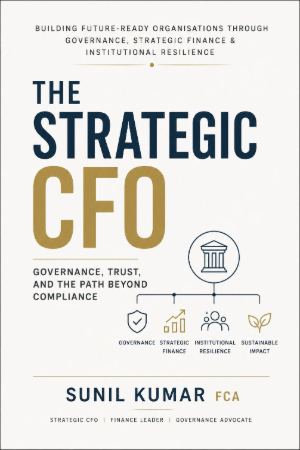
The title of this book – The Strategic CFO: Leading Beyond Finance in High-Impact Organizations – reflects a conviction that has shaped my own journey in the social sector: that the finance function, when practiced with rigor and purpose, is one of the most powerful instruments an institution has for protecting its mission.
The subtitle – Governance, Trust, and the Path Beyond Compliance – describes the journey this book takes the reader on. Part I lays the foundation by examining how the social sector itself is changing and why governance, not finance alone, is the first line of defense for any institution. Part II moves into the operational realities of trust, cash, resilience, budgeting, and reserves – the building blocks of sustainability. Part III addresses the regulatory landscape – FCRA, GST, and FEMA – not as a compliance burden, but as a governance discipline that, when embedded into everyday systems, becomes a source of institutional credibility.
This book is written for CFOs and finance leaders who want to expand their role beyond ledgers and filings; for CEOs and Boards who want to understand what to expect from a strategic finance function; and for emerging leaders who want to understand why governance, trust, and financial discipline are inseparable from mission success.
Over more than two decades in the social sector, I have observed a recurring pattern.
Institutions rarely collapse because of lack of intent. They weaken because governance, financial realism, institutional discipline, leadership maturity, and strategic foresight fail to evolve at the same pace as ambition.
In the development sector, the language of impact often dominates institutional conversations.
Yet beneath every sustainable impact story lies another reality:
- strong institutions,
- prudent governance,
- transparent systems,
- disciplined execution,
- leadership integrity,
- resilient culture,
- financial realism,
- and institutional trust.
This book is therefore not merely about finance. It is written primarily for the global social impact sector—organisations whose purpose is to create social or public value—while recognising that many of its CFO principles apply across sectors and geographies.
It is about institutional resilience.
It is about how governance, compliance, leadership judgment, strategic finance, technology, risk management, donor confidence, operational discipline, and institutional credibility intersect to shape the future of mission-driven organizations.
The role of the Chief Financial Officer (CFO) in the social sector is changing rapidly.
The future-ready CFO is no longer merely:
- a controller of accounts,
- a custodian of vouchers,
- a compliance reviewer,
- or a reporting officer.
The modern CFO increasingly operates as:
- a strategic partner,
- a governance architect,
- a steward of institutional credibility,
- a builder of trust capital,
- a translator of uncertainty,
- a protector of institutional resilience,
- a risk leader,
- and an enabler of sustainable scale.
- an advisor to the CEO and Governing Board on matters pertaining to financial and institutional sustainability
This transformation reflects a larger shift occurring across the social sector.
The sector itself is changing.
Donors are changing.
Boards are changing.
Regulatory expectations are changing.
Technology is changing.
And increasingly, society expects nonprofit institutions to operate with the same seriousness, governance maturity, strategic discipline, and transparency expected from large enterprises — while simultaneously remaining deeply mission-oriented.
This creates a unique leadership challenge.
Mission without systems becomes fragile. Systems without mission become irrelevant.
Sustainable institutions require both.
Many insights contained in this manuscript emerged from practical governance discussions, institutional observations, leadership experiences, donor interactions, regulatory reflections, and strategic finance discussions developed over time.
This manuscript is intentionally detailed. Its purpose is not simply to inform, but to provoke institutional thinking.
If this work contributes even modestly toward strengthening governance maturity, financial realism, institutional resilience, and strategic leadership within the social sector ecosystem, it will have achieved its purpose.
— Sunil Kumar, FCA
The strategic CFO does not simply report what has happened. The strategic CFO helps the institution understand what is happening, what may happen next, what could go wrong, and what leadership should do about it.
HOW TO USE THIS BOOK
WHERE TO START
Recommended reading paths
Choose the reading path closest to your role. Each chapter reference is clickable and takes you directly to the relevant part of the book.
| Reader | Suggested reading path |
|---|---|
| CFO / Finance Leader | Chapter 3 → Chapters 5–9 → Chapter 10 → Annexures B–E |
| CEO / Executive Director | Chapter 1 → Chapter 2 → Chapter 4 → Chapter 14 |
| Board / Trustee | Chapter 2 → Chapter 5 → Chapter 7 → Annexures A–B |
| Programme / Operations Leader | Chapter 4 → Chapter 6 → Chapter 7 → Chapter 8 |
| Compliance / Risk / Assurance | Chapter 2 → Chapter 10 → Chapter 11 → Chapter 12 → Annexure C |
| Emerging CFO / Finance Professional | Chapter 1 → Chapter 3 → Chapters 5–9 → Chapter 14 |
CROSS-REFERENCES
Use the book as a working guide
Use the links below to move from a management question directly to the chapter or practical tool most relevant to it.
| Management question | Go to |
|---|---|
| Need to understand the Strategic CFO role? | Chapter 3 |
| Need to strengthen trust and donor confidence? | Chapter 5 |
| Need to review liquidity and financial resilience? | Chapters 6–9 |
| Need to strengthen FCRA governance? | Chapter 10 / Annexure C |
| Need to review GST, tax or philanthropic structures? | Chapter 11 |
| Need to review overseas payments and FEMA governance? | Chapter 12 |
| Need to consider technology, automation and AI? | Chapter 13 |
| Need the leadership agenda for the CFO? | Chapter 14 |
| Need a Board governance checklist? | Annexure A |
| Need a Strategic CFO dashboard? | Annexure B |
| Need FCRA governance assessment tools? | Annexure C |
| Need cash-flow stress testing? | Annexure D |
| Need to build a CFO Operating System? | Annexure E |
QUESTIONS LEADERS ASK
50 practical Q&As for readers who want a concise answer first and the deeper discussion when needed. Go to Questions Leaders Ask →
One principle to carry throughout the book
Start with Chapters 1–4 for the strategic role of finance; Chapters 5–9 for trust, liquidity, budgeting and sustainability; Chapters 10–12 for regulatory governance; and Chapters 13–14 plus the annexures for the future-ready finance function.
A practical reading path
Use the book as a common language for funding, budgeting, risk, compliance, technology, institutional resilience and decision quality.
For leadership teams
Use the CEO’s Questions, Boardroom Questions and diagnostic tools to test whether the institution is financially realistic, governable, resilient and ready for its next stage of growth.
For CEOs and Boards
Use the chapters to assess your current role, strengthen liquidity and sustainability, improve governance and compliance, and move finance from reporting toward strategic decision support.
For CFOs and finance leaders
You can read the book from beginning to end, or use it as a working reference. Each chapter combines strategic ideas with practical questions, CFO reflections, action checklists and Boardroom Questions.
This is a practical leadership book, not a finance textbook. It is designed to help CFOs, CEOs, Board members and senior leaders see finance differently: as part of the institution’s governance, decision-making and resilience architecture.
WHO THIS BOOK IS FOR — AND WHAT IT IS MEANT TO CHANGE
The Strategic CFO is written primarily for finance leaders in NGOs, foundations, social enterprises and other mission-driven organisations within the global social impact sector who are expected to do more than produce accurate accounts. It is also for CEOs, Boards, trustees and senior leaders who depend on finance to make sound institutional decisions. The book is intentionally rooted in the social impact context because that is where the author has developed the depth of experience reflected in these pages. At the same time, many of the principles and frameworks are applicable to finance leadership across sectors and geographies, including the for-profit world. The book therefore seeks to retain the distinctive realities of mission-driven organisations without presenting strategic finance as a sector-exclusive discipline.
Primary Audience: CFOs and Finance Leaders
If you are a CFO, Finance Director, Head of Finance or senior finance professional, the central message is this: your role is no longer limited to reporting what has happened. Your deeper contribution is to make the institution more financially realistic, governable, resilient and capable of sustaining its mission. The book asks you to move from transaction management to institutional leadership — while retaining the discipline and independence that make finance credible.
CEOs and Executive Directors
For CEOs and Executive Directors, this book is a guide to using the CFO as a strategic partner rather than only as the owner of accounts, budgets and compliance. The message is to bring finance into important decisions early: funding choices, programme scale, contracts, liquidity, risk, technology, organisational design and sustainability.
Boards, Trustees and Governing Bodies
For Boards and Trustees, the message is simple: governance is not the act of approving reports; it is the act of asking whether the institution is capable of remaining trustworthy, financially viable and resilient. The Board should seek evidence, challenge assumptions, understand material risks and ensure that the institution does not depend excessively on one person, one donor, one system or one funding assumption.
Programme, Operations and Senior Leadership Teams
For programme and operations leaders, the book explains why finance should not be seen merely as a control function. Good finance helps the organisation understand what it can sustainably deliver, what a proposed commitment will cost, what risks accompany scale, and what trade-offs leadership is making. The goal is better decisions, not more bureaucracy.
Governance, Compliance, Internal Audit and Other Assurance Professionals
For governance, compliance and assurance professionals, the book provides a wider institutional context for their work. Compliance is strongest when it is embedded in ownership, processes, evidence, reporting and Board oversight rather than treated as a filing calendar maintained by one person.
Finance Professionals Preparing for the CFO Role
For emerging CFOs and senior finance professionals, the book sets out the capabilities that increasingly distinguish institutional finance leaders: strategic thinking, governance judgement, liquidity management, stakeholder trust, risk interpretation, technology awareness, communication and the ability to build systems that work without constant personal intervention.
The Core Message of the Book
The central message is that the Strategic CFO does not merely protect the numbers. The Strategic CFO helps build an institution worthy of the mission it serves — one that can see risks early, use resources responsibly, make better decisions, earn stakeholder trust and remain resilient through uncertainty.
What I Want the Reader to Take Away
Use the book selectively. Read the chapters most relevant to your current challenge, then return to the questions, checklists and annexures when you are ready to turn insight into action.
PART I — THE EVOLUTION OF FINANCE LEADERSHIP
Chapter 1: The New Reality Of The Social Sector
1.1 The Transformation Underway
The social sector is undergoing one of the most significant transformations in its history.
For decades, many nonprofit and development organizations were evaluated primarily on:
- intent,
- philanthropic credibility,
- social legitimacy,
- program activity,
- and fund utilization.
Increasingly, however, institutional expectations have fundamentally changed.
Today, donors, regulators, Boards, governments, CSR leaders, philanthropic institutions, multilaterals, impact investors, communities, and digital ecosystems are asking much deeper questions:
- Can this institution scale responsibly?
- Does this institution work strategically to ensure sustainability
- Can governance mature alongside growth?
- Can impact survive leadership transition?
- Can donor confidence sustain during uncertainty?
- Can compliance withstand forensic scrutiny?
- Can systems support large-scale execution?
- Can the institution adapt to AI-driven disruption?
- Can institutional credibility survive crisis?
- Can leadership remain transparent during volatility?
- Can financial discipline coexist with mission ambition?
- Can it adapt to changing circumstances
The modern social sector is no longer operating within a purely philanthropic environment.
It is increasingly operating within a governance-intensive ecosystem.
Trust has become one of the most valuable institutional currencies.
Let’s see how approval and oversight on overhead by donors has changed across last few decades.Evolution of Donor Funding for Overheads
| Era | Donor Approach | Accountability Level |
|---|---|---|
| 20–30 Years Ago | Overheads approved based on organizational needs | ⭐ Low |
| 10–20 Years Ago | Fixed overhead percentage (typically ~10%) | ⭐⭐ Moderate |
| From Last Decade | Actual-cost reimbursement with supporting evidence | ⭐⭐⭐⭐⭐ High |
⬇
The Accountability Journey
Trust-Based Funding
→
Budget-Based Funding
→
Evidence-Based Funding
CFO Implications Today
📌 Maintain robust cost allocation methodology
📌 Track actual overhead utilization
📌 Preserve supporting documentation
📌 Demonstrate value-for-money to donors
📌 Prepare for increasing donor scrutiny
CFO Reflection. Historically, many donors approved overheads based largely on organizational needs and trust in the institution. Over time, funding evolved toward fixed overhead percentages and subsequently toward actual-cost reimbursement supported by documentation and evidence. This shift reflects a broader movement from trust-based funding to accountability-driven stewardship of donor resources.
| CEO’s Question: As stakeholder expectations evolve from program performance to institutional resilience, how can we build an organization that is scalable, accountable, and future-ready |
|---|
| Strategic CFO Insight: Donor funding models have evolved from trust-based support to evidence-based accountability. Modern CFOs must build systems that demonstrate transparency, efficiency, and stewardship of donor resources. |
1.2 The Shift from Charity to Institutional Capability
Historically, many institutions focused heavily on:
- fundraising,
- program implementation,
- beneficiary outreach,
- and donor relationship management.
Today, however, institutional capability itself has become a strategic differentiator.
Funding decisions increasingly depend upon:
- governance maturity,
- financial discipline,
- reporting quality,
- risk management,
- strategic clarity,
- transparency,
- leadership depth,
- technology capability,
- operational resilience,
- and institutional credibility.
The sector is therefore evolving from:
| Earlier Model | Emerging Model |
|---|---|
| Activity-driven | Outcome-driven |
| Founder-centric | Institution-centric |
| Annual reporting | Real-time visibility |
| Compliance-focused | Governance-focused |
| Program scale | Sustainable scale |
| Financial reporting | Decision intelligence |
| Transactional funding | Trust-based partnerships |
| Reactive compliance | Compliance-by-design |
| Short-term grants | Long-term strategic capital |
This transition is redefining institutional leadership itself.
| CEO’s Question: As stakeholder expectations shift from charitable intent to institutional performance, how do we build an organization that is trusted, resilient, scalable, and sustainable? |
|---|
| Strategic CFO Insight: Programs create impact. Institutions sustain impact. The Strategic CFO ensures that while programs serve today's beneficiaries, the institution remains capable of serving tomorrow's beneficiaries as well. |
1.3 Trust Capital as Strategic Infrastructure
One of the strongest lessons from the social sector is this:
There is rarely a complete shortage of capital for credible institutions. There is often a shortage of trust.
Donors may tolerate:
- temporary delays,
- external volatility,
- economic uncertainty,
- and operational disruptions.
But institutions lose donor confidence rapidly when governance integrity weakens.
Examples include:
- inconsistent reporting,
- delayed disclosure,
- weak documentation,
- governance opacity,
- inadequate controls,
- compliance ambiguity,
- unexplained variances,
- cultural instability,
- leadership unpredictability,
- or weak institutional judgment.
- Lack of financial transparency
- If an institution comes under regulatory scrutiny
Trust capital accumulates slowly. But it can erode very quickly.
Institutions that underestimate this reality often mistake fundraising success for institutional strength.
The two are not always the same.
| CEO’s Question: Are we measuring our success by funds raised, or by the trust and institutional strength that sustain long-term funding? |
|---|
| Strategic CFO Insight: Balance sheets capture financial capital. Strategic CFOs also protect trust capital—the invisible infrastructure that determines whether financial capital continues to flow. |
| CFO Action Checklist: Establish and monitor trust metrics (donor retention, audit outcomes, compliance, and stakeholder confidence) as part of the regular CFO dashboard. |
| Boardroom Question: What are we doing today to strengthen and protect the trust capital that underpins our future funding and organizational sustainability? |
1.4 The Rise of Governance as Institutional Infrastructure
Mission-driven institutions sometimes unintentionally underinvest in governance because governance appears non-programmatic.
This is one of the most dangerous misconceptions in the development sector.
Governance is not administrative overhead. Governance is institutional infrastructure.
Without governance:
- impact becomes fragile,
- scale becomes risky,
- donor confidence weakens,
- regulatory exposure increases,
- leadership dependency intensifies,
- and institutional sustainability declines.
Strong governance does not slow impact. It protects impact.
CFO Reflection. There are many mission-driven organizations that excel in certain areas. For instance: (a) their Board or CEO may be highly reputed and capable of attracting more than sufficient grant funding; or (b) the institution's thematic area may be prioritized by the government or form part of a large donor ecosystem (e.g., HIV/AIDS, sanitation, tuberculosis, etc.), enabling the institution to receive more than enough grant funding and pursue expansion.
As a result, the institution may expand its operations into new geographies and thematic areas, often disproportionately to its existing capacity and readiness to scale, without establishing adequate systems and governance structures. Consequently, the institution may struggle to manage this growth and could face financial, programmatic, and reputational risks, leading to donor concerns and, in some cases, funding reductions or organizational decline.
Therefore, institutions should focus on developing robust systems and governance mechanisms in line with their business plans and growth strategies.
The Growth Paradox: When Funding Outpaces Institutional Readiness
┌──────────────────────────────────────────────┐
│ STRONG EXTERNAL ADVANTAGES │
└──────────────────────────────────────────────┘
│
▼
┌──────────────────────────────┐
│ Reputed Board / CEO │
│ Strong Donor Confidence │
└──────────────────────────────┘
OR
┌──────────────────────────────┐
│ High-Priority Theme Area │
│ (HIV, TB, Sanitation, etc.) │
└──────────────────────────────┘
│
▼
┌──────────────────────────────────────────────┐
│ ABUNDANT GRANT FUNDING AVAILABLE │
└──────────────────────────────────────────────┘
│
▼
┌──────────────────────────────────────────────┐
│ RAPID ORGANIZATIONAL EXPANSION │
│ • New Geographies │
│ • New Programs │
│ • Larger Teams │
│ • Increased Budget Size │
└──────────────────────────────────────────────┘
│
▼
┌───────────────────────┐
│ CRITICAL QUESTION │
│ Are systems growing │
│ as fast as funding? │
└───────────────────────┘
/ \
NO YES
│ │
▼ ▼
┌────────────────────┐ ┌──────────────────────┐
│ Weak Governance │ │ Strong Governance │
│ Weak Controls │ │ Robust Systems │
│ Limited Capacity │ │ Scalable Processes │
└────────────────────┘ └──────────────────────┘
│ │
▼ ▼
┌────────────────────┐ ┌──────────────────────┐
│ Financial Risk │ │ Sustainable Growth │
│ Programmatic Risk │ │ Donor Confidence │
│ Reputational Risk │ │ Strong Impact │
│ Donor Concerns │ │ Long-term Success │
└────────────────────┘ └──────────────────────┘
| CEO’s Question: Are we viewing governance as an administrative requirement, or as the institutional infrastructure that enables sustainable impact? |
|---|
| Strategic CFO Insight: Growth funded by grants is not sustainable unless governance, systems, controls, and organizational capacity scale at the same pace. |
CFO Action Checklist: ✓ Funding growth aligned with capacity growth |
| Boardroom Question: Are our governance systems sufficiently robust to support the organization's current scale, complexity, and future ambitions? |
1.5 The Expanding Role of Finance
Finance in the social sector can no longer remain a back-office function.
The finance function increasingly influences:
- donor confidence,
- governance quality,
- institutional transparency,
- risk visibility,
- strategic planning,
- liquidity sustainability,
- operational discipline,
- regulatory resilience,
- and long-term scalability.
The CFO therefore becomes more than a controller of funds.
The CFO becomes:
- a confidence architect,
- a strategic advisor,
- a governance translator,
- a steward of institutional memory,
- a protector of trust capital,
- and a builder of resilient systems.
| CEO’s Question: Is our finance function merely reporting the past, or is it actively enabling the institution's future? |
|---|
| Strategic CFO Insight: Donors evaluate not only financial records but also whether finance leadership can provide governance, strategic direction, risk oversight, and institutional stewardship. Compliance may qualify an institution for consideration, but leadership often determines donor confidence. |
| Boardroom Question: Is our finance function perceived as a compliance department or as a strategic partner that strengthens donor confidence and institutional credibility? |
1.6 The Indian Social Sector: Scale, Opportunity, and Obligation
For readers outside India, the transformation described in this chapter provides the broader context. India offers a particularly complex and instructive environment for social impact finance because of the interaction of FCRA, tax, donor, banking and governance requirements. The Indian context is therefore used where it adds practical depth, while the underlying governance and strategic finance principles are intended to be understood and applied more broadly.
India has one of the world's largest voluntary and social impact ecosystems. For CFOs of organisations receiving foreign contribution, the combination of FCRA, tax, donor, banking and governance requirements creates a distinctive institutional environment. This Indian experience provides useful case material for the wider social impact sector, while the specific regulatory requirements should not be assumed to apply outside India.
The CSR ecosystem adds another significant dimension. Since the introduction of mandatory CSR under Section 135 of the Companies Act, 2013, annual CSR spending has grown steadily — crossing ₹25,000 crore per year among the largest listed companies. This has created a large, structured domestic funding stream with its own governance expectations, utilization conditions, and reporting requirements that differ substantially from traditional philanthropy.
At the same time, FCRA governance has become an increasingly important institutional discipline. The 2020 amendments strengthened controls over foreign contribution, and subsequent rule changes have placed greater emphasis on approved purposes, geographic scope, disclosures, documentation and accountability. Organisations should therefore treat FCRA as an embedded governance responsibility rather than a year-end filing exercise.
Meanwhile, the sector is seeing rapid growth in impact investing, blended finance, development finance institution (DFI) funding, and ESG-linked grant-making — all of which bring commercial-grade governance expectations into what were previously purely philanthropic relationships.
The Indian CFO's Distinctive Context CFO Reflection Indian social sector CFOs operate in a uniquely complex environment — simultaneously navigating FCRA, GST, FEMA, applicable income-tax provisions, CSR regulations, state-level society and trust laws, donor-specific reporting requirements, and increasingly, ESG and impact measurement frameworks. This regulatory stack has no equivalent in most other countries. A CFO in an Indian nonprofit must be, simultaneously, a foreign-contribution compliance officer, a tax governance expert, a cash-flow manager contending with seasonal CSR disbursement cycles, and a strategic advisor to a Board that may include government nominees, CSR representatives, and international donors. The frameworks in this book are designed with this complexity in mind. Every chapter reflects the Indian institutional reality. |
|
| Indian Social Sector Indicator | Context |
| Registered NGOs (approximate) | ~3 million across India |
| Active FCRA-registered entities | See latest MHA / FCRA portal data |
| Annual foreign contributions (FCRA) | See latest MHA / FCRA portal data |
| Annual CSR spending (top listed cos.) | ₹25,000+ crore per year |
| Key recent regulatory developments | FCRA reforms, data protection, GST and tax developments — verify current law |
| Emerging funding channels | Impact investing, DFI grants, ESG-linked philanthropy, blended finance |
🔎 Strategic CFO Insight Indian social sector CFOs operate within one of the world's most complex nonprofit regulatory environments. Governance maturity is not merely aspirational here — it is a survival requirement. |
|
The modern social sector now operates within intersecting pressures including:
- FCRA regulations,
- CSR expectations,
- ESG frameworks,
- Innovative Financing
- GST interpretations,
- FEMA implications,
- cyber risks,
- AI disruption,
- donor scrutiny,
- real-time reporting expectations,
- data privacy obligations,
- reputational volatility,
- social media amplification,
- and increasing public accountability.
Many institutions are still structured for a simpler era.
The future, however, will reward organizations that:
- adapt quickly,
- govern prudently,
- digitise intelligently,
- communicate transparently,
- institutionalise learning,
- decentralise capability,
- and build resilient governance architecture.
CFO Reflection. For an institution, excellence in community engagement, a dedicated and passionate workforce, effective service delivery, and sound financial management are essential but no longer sufficient. To survive and thrive, institutions must proactively embrace emerging challenges, risks, opportunities, and changes. The examples in this chapter—including FCRA, the Digital Personal Data Protection Act, Artificial Intelligence, reputational risks, and social media—illustrate the types of institutional pressures leaders must govern. The specific regulatory and operating requirements will vary by jurisdiction, but the underlying need for agility, resilience, preparedness, and adaptive governance is universal.
| CEO’s Question: As expectations continue to rise, how can we ensure that complexity does not outpace our organizational capability? |
|---|
| Strategic CFO Insight: In an era of increasing institutional complexity, sustainable impact depends not only on operational excellence and financial stewardship but also on an institution’s ability to anticipate, adapt to, and govern emerging regulatory, technological, reputational, and funding challenges. |
| Boardroom Question: Is our institution sufficiently prepared—with the right governance, capabilities, and resources—to proactively respond to emerging risks and opportunities while ensuring long-term sustainability and mission impact? |
1.7 The Emerging Leadership Challenge
The future of the social sector will not be determined merely by:
- program scale,
- fundraising capability,
- or brand visibility.
Increasingly, institutional endurance will depend upon:
- governance maturity,
- strategic adaptability,
- leadership depth,
- financial realism,
- technological readiness,
- and institutional trust.
The institutions that survive the coming decade will not necessarily be the most ambitious.
They will often be the most disciplined.
CFO Reflection. Institutions working in blended finance are often favored by funders because they focus on innovative financing and innovative program delivery rather than relying solely on traditional programming. Funders are increasingly interested in ensuring that the same amount of grant funding can support a larger scale of impact through innovative financing mechanisms and program models.
Similarly, funders increasingly prefer leveraging resources from governments or other funding sources rather than financing the full cost of an intervention themselves. As a result, few funders are willing to provide complete philanthropic support to beneficiaries. Instead, they seek to maximize impact by encouraging co-funding, resource mobilization, and sustainable financing approaches.
| CEO’s Question: How can we ensure that our institution is not only ambitious in its vision but also disciplined in its execution? |
|---|
| Strategic CFO Insight: Catalytic capital creates greater and more sustainable impact when CFOs leverage innovation, co-funding, and resource mobilization rather than relying solely on direct grant funding. |
| Boardroom Question: How effectively are we using our philanthropic capital to attract additional resources and scale sustainable impact beyond the grants we provide? |
1.8 Key Takeaways
The social sector is undergoing a significant transformation driven by rising stakeholder expectations, funding complexities, and accountability requirements.
Donors increasingly expect measurable outcomes, transparency, and evidence of impact rather than activity-based reporting.
Nonprofits must strengthen institutional capacity, governance, and financial management to achieve sustainable impact.
Financial sustainability is becoming as important as programmatic excellence.
Data, technology, and digital systems are no longer optional; they are critical organizational capabilities.
CFOs are evolving from finance managers into strategic leaders who enable organizational growth and resilience.
Organizations that invest in systems, governance, and financial discipline will be better positioned to attract funding and scale impact.
1.9 CFO Action Checklist
Immediate Actions
☐ Assess the organization's current financial sustainability and dependency on major funding sources.
☐ Evaluate whether existing financial reports provide strategic insights or only compliance information.
☐ Review current governance and financial oversight mechanisms.
☐ Map key financial and operational risks facing the organization.
☐ Identify capability gaps in finance systems, processes, and staffing.
Strategic Actions
☐ Develop a multi-year financial sustainability roadmap.
☐ Introduce organization-wide performance and impact measurement metrics.
☐ Strengthen budgeting, forecasting, and scenario-planning practices.
☐ Build management dashboards that connect financial health with program outcomes.
☐ Position finance as a strategic partner to the CEO, Board, and program teams.
1.10 Related Chapters
Chapter 2 – Governance Fails Before Finance Fails: Explores how the institutional pressures introduced in this chapter ultimately surface as governance breakdowns.
Chapter 3 – The Evolving Role of the Social Sector CFO: Examines how the CFO’s mandate must expand to meet the new institutional expectations described here.
Chapter 5 – Trust Capital and Donor Confidence: Develops the theme of institutional trust as a strategic currency in the evolving funding landscape.
1.11 Reflection Questions
If your organization lost its largest funding source tomorrow, would its systems, governance, financial reserves, and leadership capacity be strong enough to sustain its mission and continue delivering impact?
1.12 Boardroom Questions
What institutional capabilities must our organization strengthen over the next three years to remain financially sustainable, trusted by stakeholders, and capable of delivering measurable social impact at scale?
Take-Away Messages
Chapter 2: Governance Fails Before Finance Fails
2.1 Financial Distress Begins Earlier Than Institutions Realise
Financial crises rarely begin in the ledger.
They begin much earlier.
By the time liquidity stress, audit qualifications, donor escalations, compliance breaches, regulatory scrutiny, or reputational damage become visible, institutional weakening may already have existed for years.
In many cases, financial distress is merely the final visible symptom of deeper governance erosion.
This distinction is critical.
Most institutions attempt to solve financial symptoms while ignoring governance causes.
That approach rarely creates sustainable recovery.
CFO Reflection. A complaint raised by a former employee of a partner organization escalated into a donor-led investigation. Due to inadequate governance oversight and risk management, the issue resulted in reputational damage, grant termination, and disruption of services to thousands of beneficiaries. The organization did not fail because of its mission or program quality—it failed because governance weaknesses were left unaddressed.
| CEO’s Question: Are we detecting financial distress early enough to act before it becomes a crisis? |
|---|
| Strategic CFO Insight: Financial distress begins long before cash runs out; the Strategic CFO identifies early warning signals and acts before risks become crises. |
2.2 The Silent Nature of Governance Failure
Governance failure is dangerous precisely because it develops quietly.
Unlike financial collapse, governance erosion often emerges gradually.
It may initially appear as:
- delayed decision-making,
- leadership fatigue,
- avoidance of difficult conversations,
- weak accountability,
- fragmented reporting,
- poor succession planning,
- excessive founder dependency,
- inconsistent operational discipline,
- tolerance for ambiguity,
- or cultural deterioration.
Initially, these weaknesses appear manageable. Eventually, however, they compound into institutional fragility.
The most dangerous governance risks often remain invisible within financial statements.
For example:
- burnout among leadership teams,
- weak second-line management,
- fear-based communication culture,
- resistance to technology adoption,
- donor overdependence,
- inadequate documentation discipline,
- inconsistent program quality,
- weak institutional learning,
- and low governance transparency.
Financial statements may continue appearing stable even while institutional resilience deteriorates.
CFO Reflection. A mission-driven organization derived 80% of its funding from a single donor. Following a whistleblower complaint, the donor terminated the grant. The organization was forced to downsize operations, reduce staffing, and curtail its programs. Although opportunities to diversify funding had existed earlier, the loss of its largest grant left little room for recovery. This was not merely a funding problem—it was a governance and risk management failure.
| CEO’s Question: Are governance weaknesses silently accumulating beneath our visible successes? |
|---|
| Strategic CFO Insight: Governance failures rarely emerge suddenly; they develop quietly when oversight, accountability, and risk management begin to weaken |
2.3 Governance Integrity as a Leading Indicator
Many institutions continue evaluating organizational health primarily through financial metrics.
However, financial health is often a lagging indicator.
Governance integrity is the leading indicator that matters most.
When governance weakens:
- donor confidence weakens,
- compliance quality deteriorates,
- internal controls become inconsistent,
- operational discipline declines,
- strategic judgment suffers,
- talent retention weakens,
- and institutional adaptability reduces.
Eventually, these governance failures surface financially.
This is why Boards that focus exclusively on financial review may discover problems far too late.
CFO Reflection. A mission-driven organization excelled in program delivery but underinvested in governance and institutional systems. Financial mismanagement remained undetected until a donor audit uncovered the issue, leading to grant termination. The organization did not fail because of weak programs—it failed because governance did not keep pace with growth. Donor confidence depends not only on impact, but also on strong governance and accountability.
| CEO’s Question: Are we treating governance integrity as a strategic leading indicator or merely a compliance requirement? |
|---|
| Strategic CFO Insight: Governance integrity is a leading indicator of organizational sustainability, stakeholder trust, and long-term resilience. |
2.4 Governance Is Not Administration
Mission-driven organizations sometimes unintentionally underinvest in governance because governance appears non-programmatic.
This misconception creates long-term institutional vulnerability.
Governance is not administrative overhead. Governance is institutional infrastructure.
Without governance:
- impact becomes fragile,
- growth becomes unstable,
- donor trust weakens,
- leadership concentration increases,
- and sustainability declines.
Strong governance does not reduce mission. It protects mission.
CFO Reflection. Many mission-driven organizations operate without sufficiently strong governance systems, documented processes, institutional independence, or effective oversight mechanisms. Decision-making often remains concentrated among a few individuals, while governance structures fail to mature alongside organizational growth. Although such organizations may deliver strong results and enjoy community trust, weak governance can create significant long-term institutional risks.
| CEO’s Question: Are we focusing on governance as a strategic leadership responsibility or reducing it to administrative compliance? |
|---|
| Strategic CFO Insight: Governance is not administration; it is the framework through which accountability, oversight, and strategic direction are exercised. |
2.5 Governance and Program Quality Are Interconnected
Program quality itself is fundamentally a governance issue.
Boards and leadership teams often separate governance from program execution.
This separation is artificial.
Weak governance frequently results in:
- weak implementation discipline,
- inconsistent field oversight,
- poor beneficiary tracking,
- inadequate monitoring systems,
- weak documentation,
- inflated outcome reporting,
- and reputational exposure.
High-impact organizations recognise that governance and program quality are deeply interconnected.
| CEO’s Question: How does the strength of our governance influence the quality and impact of our programs? |
|---|
| Strategic CFO Insight: Strong governance creates the accountability, oversight, and discipline necessary for consistent program quality and sustainable impact. |
2.6 Emerging Governance Risks
The next generation of governance risks will increasingly include:
- AI misuse,
- cyber vulnerabilities,
- data governance failures,
- leadership concentration,
- succession gaps,
- compliance fatigue,
- donor concentration,
- misinformation risk,
- digital reputation volatility,
- and technology dependency.
Boards that continue focusing only on historical compliance may fail to identify emerging institutional threats.
| CEO’s Question: What emerging governance risks could threaten our organization's credibility, compliance, or sustainability? |
|---|
| Strategic CFO Insight: Emerging governance risks are best managed through proactive oversight, not reactive intervention. |
2.7 The CFO's Governance Health Check: A 15-Minute Diagnostic
The following diagnostic is designed to be answered by the CFO alone, in approximately 15 minutes, at least once per quarter. It is not a compliance checklist — it is an early-warning instrument. Its purpose is to surface governance erosion before it becomes visible in financial statements.
Answer each question honestly. A single 'No' or 'Unsure' warrants a direct conversation with the CEO or Board Chair.
DECISION-MAKING HEALTH
Is there a single decision in the last 90 days that has been deferred without a documented reason or resolution timeline? If YES or UNSURE — flag immediately. Response: ________________________________ |
Does the CEO or founder personally approve more than 50% of significant financial transactions? If YES or UNSURE — flag immediately. Response: ________________________________ |
Are there decisions that all senior staff know need to be made but no one is raising formally? If YES or UNSURE — flag immediately. Response: ________________________________ |
FINANCIAL CONTROL ENVIRONMENT
Are any audit findings from prior years still open without an agreed remediation plan? If YES or UNSURE — flag immediately. Response: ________________________________ |
Has any payment been made in the last quarter that bypassed the standard approval process? If YES or UNSURE — flag immediately. Response: ________________________________ |
Is there a member of staff whose departure would make it difficult to reconstruct financial records? If YES or UNSURE — flag immediately. Response: ________________________________ |
DONOR AND FUNDING SIGNALS
Has any donor reduced reporting frequency, delayed releases, or asked unusual questions in the last 6 months? If YES or UNSURE — flag immediately. Response: ________________________________ |
Does any single donor account for more than 35% of current-year income? If YES or UNSURE — flag immediately. Response: ________________________________ |
Are there grants being implemented where utilisation is behind schedule without a documented recovery plan? If YES or UNSURE — flag immediately. Response: ________________________________ |
LEADERSHIP AND CULTURE
Has the organisation lost two or more senior staff in the last 12 months without a documented succession plan? If YES or UNSURE — flag immediately. Response: ________________________________ |
Are there topics that, by unspoken consensus, are not raised in leadership meetings? If YES or UNSURE — flag immediately. Response: ________________________________ |
Has the Board raised any concern in the last two meetings that has not yet received a written response from management? If YES or UNSURE — flag immediately. Response: ________________________________ |
COMPLIANCE AND REGULATORY
Is there any statutory filing (FCRA, GST, Income Tax, MCA) that is overdue or filed late in the current year? If YES or UNSURE — flag immediately. Response: ________________________________ |
Is there an activity or expenditure whose regulatory classification is uncertain and has not been reviewed by legal counsel? If YES or UNSURE — flag immediately. Response: ________________________________ |
Has there been any complaint — from staff, beneficiaries, or vendors — in the last 6 months that has not been formally investigated and closed? If YES or UNSURE — flag immediately. Response: ________________________________ |
Interpreting Your Score
| 'Yes' or 'Unsure' Answers | Recommended Action |
| 0 | No immediate governance concerns — maintain discipline |
| 1–2 | Monitor closely — discuss with CEO within 2 weeks |
| 3–4 | Elevated risk — raise at next Board/Audit Committee meeting |
| 5 or more | Significant governance concern — convene urgent leadership discussion |
🔎 Strategic CFO Insight This diagnostic does not replace governance review — it supplements it. Its value lies in its regularity, not its comprehensiveness. A CFO who runs this check every quarter will rarely be surprised. |
|
Every Board should periodically evaluate:
- What risks are not appearing in our financial statements?
- What assumptions are we relying upon excessively?
- Where is leadership concentration becoming unhealthy?
- Are we building institutional capability or dependency?
- What governance risks may emerge from AI?
- How resilient are we during funding volatility?
- How strong is our second line of leadership?
- Are we governance-compliant or governance-mature?
- Are our controls operational or merely documented?
- What risks are culturally suppressed?
Institutions rarely fail suddenly. They usually fail gradually before they fail visibly.
Governance therefore becomes the earliest warning system of institutional sustainability.
| CEO’s Question: Are we asking the governance questions that reveal risks before they become problems? |
|---|
| Strategic CFO Insight: Effective boards create value not only through decisions, but through the quality of the questions they ask. |
| Boardroom’s questions: What governance risks are developing beneath the surface today that could become tomorrow's financial, operational, or reputational crisis? |
2.8 Key Takeaways
Governance failures typically emerge long before financial distress becomes visible in financial statements.
Weak board oversight, unclear accountability, and ineffective risk management create hidden vulnerabilities within organizations.
Financial crises are often symptoms of deeper governance weaknesses rather than isolated finance problems.
Delayed decision-making and lack of strategic challenge from governing bodies can accelerate organizational decline.
Early warning signs frequently appear in governance processes, leadership behavior, compliance culture, and stakeholder trust.
Strong governance frameworks improve organizational resilience, donor confidence, and long-term sustainability.
CFOs play a critical role in identifying governance risks and translating them into actionable insights for leadership and boards.
2.9 CFO Action Checklist
□ Assess whether board committees have clearly defined responsibilities and reporting mechanisms.
□ Review the quality and timeliness of information provided to the Board and Audit Committee.
□ Establish governance-related early warning indicators alongside financial KPIs.
□ Evaluate segregation of duties and key internal control effectiveness.
□ Conduct periodic governance and risk maturity assessments.
□ Ensure major strategic, financial, and compliance risks are regularly discussed at board level.
□ Monitor management override risks and decision-making bottlenecks.
□ Strengthen whistleblower, ethics, and conflict-of-interest mechanisms.
□ Document and track board action items and management accountability.
□ Periodically benchmark governance practices against leading nonprofit and corporate governance standards.
2.10 Related Chapters
Chapter 1 – The New Reality of the Social Sector: Provides the broader context of shifting stakeholder expectations that makes governance discipline essential.
Chapter 3 – The Evolving Role of the Social Sector CFO: Shows how the CFO acts as a key safeguard against the governance failures described here.
Chapter 7 – Building Financially Resilient Institutions: Builds on governance foundations to demonstrate how resilient institutions are constructed.
2.11 Reflection Questions
If your organization faced a major financial crisis tomorrow, which governance weakness would most likely have contributed to it—and is that risk already visible today?
| Strategic CFO Insight: Financial statements usually reveal the consequences of failure; governance signals reveal the causes. The most effective CFOs monitor both. |
|---|
Take-Away Messages
Chapter 3: The Evolving Role Of The Social Sector Cfo
3.1 The CFO Transformation
The role of the CFO in a social impact organisation is undergoing one of the most profound transformations in institutional leadership. Although the examples in this book are primarily drawn from mission-driven organisations, the underlying transformation—from financial controller toward strategic partner, governance steward and institution builder—is relevant to CFOs across sectors.
Historically, the finance function in many organizations was viewed primarily as:
- a compliance checkpoint,
- an accounting office,
- a budgeting department,
- or a reporting mechanism.
That model is increasingly obsolete.
Today, the CFO operates at the intersection of:
- governance,
- strategic planning,
- institutional credibility,
- risk management,
- donor confidence,
- technology,
- sustainability,
- and organizational resilience.
| CEO Question | CFO Insight |
|---|---|
| Are we financially sustainable? | Sustainability depends on building financial resilience, not just maintaining cash reserves. |
| Can we scale our impact? | Impact can only scale when funding, capabilities, and governance grow together. |
| Are our donors confident in us? | Donor confidence is earned through transparency, accountability, and consistent reporting. |
| What are the biggest risks ahead? | Strategic risks must be anticipated, monitored, and managed before they become crises. |
| Are we using our resources effectively? | Data-driven decisions ensure resources are deployed for maximum mission impact. |
| How do we balance growth and control? | Strong governance enables innovation while protecting institutional integrity. |
| What are stakeholders expecting from us? | Financial information must be translated into a compelling stakeholder narrative. |
| Are we prepared for the future? | Technology adoption is essential for improving efficiency, insight, and scalability. |
| Are we compliant with regulations and donor requirements? | Compliance should be embedded into everyday processes rather than treated as a periodic exercise. |
| How can finance contribute to strategy? | Finance creates value when it acts as a strategic partner in organizational decision-making. |
3.2 From Controller to Strategic Partner
High-performing institutions increasingly position finance leadership within strategic decision-making.
This shift occurs because:
- strategy without financial realism fails,
- growth without governance becomes fragile,
- and scale without discipline weakens donor confidence.
The future-ready CFO is therefore expected to:
- protect value,
- create value,
- and communicate value.
This represents a major shift from transactional finance toward strategic finance leadership.
3.3 The CFO as a Steward of Trust Capital
Finance is no longer merely about numbers. It is increasingly about institutional credibility.
Stakeholders increasingly evaluate institutions through the lens of:
- transparency,
- responsiveness,
- governance maturity,
- reporting quality,
- operational predictability,
- and strategic discipline.
The CFO therefore becomes central to shaping institutional trust.
3.4 The CFO Maturity Self-Assessment
The following grid is designed for personal use by finance leaders. It is intentionally direct. For each capability dimension, read across the five levels and mark the description that most honestly reflects your current practice — not your aspiration, and not your job title. Then identify the one dimension where moving up one level would have the greatest impact on your institution.
| Dimension | Level 1 Transactional | Level 2 Compliance-Led | Level 3 Management Partner | Level 4 Strategic Leader | Level 5 Institutional Architect |
| Financial Reporting | Produces accurate accounts on schedule | Ensures compliance with donor and statutory requirements | Provides management with timely variance analysis and forward projections | Translates financial data into strategic insight for CEO and Board | Builds an integrated financial intelligence system used across the organisation |
| Governance & Risk | Flags obvious financial risks | Maintains internal controls and supports audits | Monitors governance indicators and escalates proactively | Advises Board on governance maturity and emerging institutional risks | Designs governance architecture; shapes Board risk culture |
| Donor & Stakeholder Trust | Prepares required donor reports | Ensures reporting meets contractual obligations | Anticipates donor questions; communicates proactively | Builds and manages institutional relationships with key donors | Acts as a strategic trust architect; shapes how the institution is perceived externally |
| Cash & Liquidity | Monitors bank balances | Tracks grant utilisation against approved budgets | Maintains rolling 12-month cash forecast with scenario sensitivity | Manages liquidity strategy, including reserve building and gap financing | Leads institution-wide liquidity architecture and stress-testing frameworks |
| Strategic Planning | Provides financial data when asked | Prepares budget based on program team inputs | Co-develops multi-year financial projections with program leaders | Drives strategic financial planning as a core leadership function | Integrates financial sustainability into the institutional strategy process |
| Technology & Data | Uses spreadsheets for standard reporting | Implements basic accounting software and standard controls | Introduces dashboards and automated reporting for management use | Leads digital finance transformation; builds data governance capabilities | Positions the finance function as the organisation's data intelligence hub |
| Compliance-by-Design | Ensures filings are completed on time | Maintains compliance calendar and documentation standards | Embeds compliance checkpoints into operational processes | Builds compliance-by-design into the institutional culture | Advises Board and CEO on regulatory strategy; shapes institutional compliance posture |
How to Use This Grid
Step 1 — Mark your honest current level for each dimension. Step 2 — Identify the dimension where you are lowest relative to your institution's needs. Step 3 — Write one concrete action that would move you one level up in that dimension within the next six months. Step 4 — Share this assessment with your CEO or a trusted colleague — not for evaluation, but for accountability.
A Personal Note on This Assessment CFO Reflection Most CFOs who attempt this grid honestly find that they cluster at Levels 2–3 across most dimensions. That is not a failure — it reflects the reality that many institutions have not yet created the conditions for a CFO to operate at Level 4 or 5. The question is not just 'Where am I?' but 'What would have to change — in me, in my team, and in my institution — for me to operate one level higher?' The answer to that question is the beginning of a strategic development plan. |
The evolving CFO capability framework increasingly includes:
Governance Stewardship
Ensuring governance systems mature alongside scale.
Strategic Risk Leadership
Helping Boards navigate uncertainty intelligently.
Financial Realism
Balancing mission ambition with sustainability.
Data and Decision Intelligence
Transforming reporting into actionable strategic insight.
Institutional Communication
Building donor and Board confidence through transparency.
Technology Adaptability
Preparing institutions for AI-enabled transformation.
Compliance-by-Design
Embedding governance into operations rather than treating it as an afterthought.
3.5 The CFO in Mission-Driven Institutions
Unlike purely commercial environments, social sector CFOs operate within multidimensional accountability systems.
They must simultaneously balance:
- donor expectations,
- program realities,
- social outcomes,
- liquidity sustainability,
- compliance requirements,
- institutional mission,
- governance maturity,
- and operational discipline.
This requires nuanced judgment.
The social sector CFO must therefore combine:
- financial expertise,
- governance maturity,
- strategic thinking,
- institutional sensitivity,
- operational understanding,
- and leadership credibility.
3.6 The CFO as an Institutional Integrator
One of the most important future roles of the CFO will involve institutional integration.
Many organizations struggle because:
- finance operates separately from programs,
- governance operates separately from operations,
- and compliance operates separately from strategy.
The future-ready CFO increasingly helps integrate:
- governance,
- strategy,
- finance,
- risk,
- technology,
- compliance,
- and institutional sustainability.
The strongest CFOs therefore do not merely manage finance. They help shape institutions.
| CEO’s Question: How do we balance impact, accountability, growth, and sustainability in an increasingly complex world? |
|---|
| Strategic CFO Insight: By combining financial realism, governance discipline, strategic foresight, and stakeholder trust |
CFO Reflection:
While some CFOs continue to perform traditional responsibilities such as accounting, finance, donor reporting, legal compliance, board documentation, due diligence, audits, and liaison with government agencies, many others have expanded their role significantly.
Today’s CFOs are increasingly responsible for strengthening governance, partnering with the CEO on organizational sustainability and growth, and building the confidence of external stakeholders such as donors, government departments, auditors, and bankers, as well as internal stakeholders including the board and peer leaders.
Modern CFOs are also expected to engage with innovative financing models, including blended finance and impact capital, environmental, social, and governance (ESG) considerations, AI and automation adoption, predictive analytics, and other emerging strategic priorities.
The role of the CFO is evolving rapidly. Every CFO should recognize this shift, prepare for the future, and adapt proactively to contribute more effectively and efficiently to the organization's mission and long-term success.
3.7 Boardroom Questions
Does our CFO function operate primarily as a financial steward, or as a strategic organizational partner?
How effectively does finance contribute to organizational strategy, sustainability, and impact decisions?
What capabilities will our finance function need over the next three to five years?
Are financial risks, opportunities, and performance insights reaching the Board in a timely manner?
How prepared is the organization to leverage technology, data analytics, and AI within finance?
Does the CFO have sufficient influence in strategic decision-making across the organization?
What investments in people, systems, and processes are required to support the next stage of finance transformation?
3.8 Key Takeaways
The social sector CFO role has evolved from financial stewardship to strategic leadership.
Modern CFOs balance financial sustainability with mission impact.
Data-driven decision-making is becoming a core finance responsibility.
Technology, automation, and AI are reshaping finance operations.
Effective CFOs serve as strategic advisors to CEOs and Boards.
Cross-functional collaboration is increasingly critical to organizational success.
Future-ready finance functions combine governance, agility, innovation, and impact measurement.
3.9 CFO Action Checklist
□ Assess the current maturity level of the finance function.
□ Identify gaps in strategic finance, analytics, and business partnering capabilities.
□ Develop a finance transformation roadmap aligned with organizational strategy.
□ Strengthen financial forecasting and scenario-planning processes.
□ Increase the use of dashboards and real-time performance insights.
□ Review opportunities for automation and digital finance solutions.
□ Build stronger partnerships with program, fundraising, and operations teams.
□ Enhance Board reporting with forward-looking insights rather than historical information alone.
□ Invest in leadership development within the finance team.
□ Establish metrics to track both financial health and mission impact.
3.10 Reflection Questions
Organization Reflection
How effectively has our organization evolved its finance function from transactional support to strategic partnership, and what barriers remain to achieving this transformation?
CFO Reflection
What three capabilities must I strengthen over the next 12 months to become a more effective strategic, impact-oriented, and future-ready CFO?
3.11 Related Chapters
Chapter 1 – The New Reality of the Social Sector: Sets the context for why the CFO role described here has become strategically essential.
Chapter 2 – Governance Fails Before Finance Fails: Highlights the governance risks that the strategic CFO is positioned to anticipate and prevent.
Chapter 4 – Finance as an Enabler of Mission Scale: Extends the strategic CFO role into the practical work of enabling organizational scale.
Take-Away Messages
Chapter 4: Finance As An Enabler Of Mission Scale
4.1 Finance as a Partner in Creating Impact
Finance creates greater value when it is involved early in decisions that affect mission delivery, organisational scale, funding, risk and sustainability.
A strategic finance function works alongside programme and leadership teams to understand what the organisation is trying to achieve, assess the financial and institutional implications, and help shape feasible options.
When finance is engaged at the right stage, it can help the institution:
protect mission resources,
- strengthen decision quality,
- identify financial and governance risks early,
- improve operational and funding discipline,
- and create a financially feasible path to sustainable impact.
| CEO’s Question: Are our financial systems enabling impact delivery or creating barriers to mission success? |
|---|
| Strategic CFO Insight: Strong finance is not the enemy of impact—it is the infrastructure that makes sustainable impact possible. |
4.2 Beyond Cost Reduction
One of the most common institutional mistakes involves confusing cost reduction with cost efficiency.
Cost reduction alone can weaken:
- program quality,
- governance systems,
- organizational capability,
- staff morale,
- and long-term sustainability.
The more strategic objective is cost efficiency.
The goal is not necessarily to spend less. The goal is to generate greater impact per unit of cost.
| CEO’s Question: How can we improve organizational value and impact, not just reduce costs? |
|---|
| Strategic CFO Insight: The most effective CFOs create value through smarter resource allocation, not merely through expense reduction. |
4.3 Impact Per Rupee
Future-ready institutions increasingly evaluate:
- cost per beneficiary,
- program sustainability,
- operational leverage,
- implementation efficiency,
- and outcome durability.
This does not imply purely financial thinking.
Rather, it reflects stewardship.
Social capital is limited. Institutions therefore carry responsibility to utilise it responsibly.
| CEO’s Question: Are we maximizing mission outcomes for every dollar entrusted to our organization? |
|---|
| Strategic CFO Insight: The true measure of financial success in the social sector is not money spent, but impact created per purpose served. |
4.4 Finance and Program Partnership
When finance and program teams collaborate effectively:
- donor reporting improves,
- budget realism increases,
- implementation discipline strengthens,
- compliance becomes easier,
- and institutional trust deepens.
Finance should therefore not operate as an adversarial gatekeeper.
It should operate as a strategic mission partner.
| CEO’s Question: Are finance and program teams working together to maximize mission outcomes and organizational effectiveness? |
|---|
| Strategic CFO Insight: The greatest impact is achieved when finance and program teams operate as strategic partners, not functional silos. |
4.5 Financial Realism Matters
Mission ambition without liquidity realism creates institutional fragility.
Budgets may exist. That does not necessarily mean deployable cash exists.
Institutions must therefore distinguish between:
- approved funding,
- committed funding,
- restricted grants,
- unrestricted liquidity,
- and operational sustainability.
Financial realism is not pessimism. It is institutional maturity.
| CEO’s Question: Are our strategic ambitions grounded in realistic financial capacity and long-term sustainability? |
|---|
| Strategic CFO Insight: Mission-driven organizations achieve lasting impact when bold aspirations are balanced with financial realism and disciplined execution. |
CFO Reflection
During staff or partner meetings, I often begin by asking a provocative question:
"Why don't we eliminate the Finance Department and use the finance budget directly for achieving more program outcomes?"
Every department immediately responds that such a proposal is neither practical nor prudent because it would likely result in greater losses and reduced benefits. They explain that the Finance Department plays a critical role in safeguarding funds, maintaining donor confidence, ensuring governance and legal compliance, and supporting staff in managing financial processes effectively.
Each function within an organization exists for a purpose, and only professionals with the required expertise can perform that role effectively. Therefore, the Finance function is both useful and essential.
The challenge, however, is that many finance professionals do not fully understand or appreciate the importance of operational functions for an organization's survival and growth. Likewise, Finance Departments often become obstacles when finance professionals are unaware of the challenges, opportunities, and perspectives of other departments and remain confined to their own functional concerns.
Similarly, operational departments may not fully understand the challenges faced by the Finance Department or appreciate the opportunities and constraints under which it operates. In many organizations, a significant portion of audit observations attributed to the Finance Department actually stem from weaknesses in operational processes. These issues are often reflected in audit reports as financial control deficiencies, even though their root cause lies in poor performance, inadequate documentation, or insufficient support from operational teams.
When the Finance Department evolves from being merely a compliance and control function to becoming a solution-oriented partner, the perceived cost of governance transforms into an investment in organizational growth. In such organizations, Finance becomes a trusted partner to the CEO and other departments, enabling better decision-making, stronger governance, and greater impact.
4.6 Boardroom Questions
How effectively are our financial resources being translated into measurable mission outcomes?
Are funding decisions aligned with the organization's long-term strategic priorities and impact goals?
Do we have sufficient financial capacity to scale successful programs sustainably?
What financial risks could limit our ability to expand impact in the future?
Are we balancing financial discipline with innovation and growth opportunities?
How well do management reports connect financial performance with mission performance?
What investments today could significantly increase organizational impact over the next three to five years?
4.7 Key Takeaways
Finance is an enabler of mission, not a competitor to impact.
Sustainable impact requires sustainable financial management.
Strong financial systems create the foundation for program growth and innovation.
Strategic allocation of resources maximizes mission outcomes.
Financial discipline increases donor confidence and organizational credibility.
Growth without financial sustainability can undermine long-term impact.
The most effective organizations integrate financial and programmatic decision-making.
4.8 CFO Action Checklist
□ Ensure budgets are explicitly linked to strategic and impact objectives.
□ Develop financial metrics that complement impact metrics.
□ Strengthen cost analysis for programs and initiatives.
□ Build multi-year financial projections to support scaling decisions.
□ Create regular reports connecting financial performance with mission outcomes.
□ Identify underfunded capabilities that constrain organizational growth.
□ Improve resource allocation processes across programs and functions.
□ Develop scenario plans for expansion, funding volatility, and economic uncertainty.
□ Engage program leaders in financial planning discussions.
□ Communicate how finance contributes to mission achievement across the organization.
4.9 Reflection Questions
Organization Reflection
To what extent does our organization view finance as a strategic enabler of mission success rather than an administrative control function?
CFO Reflection
How can I better demonstrate the connection between financial decisions and the organization's ability to achieve greater impact and scale?
4.10 Related Chapters
Chapter 3 – The Evolving Role of the Social Sector CFO: Establishes the strategic mandate that underlies finance’s role as an enabler of scale.
Chapter 5 – Trust Capital and Donor Confidence: Connects mission scale to the donor trust required to sustain growth.
Chapter 8 – Strategic Budgeting and Financial Discipline: Provides the budgeting tools needed to operationalize finance-enabled scale.
4.11 Chapter Closing Thought
Mission creates purpose. Finance creates capacity. Sustainable impact happens when both work together.
Unit Summary – Part I: The Evolution of Finance Leadership
Part I establishes the foundation for everything that follows. Chapter 1 describes how the social sector has moved from a trust-based, intent-driven environment to a governance-intensive ecosystem in which donors, regulators, and Boards expect institutional maturity alongside mission delivery. Chapter 2 shows that financial distress is almost always preceded by governance failure, making governance integrity the earliest warning system available to institutions. Chapter 3 traces the evolution of the CFO from a transactional controller into a strategic partner, trust steward, and institutional integrator. Chapter 4 completes the unit by reframing finance not as a constraint on impact but as the discipline that allows mission ambition to be translated into sustainable, well-governed scale.
Unit Key Takeaways – Part I
- Institutional capability – governance maturity, financial discipline, and transparency – has become as important to funders as program impact itself.
- Governance failure is a leading indicator of financial failure, not a lagging consequence of it; Boards and CFOs must watch governance signals as early warnings.
- The CFO role has expanded from accounting and compliance to strategic partnership, trust stewardship, and institutional integration across the organization.
- Finance and mission are not competing priorities; disciplined finance is what enables mission ambition to scale responsibly and sustainably.
- Together, Chapters 1–4 set the strategic context for the trust, funding, and regulatory governance themes explored in Parts II and III.
PART II — TRUST, FUNDING REALISM AND SUSTAINABILITY
Take-Away Messages
| Mission Need | Financial Insight | Feasible Option | Sustainable Delivery | Impact |
|---|
Chapter 5: Trust Capital And Donor Confidence
5.1 Donors Fund Outcomes — But Trust Governance
Many organizations mistakenly assume that strong program outcomes alone guarantee sustainability.
In reality:
High-impact programs may still lose funding if governance confidence weakens.
At the same time:
Strong governance without meaningful outcomes cannot sustain relevance.
Sustainable institutions balance both.
| CEO’s Question: Do our governance, transparency, and financial stewardship practices inspire lasting donor trust? |
|---|
| Strategic CFO Insight: Donors may fund outcomes, but sustained support is earned through strong governance, accountability, and financial integrity. |
5.2 What Builds Donor Confidence
Donor confidence typically strengthens when institutions demonstrate:
- transparent reporting,
- governance maturity,
- disciplined execution,
- operational predictability,
- financial integrity,
- responsiveness,
- and evidence-based communication.
Increasingly, donors expect:
- near real-time visibility,
- structured reporting,
- risk disclosure,
- strong documentation,
- and governance transparency.
| CEO’s Question: What actions are we taking today to strengthen donor confidence and secure long-term support? |
|---|
| Strategic CFO Insight: Donor confidence is built through consistent transparency, measurable results, and disciplined financial stewardship. |
5.3 What Weakens Donor Confidence
Trust erosion often begins through seemingly small issues:
- delayed communication,
- inconsistent reporting,
- weak approval trails,
- governance opacity,
- unexplained variances,
- documentation gaps,
- and compliance ambiguity.
Donor confidence often weakens far faster than revenue declines.
| CEO’s Question: What risks or weaknesses in our organization could erode donor trust and confidence? |
|---|
| Strategic CFO Insight: Donor confidence is most often weakened by poor transparency, inconsistent reporting, and weak governance practices. |
5.4 Governance and Outcomes Are Interdependent
Focusing exclusively on outcomes while neglecting governance creates short-term success but long-term fragility.
Focusing exclusively on governance without meaningful outcomes creates institutional irrelevance.
Strong institutions therefore integrate:
- governance,
- financial discipline,
- operational excellence,
- institutional credibility,
- and sustainable outcomes.
| CEO’s Question: Are our governance practices strong enough to consistently deliver the outcomes we promise? |
|---|
| Strategic CFO Insight: Strong governance and strong outcomes are inseparable—one sustains and strengthens the other. |
5.5 Trust Is an Operational Discipline
The strongest institutions recognise:
Trust is not a communications exercise. It is an operational discipline.
Trust accumulates through:
- consistency,
- transparency,
- governance maturity,
- accountability,
- operational reliability,
- and disciplined execution over time.
Institutions rarely lose trust suddenly. Trust usually erodes gradually before it collapses visibly.
Protecting trust therefore requires continuous institutional discipline.
| CEO’s Question: If donors primarily fund outcomes and impact, why should we invest so much time and money in governance, controls, compliance, and finance processes? |
|---|
| Strategic CFO Insight: Donors may fund outcomes, but they trust governance. |
CFO Reflection
Each donor is unique and has different expectations from both the grant and the grantee. However, certain expectations are common across most donors. These include transparency, timely communication, safeguarding grant funds, effective utilization of resources to achieve intended outcomes, and responsible stewardship of funds.
Donors also expect grantees to support the achievement of their broader objectives through the grant. These objectives may include contributing to the donor's organizational or CSR goals, enhancing brand visibility, strengthening stakeholder engagement, and demonstrating the impact created through the partnership. In many cases, donors may also seek alignment with their organizational culture, values, and ways of working.
I have observed that when grantees communicate their needs, challenges, and circumstances openly and transparently, donors are often highly supportive. Once trust is established, donors are generally willing to provide the assistance and flexibility permitted within their policies and governance frameworks.
Mission-driven organizations should recognize that donors are not merely funders; they are strategic partners. Likewise, donors view credible and transparent grantees as key partners in achieving their organizational objectives and creating meaningful social impact.
Donors and mission-driven organizations are partners in driving change within their respective thematic areas, such as Health, Education, Environment, and Livelihoods. While donors contribute funding, strategic direction, and global or national-level thematic expertise, mission-driven organizations bring local context, community relationships, implementation capabilities, operational experience, and field-based thematic knowledge. A grant is not merely a funding arrangement; it is a partnership between the donor and the mission-driven organization.
Donors are not just funders. They are strategic partners in creating impact. Transparency builds trust, and trust unlocks support.
Bottom of Form
5.6 Boardroom Questions
How confident are we that our governance practices would withstand the scrutiny of major donors, regulators, and the public?
What are the key risks that could erode donor trust in our organization?
Do our financial reports provide sufficient transparency, accountability, and decision-useful insights?
How effectively are we monitoring compliance, ethics, and stewardship of donor funds?
Are governance structures evolving alongside organizational growth and complexity?
What evidence demonstrates that donor confidence is increasing or being maintained?
How can the Board strengthen its role in safeguarding trust capital and organizational reputation?
5.7 Key Takeaways
Trust is one of the most valuable assets a social sector organization possesses.
Donors fund outcomes, but they remain engaged because they trust governance and stewardship.
Strong governance enhances accountability, transparency, and credibility.
Financial integrity directly influences donor confidence and long-term partnerships.
Governance failures can destroy trust faster than program successes can build it.
Effective CFOs play a critical role in maintaining organizational trust capital.
Sustainable funding depends on both impact delivery and governance excellence.
5.8 CFO Action Checklist
□ Review financial governance policies and ensure they remain current and effective.
□ Strengthen internal controls and segregation of duties.
□ Enhance transparency in financial and donor reporting.
□ Monitor compliance with donor agreements and regulatory requirements.
□ Develop governance dashboards for leadership and Board oversight.
□ Conduct periodic risk assessments focused on financial and reputational risks.
□ Ensure timely resolution of audit findings and management recommendations.
□ Establish clear accountability for stewardship of restricted and unrestricted funds.
□ Support Board members with meaningful financial insights rather than data alone.
□ Communicate financial integrity and accountability achievements to donors and stakeholders.
5.9 Reflection Questions
Organization Reflection
How effectively does our governance framework strengthen donor confidence, stakeholder trust, and organizational credibility?
CFO Reflection
What actions can I take to enhance transparency, accountability, and stewardship in ways that deepen donor trust and strengthen long-term partnerships?
5.10 Related Chapters
Chapter 4 – Finance as an Enabler of Mission Scale: Shows how donor trust translates into the capacity to scale mission delivery.
Chapter 6 – Funds Are Not Cash: Explains the cash-flow realities that institutions must manage to honor the trust donors place in them.
Chapter 9 – Reserves, Liquidity, and Sustainability Architecture: Describes the financial architecture that protects and reinforces donor confidence over time.
5.11 Chapter Closing Thought
Impact may attract donor interest, but trust sustains donor commitment. Strong governance transforms one-time supporters into long-term partners.
Take-Away Messages
Chapter 6: Funds Are Not Cash
6.1 One of the Most Dangerous Financial Misconceptions
One of the most dangerous misconceptions in the social sector is assuming that approved funding automatically translates into operational liquidity.
It does not.
Funds and cash are fundamentally different.
An institution may possess:
- approved budgets,
- active grants,
- committed donors,
- and strong program outcomes,
while simultaneously facing severe liquidity stress.
| CEO’s Question: Are we challenging financial assumptions that could silently undermine our organization's sustainability and impact? |
|---|
| Strategic CFO Insight: One of the most dangerous financial misconceptions is believing that mission alone can compensate for weak financial discipline. |
6.2 The Illusion of Financial Stability
6.3 Worked Example: Why $214,000 in the Bank Is Not $214,000 Available
The following example is fictional but drawn from patterns commonly observed in Indian social sector organizations. It is designed to make the 'Funds Are Not Cash' principle immediately visible.
The Situation
At the Board meeting, the Chair says: 'Our bank balance is $214,000 and our quarterly budget is $112,000 — we are clearly fine for the next quarter.' The CFO pauses. She knows the true picture is different.
| Financial Position — 30 June | Amount (₹) |
| Signed grant agreements (current year) | $376,000 |
| Total bank balance across all accounts | $214,000 |
| Approved budget for July–September quarter | $112,000 |
| Reported surplus (year to date) | $14,000 |
The operational reality: against a July–September budget of $112,000, Sahyog Foundation has only $36,000 of unrestricted cash available. The institution is not fine. It faces a potential liquidity gap of about $75,000 within 90 days — even though its bank balance shows $214,000.
What the Board Sees vs. What the CFO Knows
| Total Bank Balance | Amount (USD) |
| Less: FCRA-designated account (foreign grants — restricted) | − $80,000 |
| Less: CSR grant advance — must be utilised by 31 March or returned | − $49,000 |
| Less: Advance from Donor B — conditions not yet met for utilisation | − $33,000 |
| Less: Salary advance account (payroll buffer — not available) | − $9,000 |
| Less: Security deposits and fixed deposits (locked) | − $6,000 |
| = Unrestricted, operationally available cash | $37,000 |
The operational reality: against a July–September budget of ₹95 lakh, Sahyog Foundation has only ₹31 lakh of unrestricted cash available. The institution is not fine. It faces a potential liquidity gap of ₹64 lakh within 90 days — even though its bank balance shows ₹1.82 crore.
Mandatory return obligations: the donor’s CSR funding agreement requires the CSR grant to be fully utilised or returned by 31 March. Unspent amounts cannot be absorbed into general operations unless permitted by the applicable agreement and law.
Restricted funds: Grants received for specific purposes cannot be redirected to cover operating shortfalls, even temporarily. Using restricted funds for other purposes violates donor agreements and, in the case of FCRA funds, the law.
Utilisation conditions unmet: Donor B's advance was released against a set of deliverables. Until those deliverables are certified, the funds sit in the account but cannot be spent — utilising them prematurely would trigger a repayment demand.
Mandatory return obligations: The donor's CSR funding agreement requires the CSR grant to be fully utilised or returned by 31 March. Unspent amounts cannot be absorbed into general operations unless permitted by the applicable agreement and law.
Timing mismatch: The FCRA-designated account holds funds for a project whose implementation is scheduled for September–December. The cash is real, but its deployment window has not yet opened.
Raises the liquidity gap explicitly — presenting the restricted vs. unrestricted breakdown on one page, and identifying the approximately $75,000 shortfall clearly.
Maps the receipt timeline — confirming that a $53,000 instalment from Donor C is due in mid-July, reducing the gap to about $22,000. This is manageable but not safe to ignore.
Flags the CSR return risk — warning that if programme delivery slips, the $49,000 CSR advance may need to be partially returned, converting a notional surplus into an actual deficit.
Proposes a 30-day action plan — accelerating a delayed interim report to Donor A (which will trigger a $29,000 release), reviewing discretionary July expenditure, and initiating a conversation with one program team about staggering a procurement.
Maps the receipt timeline — confirming that a ₹45 lakh instalment from Donor C is due in mid-July, reducing the gap to ₹19 lakh. This is manageable but not safe to ignore.
Flags the CSR return risk — warning that if programme delivery slips, the ₹42 lakh CSR advance may need to be partially returned, converting a notional surplus into an actual deficit.
Proposes a 30-day action plan — accelerating a delayed interim report to Donor A (which will trigger a ₹25 lakh release), reviewing discretionary July expenditure, and initiating a conversation with one program team about staggering a procurement.
CFO Reflection This situation — large total bank balance, small unrestricted cash — is one of the most common financial risks I observe in social sector organisations. Boards are not being misled. But they are receiving information that, without context, creates a false sense of security. The CFO's job is not just to present the numbers. It is to present the numbers in a way that gives the Board an accurate picture of operational reality. That means distinguishing, every time, between what is in the bank and what is actually available. |
💡 CEO's Question Is our Board receiving financial information in a format that reveals operational liquidity risk — or in a format that can obscure it? |
A Simple Dashboard Format for Every Board Meeting
| Category | This Quarter (₹) | Prior Quarter (₹) | Change |
| Total bank balance | |||
| Less: FCRA-restricted funds | |||
| Less: Other donor-restricted funds | |||
| Less: Utilisation-conditional advances | |||
| Less: Structural buffers (payroll, FDs, deposits) | |||
| = Unrestricted operational cash | |||
| Monthly operating expenditure (average) | |||
| Cash runway (months) | |||
🔎 Strategic CFO Insight Every Board financial report should include a 'Funds vs. Cash' reconciliation. It takes five minutes to prepare and prevents some of the most avoidable institutional crises. |
|||
Many Boards review annual budgets and assume institutional sustainability exists.
However, liquidity sustainability depends upon:
- timing of donor releases,
- utilization conditions,
- cash conversion timing,
- project cycles,
- reserve adequacy,
- restricted funding,
- and operational flexibility.
Financial realism therefore requires:
- cash-flow forecasting,
- liquidity stress testing,
- scenario analysis,
- and reserve planning.
| CEO’s Question: Are we relying on apparent financial strength while overlooking emerging risks that could threaten sustainability? |
|---|
| Strategic CFO Insight: Financial stability is often an illusion unless it is supported by resilient cash flows, diversified funding, and proactive risk management. |
6.4 The April Gap
In this book, the financial year is assumed to begin on 1 April, consistent with the Indian financial-year convention used in this discussion. Organisations operating on a different fiscal year should shift the timing accordingly.
One recurring challenge in the Indian social sector is the liquidity gap at the beginning of the financial year.
Corporate Social Responsibility (CSR) disbursements often do not arrive immediately in April. The timing of CSR approvals, agreements, disbursement schedules and programme commencement can create a temporary gap between the start of the financial year and the receipt of expected funds.
This creates:
- salary pressure,
- vendor delays,
- operational disruption,
- and institutional stress.
| CEO’s Question: Do we have sufficient liquidity and reserves to sustain operations through funding delays and seasonal cash flow gaps? |
|---|
| Strategic CFO Insight: Strong organizations fail less often from lack of funding than from lack of liquidity when funding arrives late. |
6.5 Cash Flow Is Governance
Liquidity planning is not merely a finance function. It is a governance responsibility.
Boards must therefore evaluate:
- forward cash visibility,
- reserve adequacy,
- donor concentration,
- liquidity resilience,
- and operational runway.
Institutions do not usually collapse because budgets disappear. They often collapse because liquidity disappears.
Cash therefore becomes institutional oxygen.
CFO Reflection
Many mission-driven organizations have multiple signed grant agreements covering the next one or two years, surplus cash balances in their bank accounts, and ongoing spending against approved budgets. They often assume that the pace of expenditure will remain consistent throughout the grant period.
However, situations can change significantly. For example, by April, an organization may need to return unspent grant funds related to a CSR grant due to provisions under Indian CSR regulations. Many mission-driven organizations and their donors mistakenly view excess cash balances as evidence of strong financial management and may report the same as efficient utilization of grant funds. In reality, these balances may represent unspent grant amounts that will eventually need to be returned to donors.
Donors generally do not want grant funds sitting idle in bank accounts instead of being used for program implementation. Likewise, mission-driven organizations should recognize that grant funds are intended for approved program activities, not for accumulating cash reserves. Under Indian CSR regulations, unspent funds may need to be transferred to designated accounts, making cash management even more critical.
Poor cash-flow planning can create several challenges, including:
Cash management inefficiencies
Reputational risk
Donor concerns and reduced confidence
Funding shortages for program implementation
Compliance-related issues
Organizations should therefore develop robust cash-flow forecasts covering at least the next one to two years. Effective cash-flow planning helps ensure that funds are utilized as intended, compliance requirements are met, donor confidence is maintained, and program objectives are achieved.
A healthy bank balance does not always indicate strong financial management. What matters is the timely and effective utilization of funds to create impact while maintaining compliance and donor trust.
| CEO’s Question: Do our cash flow practices reflect the level of governance and stewardship expected by our stakeholders? |
|---|
| Strategic CFO Insight: Cash flow management is governance in action—it determines an organization’s ability to honor commitments, manage risks, and sustain impact. |
6.6 Boardroom Questions
How much of our reported funds are actually available for operational use today?
What proportion of our funding is restricted, committed, or tied to future obligations?
Could the organization continue operating if expected donor receipts were delayed?
Are Board discussions focused sufficiently on liquidity and cash flow, not just funding commitments?
What early warning indicators alert us to potential cash flow stress?
How often does the Board review unrestricted cash reserves and liquidity scenarios?
What actions would management take if actual cash inflows differed significantly from planned funding?
6.7 Key Takeaways
Funds received, grants awarded, and cash available are not the same thing.
Strong funding positions can mask serious liquidity risks.
Cash flow challenges can occur even when budgets appear healthy.
Restricted funding often limits the organization's financial flexibility.
Liquidity management is as important as fundraising success.
Financial sustainability requires understanding both funding and cash availability.
Effective CFOs help leaders distinguish between financial commitments and usable cash.
6.8 CFO Action Checklist
□ Develop and maintain a rolling 12-month cash flow forecast.
□ Clearly distinguish between funds, revenue, receivables, and available cash in management reports.
□ Monitor restricted and unrestricted cash balances separately.
□ Establish minimum liquidity thresholds and reserve targets.
□ Conduct monthly cash flow variance analysis.
□ Prepare downside scenarios for donor payment delays and funding disruptions.
□ Educate leadership and Board members on liquidity concepts.
□ Track grant utilization timelines and cash conversion cycles.
□ Align spending commitments with expected cash inflows.
□ Include liquidity indicators in executive and Board dashboards.
6.9 Reflection Questions
Organization Reflection
How well do our leaders understand the difference between funding commitments, reported revenues, and actual cash available to support operations?
CFO Reflection
What additional reporting, forecasting, or communication can I implement to ensure that liquidity risks are understood before they become operational challenges?
6.10 Related Chapters
Chapter 5 – Trust Capital and Donor Confidence: Frames why disciplined fund management is central to maintaining donor trust.
Chapter 7 – Building Financially Resilient Institutions: Builds on the distinction between funds and cash to outline broader resilience strategies.
Chapter 9 – Reserves, Liquidity, and Sustainability Architecture: Provides the structural mechanisms for managing the liquidity challenges raised here.
6.11 Chapter Closing Thought
Organizations rarely fail because they lack funding commitments. More often, they struggle because they lack sufficient cash at the moment it is needed. Understanding this distinction is one of the most important responsibilities of a strategic CFO.
Take-Away Messages
Chapter 7: Building Financially Resilient Institutions
7.1 Financial Resilience Is Built Before Crisis
Financial resilience is not built during crisis. It is built before crisis.
Strong institutions intentionally create:
- reserves,
- governance discipline,
- operational flexibility,
- diversified funding,
- strategic adaptability,
- and liquidity resilience.
| CEO’s Question: Are we building the financial resilience today that will protect our mission during tomorrow’s uncertainties? |
|---|
| Strategic CFO Insight: Financial resilience is not created during a crisis—it is built through disciplined planning, reserves, and risk management long before one occurs. |
7.2 Institutional Buffers Matter
Every organization experiences volatility.
The difference lies in preparedness.
Institutions with:
- reserves,
- diversified funding,
- strong governance,
- disciplined cash planning,
- and operational maturity
recover more effectively from disruption.
| CEO’s Question: Do we have sufficient institutional buffers to absorb shocks without compromising mission delivery? |
|---|
| Strategic CFO Insight: Institutional buffers—such as reserves, diversified funding, and contingency plans—provide the resilience needed to navigate uncertainty and sustain impact. |
7.3 Sustainability Beyond Funding
Long-term sustainability depends not only upon funding volume but also upon:
- governance quality,
- institutional capability,
- leadership depth,
- donor confidence,
- technology adaptation,
- strategic clarity,
- and talent sustainability.
| CEO’s Question: Are we building an institution that can sustain its mission beyond the availability of current funding? |
|---|
| Strategic CFO Insight: True sustainability comes not from funding alone, but from resilient systems, diversified resources, and strong institutional capacity. |
7.4 Diversification as Strategic Protection
Overdependence on:
- a single donor,
- one founder,
- one geography,
- one funding model,
- or one program strategy
creates institutional vulnerability.
Financial resilience therefore requires diversification not merely for growth, but for survival.
| CEO’s Question: Are we sufficiently diversified to withstand the loss of a major donor, funding source, or strategic partner? |
|---|
| Strategic CFO Insight: Diversification is not merely a growth strategy—it is a critical safeguard against financial concentration risk and organizational vulnerability. |
7.5 Reserves as Strategic Freedom
7.6 Organizational Resilience Diagnostic: A 20-Point Assessment
Rate your institution on each of the five dimensions below, using a score of 1 (weak), 2 (developing), 3 (adequate), or 4 (strong). Be honest — this assessment is most valuable when it reflects reality rather than aspiration. Total score out of 20.
DIMENSION 1: FUNDING DIVERSIFICATION
| Our largest single donor accounts for less than 30% of current-year income. Score (1–4): ______ |
| We have at least three active, unrelated funding sources. Score (1–4): ______ |
| We have unrestricted income (non-grant revenue, membership fees, earned income) that covers at least 10% of operating costs. Score (1–4): ______ |
| We have a documented 3-year funding diversification plan that is actively being implemented. Score (1–4): ______ |
DIMENSION 1: FUNDING DIVERSIFICATION Sub-total: ______ / 16
DIMENSION 2: RESERVE ADEQUACY
| Our unrestricted operating reserve covers at least 3 months of core operating expenditure. Score (1–4): ______ |
| Our Board has approved a formal reserve policy with target levels and drawdown conditions. Score (1–4): ______ |
| We have a reserve replenishment plan that is funded from the current-year budget. Score (1–4): ______ |
| We distinguish clearly between restricted reserves, designated reserves, and free reserves in our financial statements. Score (1–4): ______ |
DIMENSION 2: RESERVE ADEQUACY Sub-total: ______ / 16
DIMENSION 3: LEADERSHIP DEPTH
| There is a documented succession plan for the CEO and at least two other critical leadership roles. Score (1–4): ______ |
| At least two members of the senior team could manage key donor relationships if the CEO became unavailable. Score (1–4): ______ |
| The finance function can operate effectively without any single individual for at least 30 days. Score (1–4): ______ |
| We have deliberately developed second-line leadership capacity in the last 12 months. Score (1–4): ______ |
DIMENSION 3: LEADERSHIP DEPTH Sub-total: ______ / 16
DIMENSION 4: SYSTEMS MATURITY
| Our financial systems can produce accurate management accounts within 10 working days of month-end. Score (1–4): ______ |
| We have a rolling 12-month cash flow forecast that is updated monthly. Score (1–4): ______ |
| Our governance and compliance calendar is documented and monitored by someone other than the CFO. Score (1–4): ______ |
| We have tested our data backup and business continuity systems in the last 12 months. Score (1–4): ______ |
DIMENSION 4: SYSTEMS MATURITY Sub-total: ______ / 16
DIMENSION 5: BOARD OVERSIGHT STRENGTH
| Our Board reviews a forward-looking financial dashboard (not just historical accounts) at every meeting. Score (1–4): ______ |
| Our Audit/Finance Committee met at least twice in the last year and reviewed management accounts in detail. Score (1–4): ______ |
| The Board has formally discussed at least one major risk scenario and its financial implications in the last 12 months. Score (1–4): ______ |
| Board members other than the treasurer or finance committee chair can interpret and question financial information independently. Score (1–4): ______ |
DIMENSION 5: BOARD OVERSIGHT STRENGTH Sub-total: ______ / 16
Interpreting Your Score
| Total Score (out of 80) | Resilience Rating |
| 68–80 | Strong — your institution has significant resilience depth; focus on maintaining and extending |
| 52–67 | Moderate — meaningful resilience exists; identify your weakest dimension and act on it specifically |
| 36–51 | Developing — material vulnerabilities are present; prioritise the 3–4 lowest-scoring items immediately |
| Below 36 | Fragile — significant institutional vulnerability; escalate resilience-building to a strategic priority |
This diagnostic is not a compliance document. It is a starting point for a conversation between the CFO and CEO — and then between the CEO and Board. The most valuable output is not the total score but the identification of the one or two dimensions where targeted investment would have the greatest protective impact.
🔎 Strategic CFO Insight Resilience is not built dimension by dimension. It is built choice by choice. Each time a surplus is directed to reserves rather than new expenditure, each time a second-line leader is developed rather than bypassed, each time a scenario plan is built rather than avoided — that is a resilience decision. |
Many institutions treat reserves passively.
Strong institutions treat reserves strategically.
Reserves provide:
- liquidity protection,
- strategic flexibility,
- operational continuity,
- crisis resilience,
- and governance confidence.
Institutions without reserves often become operationally reactive.
Institutions with reserves gain decision-making flexibility.
| CEO’s Question: Do our reserves provide the strategic flexibility needed to pursue opportunities and navigate uncertainty with confidence? |
|---|
| Strategic CFO Insight: Well-managed reserves are not idle funds—they are a source of strategic freedom, resilience, and long-term sustainability. |
7.7 The Future of Financial Sustainability
The future will increasingly reward institutions that combine:
- mission credibility,
- governance maturity,
- financial realism,
- strategic adaptability,
- and institutional discipline.
Financial sustainability is therefore not merely about raising more funds.
Increasingly, it is about building institutions capable of surviving uncertainty responsibly.
| CEO’s Question: Are we preparing our organization for the future of financial sustainability, or relying on funding models of the past? |
|---|
| Strategic CFO Insight: The future of financial sustainability belongs to organizations that combine mission excellence with innovation, resilience, and diversified revenue strategies. |
CFO Reflection. We have seen many mission-driven organizations survive difficult times, often due to one or more of the following factors: the availability of reserve funds, donor trust in the organization, the uniqueness and relevance of the program being implemented, the capability of the founder and leadership team, a diversified donor base, strong governance, committed staff members, and a clear understanding of the risks inherent in their work.
These organizations recognize that crises are neither entirely new nor unexpected. They understand that resilience is built as part of organizational culture, systems, and ethical practices long before a crisis occurs.
Mission-driven organizations that invest in strong governance, sound practices, donor relationships, financial sustainability, and organizational culture are better positioned to withstand challenging periods.
Conversely, organizations with weak practices may appear successful during good times, but they often struggle to sustain themselves during periods of uncertainty and adversity.
Resilience is not an event; it is a habit.
7.8 Boardroom Questions
How resilient is our organization to a major funding disruption, economic downturn, or operational crisis?
What financial buffers are available to protect mission delivery during periods of uncertainty?
How many months of operating expenditure can our unrestricted reserves support?
What are the organization's most significant financial vulnerabilities today?
Are resilience indicators reviewed regularly alongside financial performance metrics?
What contingency plans exist for high-impact, low-probability events?
How can the Board strengthen long-term organizational sustainability without compromising current impact?
7.9 Key Takeaways
Financial resilience is built before a crisis, not during one.
Sustainable organizations maintain adequate reserves, liquidity, and financial flexibility.
Diversified funding sources reduce dependence on any single donor or revenue stream.
Scenario planning strengthens preparedness and decision-making under uncertainty.
Financial resilience enables organizations to continue serving beneficiaries during disruptions.
Strong governance and disciplined financial management are critical resilience enablers.
Resilient institutions can adapt, recover, and emerge stronger from challenges.
7.10 CFO Action Checklist
□ Assess the organization's current financial resilience and sustainability position.
□ Establish and regularly review reserve and liquidity policies.
□ Develop a rolling 12–24 month financial forecast.
□ Conduct stress testing and scenario planning exercises.
□ Monitor funding concentration risks and donor dependency levels.
□ Strengthen cash flow forecasting and liquidity management processes.
□ Create crisis-response financial playbooks for major disruption scenarios.
□ Identify critical expenditures and mission-essential activities.
□ Establish resilience metrics for management and Board reporting.
□ Review insurance, compliance, and risk mitigation arrangements periodically.
7.11 Reflection Questions
Organization Reflection
If a major funding disruption occurred tomorrow, how effectively could our organization sustain critical operations while continuing to deliver mission outcomes?
CFO Reflection
What specific actions can I take over the next year to improve our organization's financial flexibility, preparedness, and long-term resilience?
7.12 Related Chapters
Chapter 6 – Funds Are Not Cash: Establishes the liquidity discipline that underpins financial resilience.
Chapter 8 – Strategic Budgeting and Financial Discipline: Provides the planning processes through which resilience is operationalized.
Chapter 9 – Reserves, Liquidity, and Sustainability Architecture: Extends resilience thinking into the specific design of reserves and liquidity buffers.
7.13 Chapter Closing Thought
Strong organizations are not defined by the absence of crises. They are defined by their ability to withstand shocks, adapt to change, and continue advancing their mission when challenges arise. Financial resilience is the foundation of that capability.
Take-Away Messages
Chapter 8: Strategic Budgeting And Financial Discipline
8.1 Budgets Are Strategic Documents
Budgets are often misunderstood as accounting exercises.
In reality, budgets represent strategic intent translated into financial architecture.
A budget reflects:
- institutional priorities,
- operational assumptions,
- governance maturity,
- leadership judgment,
- and organizational discipline.
Weak budgeting frequently produces:
- unrealistic expectations,
- operational stress,
- donor dissatisfaction,
- and institutional instability.
Strong budgeting strengthens:
- execution discipline,
- accountability,
- resource allocation,
- and institutional credibility.
| CEO’s Question: Does our budget clearly reflect the strategic priorities and mission outcomes we intend to achieve? |
|---|
| Strategic CFO Insight: Budgets are more than financial plans—they are strategic documents that translate organizational priorities into action and impact. |
8.2 The Problem with Linear Budgeting
8.3 Ten Budget Red Flags: Signs That a Budget Is a Compliance Exercise, Not a Strategic Document
The following red flags are drawn from common patterns in social sector budgeting. Each one signals that the budget is being built to satisfy a process requirement rather than to guide institutional decision-making. CFOs who recognise these patterns early can correct them before the budget is finalised — and before the consequences become visible in mid-year variances.
Red Flag 1 — The 10% Uplift The budget is last year's actuals plus a uniform inflation adjustment across all lines. What it signals: no one has questioned whether last year's activities remain the right priorities. Resources are being renewed, not reallocated. Programmes that underperformed are funded at the same level as those that exceeded targets. What to do instead: begin the budget cycle by asking which activities generated the most impact per rupee last year, and which should be reduced or restructured. Reallocation is a strategic act — it should be deliberate. |
Red Flag 2 — Twelve Equal Monthly Tranches The annual grant is divided by 12 and recorded as identical monthly expenditure. What it signals: implementation seasonality has been ignored. A field program that operates in 9 months, a training cycle that peaks in Q3, or a procurement that occurs in Q1 will all create real variances against this budget — variances that are entirely predictable and entirely avoidable. What to do instead: map actual expenditure to the implementation calendar. Work with programme teams to identify which months will be high-intensity and which will be low. Build activity-linked budgets, not time-divided budgets. |
Red Flag 3 — Assumptions Not Documented The budget is a set of numbers with no accompanying assumptions register. What it signals: if anyone needs to understand why a line is what it is — in a donor report, an audit, a Board discussion, or a mid-year review — there is no record. Numbers without assumptions cannot be defended or revised intelligently. What to do instead: for every significant line item, document the assumption behind it in a parallel register. When actuals diverge, the first question is always 'which assumption proved wrong?' — and that question cannot be answered without a record. |
Red Flag 4 — Finance Built It Alone The budget was prepared by the finance team using last year's figures, without input from programme and operations teams. What it signals: the budget does not reflect implementation reality. Programme teams will not feel accountable to numbers they did not help create. Variances become excuses rather than learning. What to do instead: the budget process should be co-owned. Finance provides the framework, constraints, and historical baseline. Programme teams provide implementation plans, activity timelines, and bottom-up cost estimates. The CFO reconciles the two. |
Red Flag 5 — No Scenario Has Been Modelled The budget has one version: the base case. There is no consideration of what happens if a major grant is delayed, not renewed, or reduced. What it signals: the institution is planning as if the world will cooperate. It will not always. An institution with only one budget is an institution that cannot adapt. What to do instead: build two additional scenarios alongside the base case. A conservative scenario (assume the second-largest grant is delayed by 3 months) and a stress scenario (assume it is not renewed). These scenarios should inform reserve policy and contingency planning. |
Red Flag 6 — Revenue Budget Equals Proposal Pipeline The income side of the budget includes grants that are in proposal stage, not yet approved. What it signals: expenditure commitments are being made against income that may not materialise. This is how institutions end up with staff hired against funding that was never confirmed. What to do instead: income budgets should be built on confirmed grants only. Probable and proposed income should sit in a separate pipeline tracker — visible to leadership for planning purposes but not included in the operational budget until confirmed. |
Red Flag 7 — No Budget Owner Below the CFO The budget is a single institutional document owned and managed exclusively by finance. Programme and operations heads have no individual budget lines they are accountable for. What it signals: accountability for spending is diffuse. When overruns occur, there is no clear owner. Budget management becomes a finance policing exercise rather than a shared institutional discipline. What to do instead: assign budget ownership to the function responsible for each major expenditure category. Programme heads own programme budgets. Operations heads own operational budgets. Finance monitors, consolidates, and advises — but does not own lines it does not control. |
Red Flag 8 — The Overhead Line Is a Plug The overhead or shared cost allocation is the final line entered — whatever number is needed to make the budget balance. What it signals: overhead is not being managed strategically. It is being residually determined by what is left after programme costs are allocated. This makes it impossible to know whether overhead investment is appropriate, sustainable, or well-governed. What to do instead: build overhead from a bottom-up cost allocation methodology. Know what each overhead activity costs, how it is allocated, and what the evidence base for the allocation is. This is the foundation of defensible overhead reporting to donors. |
Red Flag 9 — The Budget Is Prepared Once and Filed After Board approval, the budget is stored and not revisited until the annual audit. What it signals: the budget is being used as an approval mechanism, not a management tool. In a dynamic funding environment — where grants are delayed, renewed, restructured, or cancelled — a static annual budget is obsolete within months. What to do instead: introduce a quarterly budget review process. Compare actuals to budget, revise forward projections based on confirmed information, and update the cash-flow forecast to reflect changed assumptions. The budget should be a living document. |
Red Flag 10 — No Connection to Impact Metrics The budget tracks rupees but not outcomes. There is no line-of-sight between what is spent and what is expected to be achieved. What it signals: the organisation cannot answer the donor's most important question: 'What impact did our funding create?' More critically, it cannot identify which programmes are cost-efficient and which are not. What to do instead: for each major programme budget line, attach at least one expected outcome metric. This does not require a complex impact measurement system — it requires only that financial planning and programme planning use the same vocabulary. |
🔎 Strategic CFO Insight A budget that no one argues about during preparation is a budget that no one will be accountable to during implementation. The goal is not consensus — it is shared ownership of realistic commitments. |
Many organizations continue using simplistic linear budgeting approaches.
For example:
- dividing annual grants equally across months,
- assuming uniform expenditure patterns,
- or ignoring implementation seasonality.
This creates significant governance risk.
Institutional expenditure is rarely linear.
Program implementation may depend upon:
- recruitment cycles,
- academic calendars,
- donor release timing,
- field mobilisation,
- procurement cycles,
- regulatory approvals,
- and implementation intensity.
Future-ready institutions therefore increasingly adopt:
- activity-based budgeting,
- cash-flow-linked planning,
- scenario-based forecasting,
- and dynamic resource allocation.
| CEO’s Question: Are we relying on incremental budgeting assumptions that may limit innovation, adaptability, and strategic decision-making? |
|---|
| Strategic CFO Insight: Linear budgeting often reinforces the past, while strategic budgeting aligns resources with future priorities and emerging opportunities. |
8.4 Budget Discipline and Strategic Flexibility
Financial discipline does not imply rigidity.
Strong institutions combine:
- planning discipline,
- governance oversight,
- operational flexibility,
- and strategic adaptability.
The objective is not merely budget adherence.
The objective is disciplined achievement of mission outcomes within sustainable institutional limits.
| CEO’s Question: Are we maintaining budget discipline while preserving the flexibility needed to respond to changing priorities and opportunities? |
|---|
| Strategic CFO Insight: Effective budgeting balances disciplined resource management with the strategic flexibility required to adapt and create greater impact. |
CFO Reflection
A few years ago, a large grant from a major philanthropic donor was expected to continue. Based on this expectation, we expanded our program activities, recruited additional staff, and increased our planned expenditure. We also began building reserves and creating budget provisions for future needs.
However, a year later, the donor informed us that the grant would not be renewed. As a result, we had to significantly reduce our planned activities and realign our budget. This experience taught us an important lesson: never assume that current funding will continue indefinitely.
We recognized the need to build stronger financial resilience and improve our budgeting discipline. We also learned that organizations should avoid committing all available resources based solely on expected future funding.
Today, we approach budgeting differently. We prepare budgets based on confirmed funding, realistic assumptions, organizational priorities, historical trends, and future contingencies. We also regularly review and update our plans as circumstances change.
Good budgeting is not simply about allocating resources—it is about balancing ambition with sustainability. Organizations that plan prudently are better equipped to navigate uncertainty, protect their mission, and continue delivering impact even when funding conditions change.
Budget for certainty. Plan for uncertainty. Hope for growth, but prepare for change.
8.5 Boardroom Questions
Does our budget clearly reflect the organization's strategic priorities and mission objectives?
Are resources being allocated to the highest-impact programs and initiatives?
How flexible is the budget in responding to emerging opportunities and risks?
What assumptions underpin the budget, and how frequently are they reviewed?
Are we monitoring both financial performance and strategic outcomes against budget?
Does the budgeting process encourage innovation and long-term sustainability?
How effectively does management use budgeting as a decision-making tool rather than merely a compliance exercise?
8.6 Key Takeaways
Budgets are strategic documents, not merely financial statements.
Effective budgeting aligns resources with organizational priorities and impact goals.
Traditional incremental budgeting can perpetuate inefficiencies and outdated assumptions.
Financial discipline enables mission delivery and long-term sustainability.
Scenario-based budgeting improves organizational agility and resilience.
Regular budget reviews support proactive decision-making and resource reallocation.
Strategic budgeting helps leaders make informed trade-offs in resource-constrained environments.
8.7 CFO Action Checklist
□ Ensure budget development begins with strategic priorities rather than historical spending patterns.
□ Challenge assumptions underlying major budget allocations.
□ Link budget line items to organizational goals and expected outcomes.
□ Introduce scenario planning into the budgeting process.
□ Conduct regular budget-versus-actual reviews with leadership teams.
□ Identify opportunities to redirect resources toward higher-impact initiatives.
□ Establish clear accountability for budget ownership across departments.
□ Monitor both financial and non-financial performance indicators.
□ Develop early-warning indicators for budget risks and variances.
□ Communicate budget insights in a way that supports strategic decision-making.
8.8 Reflection Questions
Organization Reflection
To what extent does our budgeting process drive strategic decision-making and mission impact rather than simply managing expenditures?
CFO Reflection
How can I transform budgeting from an annual financial exercise into a continuous strategic management process that supports organizational priorities?
8.9 Related Chapters
Chapter 4 – Finance as an Enabler of Mission Scale: Connects budgeting discipline to the broader goal of enabling sustainable scale.
Chapter 7 – Building Financially Resilient Institutions: Shows how strategic budgeting contributes directly to institutional resilience.
Chapter 9 – Reserves, Liquidity, and Sustainability Architecture: Links budgeting decisions to the long-term sustainability architecture of the organization.
8.10 Chapter Closing Thought
A budget is far more than a financial plan—it is a statement of organizational priorities. Every budget allocation reflects a strategic choice about where the organization will invest its resources, attention, and impact.
Take-Away Messages
Chapter 9: Reserves, Liquidity, And Sustainability Architecture
9.1 Why Reserves Matter
Many institutions hesitate to build reserves because reserves may appear non-programmatic.
This perspective is strategically dangerous.
Reserves are not signs of inefficiency. Reserves are instruments of institutional resilience.
Strong reserves enable:
- continuity during donor delays,
- operational stability,
- leadership confidence,
- strategic flexibility,
- and crisis preparedness.
Institutions without reserves often become operationally reactive.
| CEO’s Question: Do we have sufficient reserves to protect our mission, maintain stability, and seize strategic opportunities when they arise? |
|---|
| Strategic CFO Insight: Reserves are not a sign of excess resources—they are a critical safeguard for organizational resilience, independence, and long-term impact. |
9.2 Liquidity as Strategic Infrastructure
Liquidity is frequently underestimated in governance discussions.
Yet institutions rarely collapse because annual budgets disappear.
They collapse because operational liquidity disappears.
Liquidity therefore becomes institutional oxygen.
Boards should therefore regularly review:
- cash runway,
- reserve adequacy,
- donor concentration,
- monthly cash burn,
- and financial stress indicators.
| CEO’s Question: Do we have the liquidity needed to sustain operations, respond quickly to opportunities, and navigate uncertainty without disruption? |
|---|
| Strategic CFO Insight: Liquidity is strategic infrastructure—it provides the financial agility that enables organizations to operate, adapt, and grow with confidence. |
9.3 Sustainability Requires More Than Fundraising
9.4 How to Start Building Reserves When Margins Are Thin
Many CFOs understand the importance of reserves in principle but face a practical question that the principle does not answer: when every rupee of income is already allocated to programme delivery or operating costs, where does a reserve come from?
The following five approaches are drawn from practice. None of them requires a large surplus. Each of them requires deliberate intent — which is the scarce resource in most institutions.
Approach 1 — Board Approval of a Reserve-Building Policy
Nothing legitimises the accumulation of a surplus more effectively than a Board-approved reserve policy. Without this, any unspent balance at year-end appears as an embarrassment — an indication that funds were not deployed for mission. With it, a planned surplus is a governance achievement.
The policy should specify: the target reserve level (expressed as months of operating expenditure), the sources of funding for the reserve (typically unrestricted income and budget savings), the conditions under which the reserve may be drawn down, and the requirement to replenish it within a defined period after drawdown.
Once the policy exists, the CFO has a mandate. Without it, reserve-building will always lose the argument against programme expenditure.
Approach 2 — Overhead Recovery Negotiation
Many institutions chronically under-recover overhead costs in donor grants because the rates they negotiate — or accept — do not reflect actual institutional costs. A CFO who builds a defensible, evidence-based overhead recovery model can negotiate higher recovery rates that generate unrestricted income.
The argument is straightforward: the actual cost of governance, finance, HR, IT, and senior leadership attributable to a programme should be recovered in the grant budget. When it is, the surplus that results from not spending that recovery on the direct cost to which it was allocated becomes available for reserves.
A 1–2% improvement in overhead recovery across a ₹10 crore grant portfolio generates ₹10–20 lakh of unrestricted income per year — enough to begin building a meaningful reserve within three to five years.
Approach 3 — Budget Surplus Reinvestment Discipline
In most organizations, year-end budget savings are informally redistributed to programme activities before the year closes — through accelerated procurement, advance payments, or the purchase of assets that were not in the original plan. The motivation is understandable: a surplus may suggest to donors that the budget was padded.
A reserve policy changes this dynamic. When the Board has approved a reserve target and a plan for building it from budget savings, the CFO can defend the decision not to spend a year-end surplus. The surplus is not waste — it is a planned contribution to institutional resilience.
Practically: identify a realistic savings target (typically 2–4% of total expenditure) at the beginning of the year, communicate it to budget holders as a discipline rather than a cut, and protect it through the year.
Approach 4 — Unrestricted Fundraising
The most direct route to reserves is unrestricted income — donations, institutional memberships, fundraising events, or earned income that carry no donor-imposed conditions on use.
Many organizations do not pursue unrestricted fundraising because their fundraising capacity is entirely devoted to grant applications. A small, deliberate investment in building an unrestricted income stream — even one that generates ₹5–10 lakh per year initially — creates the raw material for reserve-building.
The CFO's role here is to make the business case to the CEO and Board: the return on investment from unrestricted fundraising, measured in institutional resilience, is among the highest available to a social sector organization.
Approach 5 — Multi-Year Grant Negotiations
Single-year grants create annual uncertainty and administrative cost. Multi-year grants — even at the same total value — allow for more efficient resource deployment, smoother cash flow, and the possibility of building a modest year-end balance that can be directed to reserves.
When negotiating grant renewals, CFOs should routinely explore whether multi-year arrangements are possible, whether grant terms permit modest reserves to be carried forward between years, and whether overhead recovery rates can be increased in recognition of the governance investment the institution makes.
Not every donor will agree. But the conversation — initiated by a CFO who can explain the institutional benefits clearly — is more often productive than it appears in advance.
Starting from Zero CFO Reflection I have worked with institutions that had zero reserves and believed they were structurally unable to build any. In most cases, the barrier was not financial — it was the absence of a Board mandate, a policy framework, and a CFO willing to have the uncomfortable conversation that a surplus is not a problem to be spent away. The first reserve cheque written into a designated account is often the hardest. After that, it becomes a discipline — and eventually, a source of the institutional confidence that changes how an organisation makes decisions. |
🔎 Strategic CFO Insight Building reserves is not a financial question. It is a governance question. It requires a Board that understands the difference between frugality and institutional sustainability — and a CFO willing to make that case clearly and persistently. |
Many institutions define sustainability narrowly as fundraising success.
Long-term institutional sustainability actually depends upon:
- governance maturity,
- financial realism,
- strategic adaptability,
- leadership continuity,
- donor trust,
- operational resilience,
- and institutional capability.
Fundraising alone cannot compensate for governance fragility.
| CEO’s Question: Are we building sustainability through strong systems, diversified resources, and operational excellence—not just through fundraising success? |
|---|
| Strategic CFO Insight: Fundraising secures resources, but long-term sustainability depends on financial discipline, institutional capacity, and strategic resilience. |
9.5 Boardroom Questions
Does the organization maintain sufficient reserves and liquidity to withstand funding disruptions or unexpected crises?
What is our current unrestricted reserve position, and how many months of operations can it support?
Are liquidity levels regularly monitored and reported to the Board?
How vulnerable is the organization to delays in donor disbursements or grant renewals?
What policies govern the creation, use, and replenishment of reserves?
Are we balancing mission investment today with long-term organizational sustainability?
What actions are needed to strengthen our financial sustainability architecture over the next three years?
9.6 Key Takeaways
Reserves provide stability, flexibility, and resilience during periods of uncertainty.
Liquidity is a strategic asset, not merely an operational metric.
Sustainable organizations intentionally build financial buffers before they are needed.
Strong reserve policies support confident decision-making and risk management.
Financial sustainability depends on both funding availability and cash accessibility.
Organizations with adequate liquidity can seize opportunities while managing risks.
Long-term mission success requires disciplined stewardship of financial resources.
9.7 CFO Action Checklist
□ Establish and regularly review reserve and liquidity policies.
□ Define target reserve levels approved by the Board.
□ Monitor unrestricted cash and reserve adequacy monthly.
□ Develop rolling cash flow forecasts covering at least 12 months.
□ Separate restricted funds from available operating liquidity in reporting.
□ Create reserve replenishment plans following periods of utilization.
□ Conduct liquidity stress testing under adverse funding scenarios.
□ Assess donor concentration and funding dependency risks.
□ Include liquidity and reserve metrics in Board dashboards.
□ Regularly communicate the strategic importance of reserves to leadership and stakeholders.
9.8 Reflection Questions
Organization Reflection
If a major funding delay or economic disruption occurred today, would our reserves and liquidity provide sufficient protection to sustain mission-critical activities?
CFO Reflection
What actions can I take to strengthen the organization's liquidity position and build a more resilient sustainability architecture over the next 12 months?
9.9 Related Chapters
Chapter 6 – Funds Are Not Cash: Provides the foundational understanding of liquidity that underlies the sustainability architecture discussed here.
Chapter 7 – Building Financially Resilient Institutions: Frames reserves and liquidity as core components of broader institutional resilience.
Chapter 8 – Strategic Budgeting and Financial Discipline: Shows how budgeting practices feed into and protect reserve and liquidity positions.
9.10 Chapter Closing Thought
Reserves protect the mission. Liquidity protects operations. Together, they form the financial sustainability architecture that enables organizations to navigate uncertainty, invest in growth, and deliver impact over the long term.
Unit Summary – Part II: Trust, Funding Realism and Sustainability
Part II moves from strategic framing into the operational realities that determine whether an institution remains financially viable. Chapter 5 establishes trust capital as the foundation of donor confidence and shows how governance and outcomes are interdependent. Chapter 6 confronts one of the sector’s most dangerous misconceptions – that committed funds equal available cash – and explains why cash-flow governance is essential. Chapter 7 builds on this to show how institutions construct financial resilience before crisis strikes, through buffers, diversification, and reserves. Chapter 8 reframes budgeting as a strategic, adaptive process rather than a static annual exercise, and Chapter 9 ties the unit together by detailing the reserves and liquidity architecture that underpins long-term sustainability.
Unit Key Takeaways – Part II
- Donor trust is built and protected through governance, transparency, and demonstrated stewardship – not through impact narratives alone.
- Committed funding is not the same as available cash; institutions fail from liquidity gaps far more often than from a lack of funding commitments.
- Financial resilience – buffers, diversified funding, and reserves – must be built proactively, long before a crisis tests the institution.
- Budgets are strategic statements of organizational priorities and should be managed as living, adaptive tools rather than fixed annual documents.
- Reserves protect the mission and liquidity protects operations; together they form the sustainability architecture that lets institutions navigate uncertainty.
PART III — REGULATORY GOVERNANCE — INCOME TAX, FCRA, GST AND FEMA
REGULATORY GOVERNANCE — INCOME TAX, FCRA, GST AND FEMA
Composite Case Study: One Institution, Three Regulatory Challenges
The three chapters in Part III — FCRA, GST, and FEMA — are presented separately because each has a distinct legal framework. In practice, however, these frameworks intersect constantly. The decisions an institution makes under one framework affect its exposure under the others.
The following fictional case study traces Sahyog Foundation — a mid-sized, Delhi-based education and livelihoods nonprofit — through a single 18-month period in which all three regulatory frameworks converge simultaneously. The purpose is not to provide legal advice but to show how a strategic CFO navigates at the intersection of these frameworks.
About Sahyog Foundation
Sahyog Foundation is a 12-year-old organization working in education and rural livelihoods across Rajasthan and Uttar Pradesh. It has:
FCRA registration — valid, received its first international grant from a UK-based foundation in 2019
Tax-exemption registration under applicable income-tax law — enabling the organization to claim applicable income-tax exemption, subject to the conditions of the law; donor tax deductions are governed separately by the applicable provisions
GST registration — recently obtained after a donor raised questions about service tax liability on a new government partnership
Annual income of approximately ₹18 crore — ₹6 crore FCRA (foreign), ₹9 crore CSR (domestic), ₹3 crore government contracts
A CFO with 8 years of experience in the social sector, supported by a finance team of four
Month 1 — The FCRA Renewal
Sahyog's FCRA registration is due for renewal. The CFO begins the process 9 months in advance — allowing sufficient time to test compliance, reconstruct evidence, address exceptions and obtain specialist advice where required.
During the internal readiness review, the CFO identifies three issues:
Administrative expenses in Year 3 were 23% of FCRA receipts — exceeding the 20% cap introduced by the 2020 Amendment. The FC-4 return for that year, filed before the CFO joined, did not flag this.
A sub-grant made to a partner NGO in Year 4 was not pre-approved by MHA — again, before the CFO's tenure, and before the Amendment's sub-granting restrictions were clearly understood.
Two bank reconciliations for the FCRA designated account were missing from Years 2 and 3.
The CFO's response: commission a forensic reconstruction of the FCRA account for Years 2–4, engage FCRA counsel, prepare a voluntary disclosure and remediation plan, and present it to the Board Audit Committee before submitting the renewal application. The renewal is approved — with conditions — 7 months later.
| Voluntary disclosure and remediation may be an important part of a credible compliance strategy, but the appropriate approach should be determined with specialist FCRA advice based on the facts, applicable law and regulatory requirements. |
Month 6 — The Government Contract
Sahyog receives an approach from the Rajasthan state government to implement a skill development programme for ₹4.2 crore over 18 months. The programme would be funded through the state's externally-aided project (EAP) window, with the World Bank as the original source of funds flowing through the state government.
Three regulatory questions arise simultaneously:
| Question | Framework | CFO's Analysis |
| Does this constitute FCRA foreign contribution? | FCRA | No — funds flow from state government to Sahyog as a domestic contract. World Bank to government flows are government-to-government and do not constitute a foreign contribution to Sahyog. |
| Is this a taxable supply under GST? | GST / IT Act | Yes — this is a government contract, not a grant. Sahyog is providing skill development services to the state government for consideration. GST registration is required; output tax applies. |
| Does the government contract income affect the organisation’s tax-exemption status? | Income Tax | Potentially — if skill development services constitute 'business income' rather than charitable activity. Requires legal review of how the income is characterised and whether it constitutes activity in the nature of trade. |
The CFO engages counsel on all three questions before signing the contract. The conclusions: the FCRA analysis is clean; the GST position requires registration and output tax planning; and the Income Tax position requires the contract to be structured so that the skill development activity is conducted as part of Sahyog's charitable objects, with appropriate documentation.
The contract is signed — but with three amendments negotiated by Sahyog's CFO: a revised payment clause that characterises the arrangement as 'grant for programme implementation' rather than 'payment for services,' a waiver of the performance penalty clause, and a budget line for GST to be recovered separately from the programme budget.
Month 12 — The International Training
Sahyog's UK donor proposes a capacity-building initiative: three of Sahyog's senior staff will attend a 5-day residential training in London, with all costs borne by the UK foundation.
Two regulatory questions:
| Question | Framework | CFO's Analysis |
| Does travel funding from the UK foundation constitute a foreign contribution under FCRA? | FCRA | Yes — any foreign source payment for travel, accommodation, or per diem for an FCRA-registered organisation's staff is a foreign contribution and must flow through the FCRA designated account, even if paid directly by the donor. |
| Does the overseas payment by the donor on Sahyog's behalf require FEMA compliance? | FEMA | The direct payment by the UK foundation to the London hotel and training provider does not constitute an outward remittance by Sahyog — but it must be recorded as a foreign contribution received in kind and reported in the FC-4 return at market value. |
The CFO advises that the training be restructured only after obtaining specialist advice on the FCRA, foreign-exchange and tax treatment. The UK foundation remits the funds through the appropriate FCRA channel, and Sahyog makes the overseas payments through the authorised banking channel using the tax and remittance reporting requirements applicable on the date of payment. The full arrangement is documented and reported in accordance with the applicable requirements. A letter from FCRA counsel confirms the treatment before any payment is made. Because cross-border tax and reporting requirements can change, the CFO verifies the latest legal position and applicable forms before the transaction is executed.
Month 18 — What the CFO Has Built
By the end of this 18-month period, Sahyog's CFO has:
Secured FCRA renewal despite historical compliance gaps — through voluntary disclosure and a credible remediation plan
Structured a government contract in a way that is legally compliant under GST and applicable income-tax law without jeopardising the charitable registration
Correctly characterised an international training arrangement under both FCRA and FEMA, avoiding a compliance error that would have appeared routine to a less attentive finance function
Produced a Board Regulatory Risk Report covering all three frameworks — the first time the Board had visibility of the interconnected regulatory position
Documented every decision and the legal basis for it — creating an audit trail that will be valuable in any future regulatory review
💡 The Central Lesson of This Case No regulatory challenge in this case study was exotic or exceptional. Each one is encountered routinely by mid-sized Indian nonprofits every year. What distinguished Sahyog's CFO was not special expertise in each framework individually — it was the habit of asking, for every significant transaction: 'Which regulatory frameworks are relevant here, and have I checked them all?' That question — asked early, every time — is the foundation of regulatory governance maturity. |
Take-Away Messages
Chapter 10: Fcra – Governance Beyond Compliance
10.1 FCRA Is Not Merely a Filing Requirement
FCRA compliance is often misunderstood as a documentation exercise.
In reality, FCRA governance reflects institutional discipline.
Many FCRA risks do not originate in annual returns. They originate in everyday operational decisions.
Examples include:
- weak approval trails,
- inconsistent expenditure classification,
- casual documentation practices,
- inadequate donor due diligence,
- poor governance oversight,
- and weak operational discipline.
| CEO’s Question: Are we treating FCRA compliance as a strategic governance responsibility rather than merely a statutory filing obligation? |
|---|
| Strategic CFO Insight: FCRA compliance is not just about filings—it is a cornerstone of donor trust, regulatory credibility, and institutional sustainability. |
10.2 Compliance-by-Design
Future-ready institutions increasingly adopt a compliance-by-design philosophy.
This means:
- governance systems are embedded into operations,
- compliance discipline becomes cultural,
- and risks are prevented rather than corrected later.
Strong institutions operationalise credibility.
Compliance therefore becomes part of institutional architecture rather than a year-end activity.
| CEO’s Question: Are our processes designed to embed compliance proactively, or are we relying on corrective actions after issues arise? |
|---|
| Strategic CFO Insight: Compliance-by-design reduces risk, strengthens governance, and ensures accountability is built into every organizational process from the start. |
10.3 Conservative Interpretation Matters
Where legal interpretation is ambiguous, institutions should adopt:
- prudence,
- consistency,
- transparency,
- and documented rationale.
Aggressive interpretation may create long-term governance exposure.
| CEO’s Question: Are we making regulatory and compliance decisions with an appropriate level of prudence to protect the organization’s reputation and future? |
|---|
| Strategic CFO Insight: In compliance matters, conservative interpretation often reduces risk, preserves credibility, and safeguards long-term organizational sustainability. |
10.4 FCRA and Institutional Trust
FCRA registration creates an ongoing responsibility to protect donor intent, comply with applicable requirements, and maintain evidence that foreign contribution has been received and utilised appropriately. The strongest institutions treat FCRA governance as part of their broader trust architecture — connecting the Board, leadership, finance, programmes, compliance and internal audit rather than leaving responsibility with one function alone.
10.5 FCRA 2026 — Recent Regulatory Changes
The Foreign Contribution (Regulation) Amendment Rules, 2026 were notified on 22 June 2026. This section records the governance implications relevant to a 2026 edition of this book. It is intentionally presented as a concise governance snapshot, not as a live compliance manual. The separate Foreign Contribution (Regulation) Amendment Bill, 2026 is not treated as enacted law in this book.
Key changes relevant to CFOs and Boards
1. Key Functionaries: The 2026 Rules clarify and broaden the concept of “Key Functionary”. Organisations should review their governing body, senior management and other persons responsible for the management or affairs of the organisation and ensure that applicable FCRA records are aligned.
2. Purpose-specific and State/UT-specific registration: FCRA registration is linked more precisely to specified purposes and the States/UTs in which the organisation operates. Existing associations should map their approved purposes and geographic operations and complete the applicable transition process, including the applicable FC-6F process, within the prescribed period.
3. Minimum utilisation / reasonable activity for renewal: The 2026 Rules introduce a minimum utilisation benchmark of ₹10 lakh of foreign contribution over the preceding two financial years for the relevant assessment of reasonable activity, subject to the applicable provisions.
4. Prior-permission instalments: For applicable prior-permission cases involving subsequent instalments, the amended framework introduces a 75% utilisation condition, field inquiry and the prescribed FC-3BB process before further instalments are released.
5. Expanded annual reporting and disclosures: FCRA reporting has become more granular, including activity/project and location information and additional disclosures relating to the organisation, publications, website and social-media details and, where applicable, ultimate foreign donors in intermediary remittance arrangements, together with CA/UDIN-related reporting requirements.
6. Activity classification and governance: The amended framework introduces more granular activity categories and restrictions relevant to the purposes for which foreign contribution may be received and used. Organisations should map approved FCRA purposes to actual activities, budgets, grants, utilisation records and supporting documentation.
7. Integrated governance and resilience: The CFO should integrate FCRA requirements with the compliance calendar, grant register, donor due diligence, asset register, Board reporting, internal audit and document-retention systems. The Board should also maintain adequate regulatory fluency, a clear ownership structure and a continuity plan for a material FCRA disruption, including a potential account-freeze scenario.
MHA/FCRA guidance MHA/FCRA guidance10.6 The Ten Most Common FCRA Compliance Failures — and How to Prevent Them
The following ten failure patterns are drawn from real experience of FCRA governance reviews, donor due diligence exercises, and institutional recovery processes. They are presented not to alarm but to equip. Every one of them is preventable. Most of them are avoidable with systems that cost very little to build and maintain — but that require consistent discipline to sustain.
For each failure, the root cause is identified alongside the prevention mechanism. The root cause is usually more useful than the symptom — because the same root cause frequently produces multiple compliance failures simultaneously.
| Failure 1 — Late or Incomplete FC-4 Filing The annual FCRA return (FC-4) is filed after the due date, filed with errors, or filed without the required supporting schedules. Root cause: No one owns the FCRA compliance calendar. The filing is treated as a year-end activity that competes with audit preparation and program close-out — and loses. Prevention: Assign explicit ownership of the FCRA compliance calendar to a named individual (not the CFO alone). Set an internal deadline sufficiently ahead of the applicable statutory deadline. Treat late filing as a governance incident requiring Board notification — this changes the culture around timeliness. |
Failure 2 — Use of FCRA Funds for Purposes Outside the Approved Utilisation Foreign contributions are used for activities, expenditures, or entities not specified in the grant agreement or FCRA registration purpose. Root cause: Programme teams implement grants without finance review of each activity against FCRA-approved purposes. The assumption is made that if the activity is good for the mission, it is permitted under FCRA. Prevention: Every new activity funded by FCRA grants must be cleared by the CFO against three documents: the FCRA registration certificate (approved purpose), the donor agreement (approved activities), and any applicable MHA guidelines. No activity should begin without this clearance. |
| Failure 3 — Transfer of FCRA Funds to Sub-Grantees Without Authorisation Since the 2020 FCRA Amendment, the transfer of foreign contributions to other organisations (sub-granting) is prohibited under Section 7 of the FCRA, subject to the Act and applicable law. Many organisations continue to sub-grant under arrangements that pre-date the amendment. Root cause: The 2020 Amendment is not yet fully embedded into institutional practice. Finance teams may be unaware that arrangements permitted before the amendment may not remain permissible under the amended Act and current rules. Prevention: Conduct an immediate review of all arrangements under which FCRA funds flow to partner organisations, sub-implementers, or sister entities. Seek specialist FCRA advice on whether the proposed transfer — including any in-kind transfer — is permissible and whether specific MHA permission is required. Apply for any required permission well in advance of disbursement. |
| Failure 4 — Administrative Expense Cap Exceeded The FCRA framework places a statutory ceiling on administrative expenses, subject to the applicable rules and permitted treatment of such expenditure. Organisations that historically allocated 25–30% to administration have not adjusted their cost structures or their donor negotiations. Root cause: The cap was introduced without transition guidance, and many organisations are uncertain how to classify expenses. Some organisations have applied inconsistent definitions of 'administrative' across grants, making cumulative tracking unreliable. Prevention: Define 'administrative expense' clearly in an internal FCRA accounting policy, approved by the Board. Implement monthly tracking of administrative spend as a percentage of FCRA receipts. Set a Board-approved internal warning threshold below the applicable statutory ceiling — allowing time to adjust before year-end. |
Failure 5 — Mixing of FCRA and Non-FCRA Funds Foreign contributions are deposited into, or transferred through, bank accounts other than the single designated FCRA account. Or domestic funds are used to pay expenses that are then reported as FCRA-funded. Root cause: Cash flow pressure leads to informal pooling of funds. A salary payment is made from the general account when the FCRA account has the balance, with the intention of reimbursing — and the reimbursement is not properly documented or is delayed. Prevention: The FCRA designated account must remain ring-fenced absolutely. No domestic funds should flow into it. No FCRA funds should flow through any other account. All FCRA receipts, transfers, and payments must originate and terminate from the designated account. This is a non-negotiable control. |
Failure 6 — Inadequate Donor Due Diligence The organisation receives foreign contributions from a donor without conducting adequate due diligence on the donor's identity, source of funds, or eligibility to give under FCRA. Root cause: Development fundraising moves quickly. Organisations accept commitments before governance processes catch up. The due diligence is treated as a formality rather than a substantive control. Prevention: Establish a standard donor due diligence checklist for all FCRA donors — covering registration documents, source of funds declaration, sanctions screening, and Board approval for any donor above a threshold. No FCRA donation should be acknowledged, and no agreement should be signed, until the checklist is complete. |
Failure 7 — Inconsistent Expenditure Classification Across Grants The same category of expenditure (for example, staff salary, travel, or depreciation) is classified differently across FCRA grants — as programme in one grant and administrative in another — leading to inconsistencies in utilisation reports. Root cause: There is no institutional cost classification policy. Each grant is managed independently, with the programme team or finance officer making ad hoc classification decisions. Prevention: Adopt a single, Board-approved expenditure classification framework that applies consistently across all grants. Whenever a new grant is set up, map the donor's budget categories to this internal framework before implementation begins. Inconsistencies discovered mid-grant are much harder to resolve than those prevented at inception. |
Failure 8 — Failure to Return Unutilised FCRA Funds At project close, unutilised foreign contribution balances are not returned to the donor or handled in accordance with grant agreement terms and FCRA provisions. Root cause: Project close-out processes are weak. Finance teams may be unaware that FCRA has specific provisions governing the treatment of unutilised balances, or they may assume that donor approval to carry forward automatically satisfies FCRA requirements. Prevention: Build a project close-out protocol that includes explicit steps for FCRA balance disposition — covering donor notification, MHA intimation where required, and fund transfer documentation. This protocol should be triggered automatically when a grant enters its final quarter. |
Failure 9 — Bank Reconciliations Not Maintained for the FCRA Account The FCRA designated bank account is not reconciled monthly, or reconciliations are prepared but not reviewed and approved by the CFO. Root cause: The FCRA account is treated as a separate ledger that receives less routine attention than the main operating accounts. Reconciliations are prepared for audit but not maintained as a monthly governance control. Prevention: The FCRA account should be reconciled monthly, reviewed by the CFO, and signed off. Unreconciled items should be cleared within 30 days. The reconciliation should be presented to the Audit Committee quarterly. Regulators and donors treat unreconciled FCRA accounts as a significant governance red flag. |
| Failure 10 — Board Not Informed of FCRA Compliance Status The Board receives financial accounts that include FCRA-funded activities but is not separately informed of FCRA compliance status, regulatory changes, or material risks to FCRA registration. Root cause: FCRA compliance is treated as an operational finance function. The Board sees the outputs (grant reports, audited accounts) but not the compliance process or its risks. Prevention: Include a standing FCRA Compliance Update on the Board/Audit Committee agenda at least twice a year. This update should cover: registration status, approved purposes and States/UTs, Key Functionaries, utilisation against approved purposes, administrative expense tracking, relevant disclosures, regulatory correspondence, and material changes in FCRA law or MHA guidance. Board awareness of FCRA risk is itself a governance control. |
🔎 Strategic CFO Insight FCRA compliance failures rarely occur because people intended to break the law. They occur because systems are weak, ownership is unclear, and the Board is not close enough to the process to ask the right questions. Every failure on this list is a system failure first. |
Increasingly, FCRA maturity influences:
- donor confidence,
- Board trust,
- regulatory credibility,
- and institutional reputation.
The strongest institutions recognise that FCRA compliance is not merely legal compliance.
It is governance signalling.
| CEO’s Question: How effectively are we leveraging FCRA compliance to strengthen institutional trust among donors, regulators, and other stakeholders? |
|---|
| Strategic CFO Insight: Strong FCRA compliance is more than a regulatory requirement—it is a visible demonstration of institutional trustworthiness, accountability, and governance excellence. |
CFO Reflection
FCRA funds provide an opportunity for mission-driven organizations to strengthen their capabilities and expand their impact. They should not be viewed as a risk, provided they are managed with integrity, strong governance, prudence, and sound financial practices.
If a mission-driven organization obtains FCRA registration, it not only gains access to international funding but also enhances its credibility by demonstrating robust governance, strong project implementation capabilities, and compliance with legal requirements.
However, FCRA compliance does not end with obtaining registration. FCRA funds require continuous attention to governance, compliance, utilization, reporting, and regulatory adherence. Failure to comply with FCRA provisions can result in serious consequences, including suspension or cancellation of FCRA registration.
Organizations must therefore manage FCRA funds carefully, in accordance with the intent of the law and applicable regulatory requirements. In certain cases, non-compliance may also expose key management personnel, board members, and other responsible individuals to personal liability.
FCRA registration is not merely a gateway to international funding—it is a long-term responsibility that requires strong governance, disciplined compliance, and prudent stewardship of funds.
10.7 Boardroom Questions
Is our organization treating FCRA as a strategic governance framework or merely as a compliance requirement?
How confident are we that our FCRA processes would withstand regulatory scrutiny at any time?
What risks could arise from weaknesses in FCRA governance, reporting, or fund utilization?
Are Board members receiving adequate visibility into FCRA compliance, utilization, and regulatory developments?
How effectively are FCRA controls integrated into day-to-day operations and decision-making?
What contingency plans exist if foreign funding is delayed, restricted, or disrupted?
Would the organisation be able to continue essential operations if its FCRA account were temporarily frozen?
How can strong FCRA governance enhance donor confidence, organizational credibility, and long-term sustainability?
10.8 Key Takeaways
FCRA is fundamentally a governance responsibility, not merely a regulatory filing obligation.
Strong FCRA governance protects organizational reputation, donor confidence, and operational continuity.
Compliance-by-design is more effective than compliance-by-correction.
Robust internal controls reduce the risk of violations and regulatory challenges.
FCRA governance requires collaboration across finance, programs, leadership, and the Board.
Timely reporting, documentation, and transparency are essential components of good governance.
Organizations that embed compliance into culture are better positioned for sustainable growth.
10.9 CFO Action Checklist
□ Conduct a comprehensive review of FCRA governance policies and procedures.
□ Ensure all FCRA-related processes are documented and periodically updated.
□ Strengthen controls over receipt, utilization, reporting, and monitoring of foreign contributions.
□ Establish a compliance calendar covering all statutory deadlines and obligations.
□ Monitor FCRA fund utilization regularly against donor and regulatory requirements.
□ Provide periodic FCRA governance updates to leadership and the Board.
□ Conduct internal reviews or compliance audits of FCRA processes.
□ Train relevant staff on FCRA responsibilities and compliance expectations.
□ Maintain complete supporting documentation for all FCRA transactions.
□ Develop contingency plans for potential regulatory or funding disruptions.
□ Ensure the Board has sufficient FCRA governance fluency and that regulatory oversight is assigned to a named committee or accountable body.
10.10 Reflection Questions
Organization Reflection
Does our organization view FCRA compliance as a strategic governance responsibility that safeguards trust, sustainability, and operational continuity?
CFO Reflection
What improvements can I make to strengthen compliance-by-design and ensure that FCRA governance becomes an embedded organizational capability rather than a periodic compliance exercise?
10.11 Related Chapters
Chapter 2 – Governance Fails Before Finance Fails: Provides the governance principles that compliance-by-design under FCRA depends upon.
Chapter 11 – GST, Taxation, and Philanthropic Structures: Continues the regulatory governance theme into taxation and philanthropic structuring.
Chapter 12 – FEMA, Overseas Payments, and Institutional Governance: Extends regulatory governance to cross-border transactions and foreign contributions.
10.12 Chapter Closing Thought
The most effective organizations do not prepare for compliance inspections—they build systems, controls, and cultures where compliance is embedded into everyday operations. FCRA governance is not about avoiding penalties; it is about preserving trust, credibility, and the privilege of serving through global partnerships.
Take-Away Messages
Chapter 11: Gst, Taxation, And Philanthropic Structures
11.1 The Increasing Sophistication of Tax Governance
The taxation environment for nonprofits is becoming increasingly sophisticated.
Institutions must carefully distinguish between:
- philanthropy,
- grants,
- service arrangements,
- commercial activity,
- and contractual obligations.
Weak structuring may create:
- GST exposure,
- governance ambiguity,
- donor confusion,
- reputational risk,
- and regulatory disputes.
| CEO’s Question: Are our tax governance practices evolving to keep pace with increasing regulatory scrutiny and stakeholder expectations? |
|---|
| Strategic CFO Insight: Modern tax governance requires proactive oversight, robust controls, and strategic compliance to protect institutional credibility and sustainability. |
11.2 Grants Versus Services
11.3 Worked Example: When a Grant Becomes a Service — Navigating the GST Boundary
The following scenario is fictional but reflects a transition pattern commonly observed as Indian nonprofit organizations grow their relationships with government agencies and corporate CSR donors. It is designed to show how the same underlying activity can attract very different tax treatment depending on how the relationship is structured — and why getting this wrong creates governance risk, not just tax risk.
Phase 1 — The Grant Arrangement (2019–2022)
Sahyog Foundation receives ₹1.2 crore annually from a large pharmaceutical company to deliver health education programs in rural Maharashtra. The arrangement is structured as a philanthropic grant:
The donor's motivation is charitable — improving community health outcomes in areas near their manufacturing facilities.
Sahyog has full discretion over implementation methodology.
Reporting is impact-based: beneficiaries reached, behavior change indicators, community feedback.
There is no agreement to provide any service to the donor — no branding requirement, no exclusivity clause, no intellectual property transfer.
Any unspent balance at year-end is returned to the donor.
| GST Analysis — Phase 1 | Assessment |
| Nature of arrangement | Charitable grant — no supply of service to donor |
| Consideration received | Not in exchange for a supply — donor receives no benefit |
| GST applicability | Not applicable — this is a donation / grant, not a taxable supply |
| Key documentation required | Grant agreement confirming philanthropic intent; impact reports (not service reports); no SLA or deliverable contract |
Phase 2 — The Transition (2023)
The pharmaceutical company's new CSR head wants to formalise the relationship. A legal team drafts a new 'Implementation Agreement.' The following provisions appear:
Sahyog will deliver 'health education services' to beneficiaries in specified geographies.
The agreement specifies monthly deliverables: number of village health meetings, number of beneficiaries enrolled, number of health workers trained.
The company's brand will appear in all program materials.
Sahyog's health education curriculum will be reviewed and approved by the company.
Penalties apply if monthly targets are missed.
The intellectual property in the curriculum, developed using grant funds, will be jointly owned.
The CFO reads this draft and immediately flags it for review. The arrangement has moved, on paper, from a charitable grant to a contractual service delivery arrangement. Whether or not the parties intend this, the legal language has created a taxable supply under GST.
| GST Analysis — Phase 2 Draft | Assessment |
| Nature of arrangement | Service delivery contract — Sahyog is supplying services to the company |
| Consideration received | ₹1.2 crore received in exchange for specified deliverables |
| GST applicability | Likely applicable — this is a taxable supply of service |
| Potential GST liability | ₹1.2 crore × 18% = ₹21.6 lakh annually if service classification is confirmed |
| Additional risk | Retroactive GST demand on prior years if the earlier arrangement is re-characterised |
| IP ownership clause | Creates additional complexity — may affect the organisation’s tax-exemption status |
Phase 3 — How the CFO Resolves It
Rather than signing the new agreement or refusing it outright, Sahyog's CFO takes three steps:
Engages a GST and nonprofit tax counsel to assess the draft agreement before signing. The counsel confirms that the revised structure creates a taxable supply.
Returns to the donor with a counter-proposal: retain the philanthropic grant structure, replace the service-level agreement with an outcome accountability framework, remove the penalty clause and IP transfer, and describe the company's brand use as a permitted acknowledgement rather than a service obligation.
Documents the entire negotiation and the rationale for the final agreed structure — creating a paper trail that explains why the arrangement is treated as a grant, not a service, if it is ever reviewed by a GST officer or donor due diligence team.
| Revised Agreement — Key Provisions | GST Impact |
| Philanthropic grant language retained | No taxable supply created |
| Outcome accountability framework (not SLA) | Reporting obligation, not service contract |
| Brand acknowledgement (not brand obligation) | Not consideration for a supply |
| IP remains with Sahyog | No supply of IP to donor |
| No penalty for target shortfall | Not a commercial service arrangement |
| GST treatment | Not applicable — structure remains a grant |
The Governance Lessons
The CFO must review every new or renewed funding agreement — not just for financial terms but for legal characterisation. A grant that becomes a service contract does so gradually and often through provisions drafted by the donor's legal team rather than the CFO's.
The boundary between grant and service is not always obvious on the face of the document. The presence of detailed deliverables, performance penalties, IP transfer, or commercial exclusivity are the most common signals that the line has been crossed.
Retroactive GST risk is real. If an arrangement has operated as a de facto service contract for several years while being reported as a grant, a GST assessment could produce a multi-year liability. Conservative structuring and proactive legal review are the only reliable protection.
The income-tax implications must be considered alongside GST. Receiving service income through a tax-exempt charitable institution raises questions about whether the income arises from charitable activities or business/commercial activity — with different tax treatments and potential compliance implications. The organisation should verify the applicable legal position for the relevant tax period.
CFO Reflection I have seen this transition happen many times — a programme that begins as genuine philanthropy, over several years, acquires the characteristics of a commercial contract as both parties seek greater accountability and structure. The CFO is usually the last person in the room to see the new agreement draft. The most important governance principle here is simple: no funding agreement should be signed without a CFO review of the tax, FCRA, and income tax implications. This is not bureaucracy. It is institutional protection. |
🔎 Strategic CFO Insight The difference between a grant and a service is not always a matter of intent. It is a matter of legal structure. Institutions that conflate the two may find that their charitable purpose registration and their tax position are both at risk — simultaneously. |
Pure philanthropic grants differ fundamentally from commercial services.
Governance complexity arises when:
- donor branding increases,
- deliverables resemble commercial obligations,
- grant structures mimic contracts,
- or intellectual property transfer occurs.
Strong institutions therefore maintain:
- carefully drafted agreements,
- clear philanthropic intent,
- legal review mechanisms,
- and transparent documentation.
| CEO’s Question: Do we clearly distinguish between grants and service income to ensure compliance, transparency, and strategic decision-making? |
|---|
| Strategic CFO Insight: Misclassifying grants and services can create significant compliance and governance risks; clarity is essential for financial integrity and sustainability. |
11.4 Tax Governance as Institutional Governance
Tax discipline increasingly reflects institutional maturity.
Weak tax governance may signal:
- weak documentation culture,
- inadequate leadership oversight,
- and operational inconsistency.
Strong institutions therefore treat taxation not merely as statutory compliance but as governance architecture.
| CEO’s Question: Do we view tax governance as a compliance function, or as a core component of institutional governance and stewardship? |
|---|
| Strategic CFO Insight: Strong tax governance reflects strong institutional governance, reinforcing credibility, transparency, and long-term sustainability. |
CFO Reflection
Many mission-driven organizations attempt to take advantage of grey areas where there is no clear guidance under GST laws, Income Tax laws, CSR regulations, and other legal frameworks. Another common mistake is applying the interpretation used in one project or funding arrangement to other projects without considering differences in facts, donor requirements, or legal provisions.
Such practices can result in loss or restriction of tax-exemption benefits, GST exposure, litigation with donors, and disputes with government agencies. This is possible because legal provisions, donor requirements, and contractual obligations can be open to interpretation.
The key principle for a mission-driven organization is to adopt a conservative approach when interpreting legal and contractual provisions. This includes ensuring consistency in the application of such interpretations, maintaining proper documentation, practicing transparency and disclosure, and demonstrating strong compliance discipline.
When legal or contractual provisions are open to interpretation, prudence, consistency, transparency, and documentation are often the safest course of action.
11.5 Boardroom Questions
Does the Board have sufficient visibility into the organization's tax risks, compliance obligations, and governance framework?
Are our grant, donation, and service delivery models structured in a tax-efficient and compliant manner?
How confident are we that GST, direct tax, and regulatory positions would withstand external scrutiny?
What financial, reputational, or operational risks could arise from weaknesses in tax governance?
Are we proactively monitoring changes in tax regulations that may affect our funding or operating model?
How effectively are tax considerations integrated into strategic decisions, partnerships, and new initiatives?
Does the organization have the internal capability and oversight required to manage increasing tax complexity?
11.6 Key Takeaways
Tax governance is becoming an increasingly important component of nonprofit financial leadership.
Understanding the distinction between grants, donations, and services is critical for tax compliance.
GST implications can arise even within mission-driven and philanthropic activities.
Strong tax governance protects organizational credibility, funding relationships, and sustainability.
Proactive tax planning is more effective than reactive compliance management.
CFOs must monitor evolving regulatory frameworks and assess their impact on organizational strategy.
Tax compliance should be integrated into organizational decision-making rather than treated as a standalone finance function.
11.7 CFO Action Checklist
□ Conduct a periodic review of GST and direct tax compliance processes.
□ Assess the tax implications of grants, donations, sponsorships, and service agreements.
□ Develop a tax governance framework with defined roles and responsibilities.
□ Maintain documentation supporting tax positions and regulatory interpretations.
□ Review contracts and funding agreements for potential tax implications before execution.
□ Monitor changes in tax laws and evaluate organizational impact.
□ Establish periodic tax risk assessments and management reviews.
□ Ensure leadership and program teams understand key tax considerations.
□ Strengthen coordination between finance, legal, and operational functions.
□ Include tax governance metrics and key risks in Board reporting.
11.8 Reflection Questions
Organization Reflection
How effectively does our organization integrate tax governance into strategic planning, operational decision-making, and risk management?
CFO Reflection
What steps can I take to move tax management from a compliance-driven activity to a strategic governance capability that supports sustainability and growth?
11.9 Related Chapters
Chapter 8 – Strategic Budgeting and Financial Discipline: Connects tax planning to the broader financial planning processes of the organization.
Chapter 10 – FCRA – Governance Beyond Compliance: Shares the regulatory governance lens applied here to GST and taxation.
Chapter 12 – FEMA, Overseas Payments, and Institutional Governance: Completes the regulatory governance triad by addressing cross-border financial flows.
11.10 Chapter Closing Thought
As philanthropic ecosystems become more sophisticated, tax governance is no longer a technical back-office responsibility. It is a strategic capability that protects trust, enables compliance, supports growth, and strengthens the long-term sustainability of mission-driven organizations.
Take-Away Messages
Chapter 12: Fema, Overseas Payments, And Institutional Governance
12.1 Cross-Border Governance Complexity
As nonprofits become globally interconnected, overseas payments raise increasingly complex governance questions.
These may involve:
- FCRA,
- FEMA,
- GST,
- donor agreements,
- CSR restrictions,
- tax governance,
- and reputational considerations.
Increasingly, overseas payments are not viewed merely as operational matters.
They are governance decisions.
| CEO’s Question: Are we equipped to manage the governance, compliance, and financial risks that arise from operating across multiple jurisdictions and regulatory environments? |
|---|
| Strategic CFO Insight: Cross-border impact requires cross-border governance discipline, where compliance, transparency, and risk management become strategic capabilities rather than administrative functions. |
12.2 Governance Principles for Overseas Payments
The strongest institutions increasingly adopt the following principles:
- overseas payments should remain exceptional,
- purpose should remain linked to charitable objectives,
- governance rationale should be documented,
- and institutional transparency should remain high.
Weak governance around overseas payments may trigger:
- donor concern,
- regulatory scrutiny,
- reputational risk,
- and compliance ambiguity.
| CEO’s Question: Do our overseas payment practices reflect the governance, compliance, and accountability standards expected of a globally connected organization? |
|---|
| Strategic CFO Insight: Every overseas payment is a governance decision that must balance mission needs with compliance, transparency, and risk management. |
12.3 Globalisation and Governance Maturity
The development sector is becoming increasingly global.
Institutions therefore require:
- stronger governance systems,
- more mature documentation,
- legal review processes,
- and strategic compliance capability.
The future will reward institutions capable of balancing global collaboration with disciplined governance.
| CEO’s Question: As our organization becomes more globally connected, are our governance systems evolving with the same level of maturity and sophistication? |
|---|
| Strategic CFO Insight: Globalization amplifies both opportunities and risks, making governance maturity a critical enabler of sustainable growth, compliance, and stakeholder trust. |
CFO Reflection
Mission-driven organizations have often made payments outside India as part of project implementation—for example, toward the procurement of goods and services from abroad, project activities implemented in India, or travel abroad for attending seminars and conferences. These payments are typically made through banking channels and after complying with the required certifications and documentation.
While such practices have been followed for a long time, evolving laws and regulatory expectations are making compliance more stringent. Consequently, such payments may not always be permissible under FCRA. However, they may be allowed under CSR regulations, provided the expenditure is necessary for implementing a CSR project in India.
The key challenge is determining when a payment falls under FCRA regulations and when it qualifies as CSR expenditure. Therefore, philanthropies, charities, and their funders should carefully assess whether payments outside India are of a small and justified nature, ensure proper documentation of the need and eligibility for such payments, and maintain complete transparency in the process.
12.4 Boardroom Questions
Does the organization have adequate governance controls over international payments, foreign vendors, and cross-border transactions?
How confident are we that overseas payments comply with FEMA, tax, regulatory, and donor requirements?
What are the key financial, regulatory, and reputational risks associated with our international transactions?
Are approval authorities and documentation standards for overseas payments clearly defined and consistently followed?
How do we monitor foreign exchange exposure, transaction costs, and compliance risks?
What governance mechanisms ensure transparency and accountability in cross-border financial activities?
As our organization expands globally, are our systems and controls evolving to manage increasing governance complexity?
12.5 Key Takeaways
Overseas payments involve governance responsibilities that extend beyond transaction processing.
FEMA compliance is closely linked to organizational credibility, risk management, and financial stewardship.
Cross-border transactions require strong documentation, approvals, and audit trails.
Effective governance reduces regulatory, operational, and reputational risks.
CFOs play a critical role in balancing operational efficiency with compliance requirements.
International funding and payment ecosystems are becoming increasingly complex and interconnected.
Strong institutional governance enables organizations to operate confidently across borders.
12.6 CFO Action Checklist
□ Establish documented policies governing overseas payments and international transactions.
□ Define approval matrices and authorization thresholds for foreign remittances.
□ Ensure complete supporting documentation is maintained for all overseas payments.
□ Periodically review FEMA compliance requirements and regulatory developments.
□ Monitor foreign exchange risks and develop mitigation strategies where appropriate.
□ Conduct regular reviews of international vendor and partner payment processes.
□ Strengthen audit trails and transaction-level governance controls.
□ Train finance and operational teams on cross-border compliance requirements.
□ Include significant international transaction risks in enterprise risk assessments.
□ Provide periodic governance and compliance updates to leadership and the Board.
12.7 Reflection Questions
Organization Reflection
As international partnerships and cross-border activities grow, are our governance systems evolving at the same pace as our operational complexity?
CFO Reflection
What improvements can I make to strengthen governance, transparency, and risk management in our organization's overseas payment processes?
12.8 Related Chapters
Chapter 10 – FCRA – Governance Beyond Compliance: Provides the foreign-contribution governance foundation relevant to overseas payment oversight.
Chapter 11 – GST, Taxation, and Philanthropic Structures: Shares the regulatory and structural considerations relevant to cross-border financial governance.
Chapter 5 – Trust Capital and Donor Confidence: Connects strong cross-border governance to the institutional credibility that sustains donor trust.
12.9 Chapter Closing Thought
Every overseas payment represents more than a financial transaction—it reflects the organization's governance standards, regulatory discipline, and stewardship of stakeholder trust. Strong cross-border governance transforms compliance obligations into institutional credibility.
Unit Summary – Part III: Regulatory Governance – Income Tax, FCRA, GST and FEMA
Part III applies the governance principles developed earlier in the book to the three regulatory domains that most directly shape institutional credibility in the Indian social sector. Chapter 10 reframes FCRA compliance as a governance discipline rather than a periodic filing exercise, emphasizing compliance-by-design and conservative interpretation. Chapter 11 extends this lens to GST and taxation, showing how tax governance has become a strategic capability rather than a back-office function, particularly as philanthropic structures grow more sophisticated. Chapter 12 closes the unit with FEMA and overseas payments, demonstrating that cross-border governance maturity must keep pace with growing international partnerships. Across all three chapters, the central message is consistent: regulatory compliance, when embedded into everyday systems and culture, becomes a source of institutional trust rather than a defensive obligation.
Unit Key Takeaways – Part III
- FCRA, GST, and FEMA compliance should be treated as embedded governance disciplines – compliance-by-design – rather than periodic, reactive exercises.
- Conservative interpretation and robust documentation protect institutions during regulatory scrutiny and strengthen long-term credibility.
- Tax governance is a strategic capability that supports growth and sustainability, not merely a technical compliance task.
- Cross-border governance maturity for overseas payments must evolve alongside the growth of international partnerships and operational complexity.
- Across all three regulatory domains, strong compliance systems convert legal obligations into institutional credibility and donor trust.
PART IV — THE FUTURE CFO AGENDA
This Part looks forward. The twelve chapters of Parts I–III address the strategic, operational, and regulatory realities that define the CFO's role today. This Part examines what is coming next — and what finance leaders in the social sector need to begin preparing for now.
Take-Away Messages
Chapter 13: Technology, AI, and the Finance Function
TECHNOLOGY, AI, AND THE FINANCE FUNCTION
13.1 The Digital Transformation of Social Impact Finance
Technology is reshaping finance functions across organisations, including the social impact sector. Cloud-based accounting systems, automated reconciliation tools, real-time dashboards, analytics and AI-assisted analysis are increasingly accessible beyond large commercial enterprises. For social impact organisations, the opportunity is significant: technology can improve accuracy, efficiency, transparency, decision support and scalability. The same principle applies across sectors—the CFO should focus less on adopting technology for its own sake and more on building the data, processes, controls and governance that allow technology to create reliable institutional value.
The purpose of this chapter is not to predict which technology will dominate or to prescribe a particular software or AI tool. Technology changes quickly; sound finance principles change much more slowly. The durable CFO questions are: What should be automated? What data must be reliable? What controls must remain human? What decisions can technology support? What risks does adoption create? And how should the Board and management govern those risks? Specific technologies and examples in this chapter should therefore be read as illustrations of current capability, not as permanent recommendations.
💡 CEO's Question How can technology help us do more with the resources we have — and give our Board and donors greater confidence in our financial management? |
🔎 Strategic CFO Insight Technology does not replace the strategic CFO — it amplifies what a strategic CFO can achieve. The question is not whether to adopt technology, but which capabilities to build first and how to govern them. |
13.2 What AI Can Already Do in Finance
Artificial intelligence is not a single technology. For practical purposes, the finance function is most immediately affected by several categories of AI capability. The examples that follow are intended to illustrate the direction of change rather than provide a time-bound catalogue. Specific capabilities, costs and availability will continue to evolve.
| AI Capability | Practical Finance Application | Current Accessibility |
| Automated data processing | Bank statement reconciliation, invoice matching, expense categorisation | Available now in most cloud accounting platforms |
| Pattern recognition | Anomaly detection in transaction data, duplicate payment identification, variance flagging | Available in mid-tier accounting software |
| Predictive analytics | Cash flow forecasting, grant utilisation projection, donor pipeline conversion modelling | Requires data history; accessible through BI tools |
| Natural language generation | Automated narrative reporting, donor report drafting, management commentary | Available through general AI tools; requires human review |
| Document intelligence | Grant agreement analysis, compliance clause extraction, audit document classification | Available through document AI platforms; emerging for nonprofits |
The important point is not that any particular AI capability will remain unchanged. It is that finance leaders should understand the underlying categories of opportunity—automation, pattern recognition, prediction, natural-language generation and document intelligence—and assess them against data quality, process maturity, control requirements, confidentiality, human judgement and risk. The tools will change; the CFO's responsibility to govern their use will remain.
🔎 Strategic CFO Insight The CFO who dismisses AI as 'not relevant to our scale' is making a mistake. The question is not scale — it is data discipline. Organisations with clean, consistent financial data can begin using AI tools immediately. Those that cannot use them have a data governance problem that needs to be solved regardless of AI. |
13.3 What AI Cannot Replace
AI is powerful at pattern recognition, speed, and consistency. It is not capable of the judgment, context, and relational intelligence that a strategic CFO provides. Specifically, AI cannot:
Understand the nuance of a donor relationship — why a delay in reporting will be received differently by Donor A than by Donor B
Exercise the ethical judgment required when a governance risk needs to be escalated despite institutional pressure not to
Read the governance culture of a Board and know when to push back and when to build consensus
Translate complex financial risk into language that a non-finance Board member will act on
Navigate the regulatory grey areas — FCRA interpretation, GST classification, FEMA characterisation — that require professional judgment and legal counsel
The strategic CFO who uses AI well becomes more valuable, not less. Freed from routine reconciliation and report generation, the CFO can spend more time on the governance, risk, and stakeholder work that only human judgment can do.
💡 CEO's Question Are we creating the conditions — clean data, digital systems, governance frameworks — in which AI can be used effectively and safely in our finance function? |
🔎 Strategic CFO Insight The CFO's role in the AI era is to be the institution's most thoughtful and disciplined user of technology — not its most enthusiastic adopter, and not its most resistant sceptic. |
13.4 AI Governance: What the CFO Must Build
The adoption of AI in finance creates new governance responsibilities. The CFO must ensure that:
| Governance Requirement | Why It Matters |
| AI usage policy — approved by Board | Establishes boundaries: which decisions can AI assist with, and which require human sign-off |
| Data privacy compliance | AI tools that process beneficiary or employee data must comply with DPDPA and donor data-sharing agreements |
| Human review of AI outputs | No financial statement, donor report, or regulatory filing should be submitted based on AI output alone without human review and sign-off |
| Bias and error monitoring | AI models trained on historical data can perpetuate historical errors; CFOs must build review processes to catch systematic bias |
| Vendor due diligence | AI tools used in finance process sensitive financial data — vendor security, data residency, and confidentiality must be assessed |
| Staff capability development | Finance staff who can use AI tools effectively and critically are an institutional asset; those who use them uncritically are a risk |
A Practical Starting Point CFO Reflection The single highest-return AI investment for most social sector CFOs is not a sophisticated analytics platform. It is a cloud-based accounting system with automated bank reconciliation and real-time dashboards. For an organisation still working in desktop spreadsheets and manual reconciliations, this single step can reduce finance team processing time by 30–40% and improve reporting quality dramatically. Start there. Get the data clean. Build the dashboard. Then consider what the next capability should be. Technology adoption in finance is a sequence, not a revolution. |
|
| 📋 Key Takeaways | |
| • AI and automation are reshaping finance operations in ways that are accessible to mid-sized nonprofits today — not just large organisations. | |
| • The highest-value AI applications for social sector finance are in reconciliation, anomaly detection, forecasting, and reporting — all available now. | |
| • AI amplifies the strategic CFO's value by freeing capacity for governance, risk, and stakeholder work. | |
| • AI governance — usage policies, human review requirements, data privacy compliance — is a new CFO responsibility. | |
| • The prerequisite for effective AI use is clean, consistent, well-governed financial data. That is a finance leadership responsibility. | |
| • Staff capability in using AI tools critically — not just efficiently — is an institutional asset that CFOs must build deliberately. | |
| ✅ CFO Action Checklist | |
| • Assess current technology maturity: cloud accounting, automated reconciliation, management dashboards. | |
| • Identify the three highest-priority technology gaps and develop a 12-month adoption roadmap. | |
| • Review data quality and consistency — the prerequisite for any AI or analytics capability. | |
| • Develop an AI usage policy for the finance function and seek Board approval. | |
| • Assess data privacy obligations under DPDPA for any AI tools that process personal data. | |
| • Build staff capability in critical use of AI tools — not just operational familiarity. | |
| • Establish human review protocols for any report, statement, or filing assisted by AI. | |
| • Include technology readiness as a standing agenda item in the annual finance function review. | |
🏛️ Boardroom Question Does our finance function have the technology foundation needed to support effective governance, real-time oversight, and strategic decision-making? What is our roadmap for digital finance transformation? |
|
Chapter Closing Thought Technology does not make an institution strategic. Discipline makes an institution strategic. Technology makes a disciplined institution faster, more transparent, and more capable of delivering the governance quality that funders, regulators, and Boards increasingly expect. |
|
Take-Away Messages
Chapter 14: The CFO's Leadership Agenda for the Next Five Years
THE CFO'S LEADERSHIP AGENDA FOR THE NEXT FIVE YEARS
14.1 The Question Every CFO Should Be Asking
Five years from now, what will distinguish the social sector CFOs who have built institutions from those who have managed finances? The answer is not technical expertise — technical competence is a baseline, not a differentiator. The answer is leadership: the ability to shape how an institution thinks about risk, trust, governance, and sustainability.
This final chapter is a personal agenda — a set of commitments that a CFO might make to themselves, their institution, and their profession over the next five years. It is deliberately direct. Good finance leadership is not abstract.
💡 CEO's Question What kind of finance leader does our institution need over the next five years — and how should we invest in developing that capability? |
🔎 Strategic CFO Insight The CFO who waits to be asked to play a strategic role will wait a long time. The CFO who builds the capability, demonstrates the value, and earns the trust will find that the strategic role follows naturally. |
14.2 Five Commitments for the Next Five Years
The agenda also requires the CFO to understand emerging financing models—including blended finance and impact capital—alongside governance, technology, AI, data and institutional resilience.
14.3 Commitment 1 — I Will Make the Invisible Visible
The most important governance risks in most social sector organizations are not in the financial statements. They are in the governance culture, the succession gaps, the funding concentration, the compliance assumptions, and the unspoken institutional tensions that no ledger captures.
A CFO who limits themselves to what is already visible — in the accounts, the budget, the audit — is a historian. A CFO who builds the tools and the relationships to surface what is not yet visible is a guardian.
Practically: implement the Governance Health Check from Chapter 2 quarterly. Build the Resilience Diagnostic from Chapter 7 into the annual planning cycle. Introduce the Funds vs. Cash reconciliation from Chapter 6 into every Board report. These are not administrative additions — they are governance instruments.
14.4 Commitment 2 — I Will Earn Trust Before I Need It
The CFO's authority in a crisis depends almost entirely on the trust that was built before the crisis. An institution in which the Board implicitly trusts the CFO's judgment — because that judgment has been demonstrated consistently over years — makes better decisions faster when the moment of stress arrives.
Trust is built through consistency, transparency, and the willingness to bring difficult information to the Board before it becomes catastrophic. A CFO who tells the Board only what it wants to hear is not serving the institution — they are protecting their own comfort at the institution's expense.
Practically: commit to one uncomfortable conversation per quarter — a risk that has not been surfaced, an assumption that should be challenged, a number that needs a more honest interpretation. Deliver it clearly, constructively, and with a proposed response.
14.5 Commitment 3 — I Will Build a Finance Function That Does Not Depend on Me
The most telling indicator of a CFO's institutional maturity is what happens to the finance function when the CFO is absent. If accurate accounts cannot be produced, donor or stakeholder queries cannot be answered, compliance obligations cannot be met, or routine decisions cannot be taken without the CFO's personal involvement, the CFO has built a dependency, not a function. The objective is not to make the CFO irrelevant; it is to ensure that the organisation does not become dependent on the CFO personally for work that should be institutionalised.
Sustainable finance functions are built on documented processes, trained teams, clear role definitions, appropriate technology, distributed knowledge and effective governance. Building this takes time and deliberate investment. It is one of the most valuable things a CFO can do for the institution because it creates continuity beyond individuals and allows the CFO to spend more time on judgement, challenge, strategy and institution-building.
Practically: identify the three processes in the finance function that currently depend most heavily on you. Over the next 12 months, document, delegate and test each one. Measure success not by how indispensable you remain, but by whether the function operates reliably during your absence.
14.6 Commitment 4 — I Will Position Finance as the Institution's Governance Partner
Finance is often positioned — by inertia, not by intent — as a control function. It is the department that says no, checks receipts, and produces reports that others read reluctantly. This positioning constrains the CFO's influence and limits finance's contribution to institutional health.
The alternative positioning — finance as the institution's governance partner — requires the CFO to be present in strategic conversations, to understand program realities, to translate financial risk into mission language, and to consistently demonstrate that strong finance and strong impact are not competing priorities.
Practically: request a standing slot in the CEO's weekly or fortnightly leadership meeting. Use it not to present finance updates but to raise one strategic or governance question that finance is uniquely positioned to see. Over time, this builds the positioning that cannot be mandated — it can only be earned.
14.7 Commitment 5 — I Will Invest in My Own Development as Deliberately as I Invest in Systems
Most CFOs in the social sector are extraordinarily conscientious about institutional development — systems, processes, team capability, governance frameworks. Many are significantly less conscientious about their own professional development.
The external environment is changing rapidly. FCRA is being tightened. GST interpretations are evolving. AI is arriving. Impact measurement standards are emerging. Blended finance models are creating new financial structures. A CFO who was well-equipped five years ago and has not actively updated their knowledge may be significantly less well-equipped today.
Practically: identify one area of professional development per year that goes beyond your current competence — impact measurement, blended finance, AI governance, ESG reporting, or something else that is emerging in your sector. Pursue it with the same rigour you bring to institutional work.
14.8 A Final Word: The CFO as Institution Builder
This book has covered a great deal of ground—from the realities of the social impact sector to FCRA governance, cash-flow resilience and technology and AI. Beneath all of it runs a single thread:
The most valuable thing a CFO can do is help build an institution that is worthy of the mission it serves. For social impact organisations, that means building institutions that are trustworthy, financially realistic, well governed, resilient and capable of sustaining impact over time. The specific regulatory, funding and operating context may differ across countries and sectors, but the deeper responsibility of the CFO—to protect institutional capacity, improve decision quality and build systems that outlast individuals—is widely applicable.
That is a high standard. It is also the right standard. The communities that social sector organizations serve deserve institutions that are as serious about their governance as they are about their mission. They deserve institutions that will still be standing — stronger, more capable, better governed — in ten years' time.
Building that institution is the CFO's deepest contribution. It does not appear on the income statement. But it is the most important work a finance leader can do.
CFO Reflection I have spent more than two decades in this sector. The institutions I have seen endure — through funding crises, leadership transitions, regulatory changes, and the ordinary turbulence of operating in complex environments — share a common characteristic that has nothing to do with the size of their balance sheet or the prestige of their donors. They are institutions that take themselves seriously. They invest in governance. They build systems before they need them. They tell their Boards the truth. They plan for disruption rather than assuming continuity. And they have CFOs who understand that their job is not to manage money — it is to protect an institution's capacity to do good over time. That is the work. And it is worth doing well. |
| 📋 Key Takeaways |
| • The next five years will reward social sector CFOs who combine technical competence with strategic leadership, governance maturity, and institutional courage. |
| • Technology, AI, regulatory complexity, and evolving funder expectations will raise the bar for finance leadership across the sector. |
| • The CFO's most durable contribution is not a set of clean accounts — it is a governance architecture that protects the institution's capacity to serve its mission over time. |
| • Building a finance function that does not depend on any single person — including the CFO — is one of the most important acts of institutional stewardship. |
| • Trust, built consistently through transparency and honest communication, is the CFO's most valuable strategic asset. |
| • Deliberate personal development is a professional obligation, not a luxury — in a rapidly changing environment, standing still is going backwards. |
🏛️ Boardroom Question How are we investing in the development of our CFO and finance leadership to ensure that the finance function is ready for the strategic, regulatory, and technological demands of the next five years? |
| Unit Summary — Part IV: The Future CFO Agenda |
| • Chapter 13: Technology and AI are reshaping finance operations now — accessible, affordable, and already transforming what strategic CFOs can achieve. Governance of AI is a new CFO responsibility. |
| • Chapter 14: The five-year leadership agenda for CFOs centres on making the invisible visible, building institutional trust, creating finance functions that do not depend on single individuals, positioning finance as a governance partner, and investing deliberately in personal development. |
| • Together, these two chapters point toward the same conclusion: the most valuable CFOs in the social sector over the coming decade will be those who combine deep professional capability with institutional courage — the willingness to say what needs to be said, build what needs to be built, and protect what needs to be protected. |
Chapter Closing Thought The social sector does not need more finance managers. It needs more institution builders — finance leaders who understand that every governance decision, every risk escalation, every honest Board conversation, and every system built to outlast their own tenure is a contribution to the mission they serve. |
| Dimension | Weight | What it tests |
|---|---|---|
| Liquidity & Funding | 20% | Cash availability, donor inflows, salary funding and near-term funding visibility |
| Governance & Compliance | 20% | Audits, statutory filings, FCRA/GST matters, Board actions and control exceptions |
| Financial Operations | 20% | Month-end close, reporting, payments, reconciliations and data integrity |
| Strategic Finance Readiness | 20% | Budgeting, forecasting, donor planning and financial sustainability |
| Administration & Systems | 20% | IT, procurement, administration, continuity and automation |
Take-Away Messages
ANNEXURES
Annexure A – Board Governance Checklist
A Practical Governance Oversight Toolkit for Boards, Trustees, Directors and Governing Councils
Purpose: Enable Boards to move beyond compliance and fiduciary oversight toward strategic stewardship, institutional resilience, sustainability, risk governance, and future readiness.
This checklist is designed for:
NGOs and Foundations
Section 8 Companies
Trusts and Societies
Social Enterprises
Mission-Driven Organizations
Audit, Finance and Governance Committees
Board Governance Maturity Framework
| Level | Characteristics |
|---|---|
| Level 1 | Compliance-focused Board |
| Level 2 | Oversight-focused Board |
| Level 3 | Strategic Board |
| Level 4 | Resilient & Future-Ready Board |
| Level 5 | High-Impact Governance Board |
Objective
Progress from "approving reports" to "governing institutional sustainability and resilience."
SECTION 1: Governance Calendar
Annual Governance Calendar Checklist
Board Meetings
□ Annual Board Calendar approved.
□ Minimum number of Board meetings defined.
□ Meeting dates communicated at beginning of year.
□ Committee meetings scheduled.
□ Strategic retreat planned.
Annual Agenda Coverage
| Governance Area | Frequency |
|---|---|
| Strategy Review | Annual |
| Budget Approval | Annual |
| Risk Review | Quarterly |
| Audit Review | Quarterly |
| CEO Performance Review | Annual |
| Succession Planning | Annual |
| Cyber Governance Review | Semi-Annual |
| AI Readiness Review | Annual |
| Donor Sustainability Review | Quarterly |
| Strategic Dashboard Review | Quarterly |
Governance Calendar Assessment
□ Governance calendar covers all major oversight responsibilities.
□ Board agenda balances compliance and strategy.
□ Time allocated for future-focused discussions.
SECTION 2: Board Committee Structure
Governance Structure Checklist
Core Committees
Audit & Finance Committee
□ Committee charter approved.
□ Independent oversight provided.
□ Financial performance reviewed quarterly.
□ Internal and external audit findings reviewed.
Governance & Nominations Committee
□ Board effectiveness assessed.
□ Board skills matrix maintained.
□ Board succession planning reviewed.
□ Director induction process established.
Risk Committee (or Integrated Board Risk Function)
□ Enterprise risks reviewed.
□ Emerging risks discussed.
□ Mitigation plans monitored.
Committee Effectiveness
□ Committee charters updated.
□ Committee membership reviewed annually.
□ Committee reports submitted to Board.
□ Committee decisions documented.
SECTION 3: Enterprise Risk Review
Risk Governance Checklist
Frequency
Recommended:
Quarterly Board Review
Monthly Management Review
Board Questions
□ What are the Top 10 organizational risks?
□ Has risk exposure increased or decreased?
□ Are mitigation plans effective?
□ Have any new emerging risks appeared?
Risk Categories
Strategic Risks
□ Funding sustainability.
□ Donor dependency.
□ Program relevance.
Operational Risks
□ Service delivery disruption.
□ Talent retention.
□ Vendor concentration.
Compliance Risks
□ Regulatory obligations.
□ FCRA compliance (where applicable).
□ Data privacy requirements.
Emerging Risks
□ AI disruption.
□ Cybersecurity threats.
□ ESG reporting expectations.
SECTION 4: Leadership Succession Oversight
Board Checklist
CEO Succession
□ CEO succession plan documented.
□ Emergency succession plan approved.
□ Successor identification process established.
□ Key leadership roles mapped.
Leadership Pipeline
□ Leadership bench strength reviewed annually.
□ Critical role dependency assessed.
□ Retention risks reviewed.
□ Leadership development initiatives monitored.
Board Question
"If the CEO becomes unavailable tomorrow, what happens next?"
SECTION 5: Donor Concentration Review
Funding Sustainability Checklist
Board Oversight
□ Funding concentration reviewed quarterly.
□ Largest donor contribution monitored.
□ Top three donor dependency monitored.
□ Funding diversification plan approved.
Risk Thresholds
| Indicator | Green | Amber | Red |
|---|---|---|---|
| Largest Donor | <25% | 25–40% | >40% |
| Top 3 Donors | <50% | 50–70% | >70% |
Board Questions
□ What happens if the largest donor exits?
□ How many months of operations are protected?
□ Is the donor pipeline sufficient?
SECTION 6: Cyber Governance Review
Cyber Oversight Checklist
Governance
□ Cybersecurity policy approved.
□ Data protection policy implemented.
□ Cyber risk ownership assigned.
□ Incident response plan documented.
Board Review Areas
□ Cyber incidents reported.
□ Vulnerability assessments conducted.
□ Backup recovery testing completed.
□ Third-party cyber risks reviewed.
Board Questions
□ Could a cyber event halt operations?
□ Are donor and beneficiary data protected?
□ How quickly can systems recover?
SECTION 7: AI Readiness Review
Future Readiness Checklist
Governance
□ AI governance framework established.
□ Acceptable AI usage policy approved.
□ Ethical AI principles defined.
□ AI risks assessed.
Capability Assessment
□ Leadership awareness created.
□ Staff AI literacy evaluated.
□ AI opportunities identified.
□ AI pilots monitored.
AI Risk Review
□ Data privacy implications assessed.
□ Bias risks considered.
□ Regulatory developments monitored.
□ Human oversight maintained.
Board Questions
□ How will AI affect our operating model?
□ What opportunities exist to improve efficiency?
□ What risks require governance attention?
SECTION 8: Data Protection & Privacy Compliance Review
DPDP / GDPR Applicability and Governance Checklist
Governance
□ Data protection ownership and accountability are formally assigned.
□ Personal-data processing activities are identified and documented.
□ The organization has assessed whether and how the Digital Personal Data Protection Act, 2023 and the 2025 Rules apply to its activities.
□ GDPR applicability has been assessed where the organization offers services to, monitors, or otherwise processes personal data relating to individuals in the European Economic Area.
□ A privacy / data-protection policy is approved, current and communicated.
Data Lifecycle & Rights
□ Data collection is limited to defined and legitimate purposes, with appropriate notices and consent / lawful-basis processes where required.
□ Data retention and deletion / disposal rules are defined and implemented.
□ Data-subject / data-principal rights requests can be received, tracked and responded to within applicable requirements.
□ Sensitive beneficiary, employee, donor and vendor data is protected through appropriate access controls, encryption and secure handling.
Third-Party & Technology Risk
□ Data-processing arrangements with vendors and technology providers are reviewed for confidentiality, security, access, retention and permitted use.
□ AI tools and other third-party platforms are assessed before personal data is entered or shared.
□ Cross-border transfers / disclosures are assessed where applicable, including contractual and regulatory requirements.
□ Data-breach / incident response procedures are documented, tested and linked to applicable notification obligations.
Board Questions
□ What personal data creates the greatest institutional, regulatory or reputational risk if misused or exposed?
□ Do we know where our highest-risk personal data resides, who can access it, and which third parties process it?
□ Are our DPDP and, where applicable, GDPR controls embedded in day-to-day operations rather than treated as a policy exercise?
SECTION 9: Strategic Dashboard Review
Quarterly Board Dashboard Checklist
Financial Sustainability
□ Liquidity position reviewed.
□ Cash runway reviewed.
□ Reserve adequacy reviewed.
□ Forecast accuracy reviewed.
Funding Sustainability
□ Donor pipeline reviewed.
□ Funding concentration reviewed.
□ Future funding gap reviewed.
Program Effectiveness
□ Program efficiency reviewed.
□ Outcome achievement reviewed.
□ Cost-per-beneficiary trends reviewed.
Governance & Compliance
□ Compliance status reviewed.
□ Audit findings reviewed.
□ Policy compliance reviewed.
Future Readiness
□ ESG readiness reviewed.
□ Cyber readiness reviewed.
□ AI readiness reviewed.
□ Institutional resilience score reviewed.
Board Governance Effectiveness Scorecard
Self-Assessment Tool
| Area | Weight | Score |
|---|---|---|
| Governance Calendar | 10 | /10 |
| Committee Effectiveness | 10 | /10 |
| Risk Governance | 15 | /15 |
| Succession Oversight | 10 | /10 |
| Donor Sustainability Oversight | 10 | /10 |
| Cyber Governance | 10 | /10 |
| AI Governance | 10 | /10 |
| Data Protection Governance | 15 | /15 |
| Strategic Dashboard Oversight | 10 | /10 |
Total Score
__/100
Governance Maturity Rating
| Score | Rating |
|---|---|
| 90–100 | High-Impact Governance Board |
| 75–89 | Strategic Board |
| 60–74 | Effective Oversight Board |
| 40–59 | Compliance-Focused Board |
| Below 40 | Governance Strengthening Required |
Quarterly Board Governance Certification
Chairperson Declaration
The Board confirms that during the quarter:
□ Governance calendar requirements were met.
□ Key risks were reviewed.
□ Leadership succession matters were considered.
□ Donor sustainability was reviewed.
□ Cyber governance oversight was exercised.
□ AI readiness was reviewed.
□ Data protection and privacy governance was reviewed.
□ Strategic dashboard performance was reviewed.
□ Appropriate actions were initiated where necessary.
Board Chair: ___________________
Date: ___________________
Take-Away Messages
Annexure B – Strategic CFO Dashboard Framework — Illustrative Example
Section 1: Institutional Health Snapshot
Executive Status
| Dimension | Status | Trend |
|---|---|---|
| Liquidity Position | 🟢 | ↑ |
| Cash Runway | 🟢 | → |
| Donor Pipeline | 🟡 | ↑ |
| Reserve Adequacy | 🟢 | → |
| Compliance Status | 🟢 | → |
| Program Efficiency | 🟡 | ↑ |
| Risk Exposure | 🟡 | ↓ |
| ESG Readiness | 🟡 | ↑ |
| FCRA Compliance | 🟢 | → |
Illustrative Institutional Health Score
Score: 84/100
| Rating | Meaning |
|---|---|
| 90–100 | Future Ready |
| 75–89 | Stable & Resilient |
| 60–74 | Watch |
| Below 60 | Strategic Intervention Required |
Section 2: Liquidity Position
Objective
Measure ability to meet short-term obligations.
Dashboard Metrics
| KPI | Target | Current |
|---|---|---|
| Cash Balance | ≥ 3 Months Opex | ₹ |
| Current Ratio | >1.5 | |
| Quick Ratio | >1.2 | |
| Working Capital | Positive |
Traffic Light
🟢 Strong
🟡 Monitor
🔴 Immediate Action
CFO Insight
"What is our ability to absorb short-term funding shocks?"
Section 3: Cash Runway
Objective
Measure sustainability without additional funding.
Dashboard Metrics
| KPI | Target |
|---|---|
| Cash Runway (Months) | >6 Months |
| Burn Rate | Monitored Monthly |
| Funding Gap | Zero |
| Forecast Accuracy | >95% |
Interpretation
| Runway | Status |
|---|---|
| >12 Months | Excellent |
| 6–12 Months | Stable |
| 3–6 Months | Watch |
| <3 Months | Critical |
CEO Question Answered
"How long can we continue operations without additional funding?"
Section 4: Donor Pipeline Dashboard
Objective
Measure future funding sustainability.
Dashboard Metrics
| Stage | Amount |
|---|---|
| Proposal Submitted | ₹ |
| Under Review | ₹ |
| Verbal Commitment | ₹ |
| Approved | ₹ |
| Received | ₹ |
Pipeline Conversion
Pipeline Conversion Rate = Approved ÷ Submitted
Target: >40%
Donor Concentration
| Indicator | Target |
|---|---|
| Largest Donor Dependency | <30% |
| Top 3 Donor Dependency | <60% |
CEO Question Answered
"How secure is future funding?"
Section 5: Reserve Adequacy
Objective
Assess organizational resilience.
Dashboard Metrics
| KPI | Target |
|---|---|
| Operating Reserve | >6 Months |
| Unrestricted Reserve | Growing |
| Emergency Reserve | Established |
| Reserve Coverage Ratio | >1 |
Reserve Readiness Scale
| Months Covered | Rating |
|---|---|
| >12 Months | Excellent |
| 6–12 Months | Strong |
| 3–6 Months | Moderate |
| <3 Months | Weak |
Board Question Answered
"Can we survive a major funding disruption?"
Section 6: Compliance Tracker
Objective
Monitor governance and regulatory obligations.
Dashboard Metrics
| Area | Status |
|---|---|
| Statutory Audit | |
| Internal Audit | |
| Tax Compliance | |
| CSR Reporting | |
| Donor Reporting | |
| Board Reporting |
Compliance Score
Target = 100%
Formula:
Completed Compliance Activities ÷ Total Due Activities
Section 7: Program Efficiency
Objective
Link financial stewardship to impact delivery.
Dashboard Metrics
| KPI | Target |
|---|---|
| Program Expense Ratio | >80% |
| Administrative Cost Ratio | Within Policy |
| Cost Per Beneficiary | Trend Down |
| Budget Utilization | 90–100% |
| Outcome Achievement | >90% |
CFO Question Answered
"Are resources being converted into impact efficiently?"
Section 8: Enterprise Risk Indicators
Objective
Provide early warning signals.
Top Risk Categories
| Risk | Status |
|---|---|
| Funding Risk | |
| Compliance Risk | |
| Cyber Risk | |
| Reputation Risk | |
| Operational Risk | |
| Talent Risk |
Risk Heat Map
| Impact | Probability | Rating |
|---|---|---|
| High | High | Critical |
| High | Medium | Significant |
| Medium | Medium | Moderate |
Risk Score
Target: Downward trend
Section 9: ESG Readiness Dashboard
Objective
Assess preparedness for evolving donor expectations.
Environmental
| KPI | Status |
|---|---|
| Carbon Tracking | |
| Energy Monitoring | |
| Sustainable Procurement |
Social
| KPI | Status |
|---|---|
| Diversity Metrics | |
| Employee Engagement | |
| Safeguarding Compliance |
Governance
| KPI | Status |
|---|---|
| Board Independence | |
| Policy Framework | |
| Ethics Compliance |
ESG Readiness Score
__/100
Target >75
Section 10: FCRA Governance Dashboard
Objective
Monitor foreign funding compliance.
Key Metrics
| Indicator | Status |
|---|---|
| Registration Validity | |
| Renewal Tracking | |
| FC-4 Filing | |
| FCRA Reconciliation | |
| Documentation Readiness | |
| Utilization Monitoring |
FCRA Risk Rating
| Score | Rating |
|---|---|
| 90–100 | Strong |
| 75–89 | Stable |
| 60–74 | Watch |
| Below 60 | High Risk |
Strategic CFO Scorecard
Weighted Institutional Resilience Index
| Area | Weight |
|---|---|
| Liquidity Position | 15% |
| Cash Runway | 15% |
| Donor Pipeline | 15% |
| Reserve Adequacy | 10% |
| Compliance Tracker | 10% |
| Program Efficiency | 10% |
| Risk Indicators | 10% |
| ESG Readiness | 5% |
| FCRA Governance | 10% |
Total Score
Σ Weighted Scores = Institutional Resilience Index
Executive Summary Section (Top of Dashboard)
Key Messages for CEO & Board
Current Status: STABLE
Strengths
Adequate liquidity
Strong compliance performance
Healthy reserve position
Watch Areas
Donor concentration
ESG maturity
Funding pipeline conversion
Actions Next 90 Days
Strengthen funding diversification.
Improve ESG reporting readiness.
Build reserve coverage to target level.
Reduce top donor dependency.
Enhance enterprise risk monitoring.
Take-Away Messages
Annexure C – FCRA Governance Toolkit
This toolkit helps organizations:
Maintain continuous FCRA compliance
Strengthen governance and Board oversight
Reduce regulatory and reputational risks
Improve donor confidence
Prepare for audits, inspections and due diligence reviews
Establish sustainable FCRA control systems
2026 FCRA Rules — Governance Update
□ Review Key Functionaries against the organisation’s governing body and management responsibilities.
□ Map FCRA-approved purposes to actual activities and supporting records.
□ Map FCRA-approved States/UTs to actual geographic operations and complete the applicable transition process, including FC-6F where required.
□ Monitor the applicable minimum foreign-contribution utilisation requirement for renewal readiness.
□ Review prior-permission arrangements and utilisation evidence; for applicable subsequent instalments, assess the 75% utilisation condition, field inquiry and FC-3BB requirements before further instalments.
□ Ensure FC-4 and related disclosures capture applicable activity/project, location, publication, website/social-media, ultimate-donor and CA/UDIN information.
□ Maintain a documented process for obtaining ultimate-donor information where contributions are routed through intermediary vehicles, where applicable.
□ Verify the latest MHA/FCRA forms, notifications and guidance before filing or taking a transaction decision.
□ Maintain a Board-level FCRA governance review, with appropriate regulatory fluency, named ownership, documented oversight and periodic review of material regulatory developments.
□ Maintain a documented continuity plan for a material FCRA disruption, including an FCRA account-freeze scenario, essential-operational funding arrangements and a communications protocol.
Module 1: FCRA Governance Framework
□ Maintain a documented continuity plan for a material FCRA disruption, including an FCRA account-freeze scenario, essential-operational funding arrangements and a communications protocol.
Governance Structure
Board of Trustees / Directors
Responsible for:
FCRA registration oversight
Approval of foreign-funded projects
Review of annual FCRA compliance report
Risk oversight
Reviewing FCRA compliance status
Monitoring utilization of foreign funds
Reviewing audit observations
CEO / Executive Director
Responsible for:
Overall compliance
Reporting to Board
CFO
Responsible for:
Financial controls
Reporting
Bank account monitoring
Return filing
Board / Governance Resilience
Maintain a current list of Key Functionaries and ensure changes in governance or management trigger an FCRA compliance review.
Maintain a Board-level view of FCRA status, material exceptions, regulatory correspondence and changes affecting approved purposes, geography, disclosures and utilisation.
Board Governance Checklist
Registration & Legal
□ FCRA registration valid
□ Renewal date tracked
□ Designated FCRA bank account operational
□ No change in key functionaries without compliance review
□ Governing documents updated
Financial Governance
□ Separate books maintained
□ Foreign receipts reconciled monthly
□ Utilization tracked donor-wise
□ Bank reconciliations completed monthly
□ Interest income tracked and treated as per grant agreement
□ Administrative expense monitoring performed
Reporting
□ FC-4 filing calendar maintained.
□ Board receives quarterly compliance updates
□ Donor reports submitted timely
□ Required FCRA financial statements and public disclosures on the organisation’s website are kept current.
Module 2: FCRA Risk Register
Sample Risk Register
| Risk | Likelihood | Impact | Control |
|---|---|---|---|
| Late FC-4 filing | Medium | High | Compliance calendar |
| Improper utilization | Low | High | Approval matrix |
| Bank reconciliation errors | Medium | Medium | Monthly review |
| Missing donor documentation | Medium | High | Central repository |
| Unauthorized transfer | Low | High | CFO approval |
| Regulatory inspection | Medium | High | Documentation readiness |
Module 3: FCRA Internal Control Framework
Key Controls
Receipt Controls
□ Foreign contribution received only in designated FCRA account
□ Donor agreements maintained
□ Receipt recorded within 2 working days
□ Source verified
Payment Controls
□ Approved budget available
□ Project authorization completed
□ Vendor documentation verified
□ Dual approval obtained
Reporting Controls
□ Monthly fund utilization review
□ Quarterly management review
□ Annual compliance certification
Module 4: FCRA Documentation Register
Mandatory Documentation
Governance Documents
□ Registration Certificate
□ FCRA Certificate
□ Renewal Approval
□ PAN
□ Trust Deed / MOA / AOA
Financial Documents
□ Audited Financial Statements
□ Ledger Reports
□ Bank Statements
□ Utilization Reports
□ FC-4 Returns
Donor Documents
□ Grant Agreements
□ Budget Approvals
□ Reporting Correspondence
□ Amendments
Module 5: Quarterly FCRA Dashboard
Governance Dashboard
Compliance Status
| Indicator | Status |
|---|---|
| Registration Validity | Green |
| FC-4 Filing | Green |
| Bank Reconciliation | Green |
| Donor Reporting | Green |
| Audit Findings | Amber |
| Documentation Readiness | Green |
Financial Dashboard
| KPI | Target |
|---|---|
| Monthly Reconciliation | 100% |
| Reporting Timeliness | 100% |
| Documentation Completeness | >95% |
| Compliance Exceptions | Zero |
| Audit Observations Closed | >90% |
Module 6: FCRA Due Diligence Assessment Tool
100-Point Readiness Score
Governance (20 Points)
□ Board oversight documented
□ Compliance calendar maintained
□ Policy framework approved
Financial Controls (25 Points)
□ Monthly reconciliations
□ Segregation of duties
□ Approval matrix
Documentation (25 Points)
□ Complete donor files
□ Bank records
□ Audit files
Reporting (15 Points)
□ Timely filings
□ Accurate disclosures
Risk Management (15 Points)
□ Risk register maintained
□ Compliance reviews conducted
Module 7: FCRA Audit Readiness Toolkit
Audit File Index
Folder A – Legal
Registration
Renewal
PAN
Governing documents
Folder B – Banking
FCRA account statements
Reconciliation files
Folder C – Grants
Agreements
Budgets
Reports
Folder D – Accounting
General ledger
Trial balance
Utilization schedules
Folder E – Compliance
FC-4 filings
Board reports
Internal audit reports
Module 8: Quarterly FCRA Governance Report
Executive Summary
Compliance Status
Key Risks
Regulatory Developments
Significant Foreign Contributions Received
Compliance Status
| Area | Status |
|---|---|
| Registration | Green |
| Reporting | Green |
| Documentation | Amber |
| Internal Controls | Green |
Risks Requiring Board Attention
Actions Planned Next Quarter
Take-Away Messages
Annexure D – Cash Flow Stress Testing Toolkit
A Practical Toolkit for CFOs, CEOs, Boards, NGOs, Foundations, Startups and Mission-Driven Organizations
1. Toolkit Overview
Why Cash Flow Stress Testing Matters
Many organizations fail not because they are unprofitable, but because they run out of cash.
Cash Flow Stress Testing helps answer critical questions:
What if a major donor delays payment?
What if revenue declines by 20%?
What if salary costs increase unexpectedly?
What if grant renewals are delayed?
What if currency fluctuations reduce available funding?
How many months can the organization survive without additional funding?
2. Cash Flow Stress Testing Framework
Four-Step Methodology
Step 1: Establish Base Case
Prepare:
Opening cash balance
Expected receipts
Expected payments
Monthly net cash movement
Closing cash balance
Step 2: Identify Risks
Examples:
| Risk Area | Example |
|---|---|
| Funding Risk | Donor delay |
| Revenue Risk | Income reduction |
| Cost Risk | Inflation increase |
| Operational Risk | Vendor payment acceleration |
| Regulatory Risk | Grant suspension |
| Foreign Exchange Risk | Currency depreciation |
Step 3: Develop Scenarios
Minimum scenarios:
| Scenario | Description |
|---|---|
| Base Case | Current budget |
| Moderate Stress | Manageable disruption |
| Severe Stress | Significant disruption |
| Extreme Stress | Survival mode |
Step 4: Define Management Actions
For each scenario:
Spending controls
Hiring freeze
Vendor negotiations
Credit facilities
Emergency fundraising
Program reprioritization
3. Cash Flow Stress Testing Model
Base Case
| Month | Opening Cash | Receipts | Payments | Closing Cash |
|---|---|---|---|---|
| April | 1.50 Cr | 2.00 Cr | 2.25 Cr | 1.25 Cr |
| May | 1.25 Cr | 1.75 Cr | 2.00 Cr | 1.00 Cr |
| June | 1.00 Cr | 2.50 Cr | 2.20 Cr | 1.30 Cr |
4. Stress Testing Scenarios
Scenario 1 – Donor Delay
Assumption
Major donor payment delayed by 90 days.
Scenario 2 – Revenue Reduction
Assumption
Revenue falls by 20%.
Scenario 3 – Cost Escalation
Assumption
Operating costs increase by 15%.
Scenario 4 – Combined Shock
Assumption
Revenue down 20%
Costs up 15%
Donor delayed 90 days
5. Liquidity Risk Assessment Tool
Liquidity Health Score
Scorecard
| Indicator | Weight |
|---|---|
| Cash Reserve | 25 |
| Funding Diversity | 20 |
| Revenue Predictability | 20 |
| Cost Flexibility | 20 |
| Contingency Planning | 15 |
Interpretation
| Score | Rating |
|---|---|
| 80–100 | Strong |
| 60–79 | Stable |
| 40–59 | Watch |
| Below 40 | Critical |
6. 13-Week Cash Flow Forecast Template
Weekly Forecast
| Week | Opening Cash | Inflows | Outflows | Closing Cash |
|---|---|---|---|---|
| 1 | ||||
| 2 | ||||
| 3 | ||||
| 4 | ||||
| ... | ||||
| 13 |
Warning Thresholds
Green
Cash available > 12 weeks
Amber
Cash available 8–12 weeks
Red
Cash available 4–8 weeks
Critical
Cash available < 4 weeks
7. Donor Dependency Analysis Tool
Funding Concentration Assessment
| Donor | Annual Funding | % of Total |
|---|---|---|
| Donor A | ||
| Donor B | ||
| Donor C |
Risk Threshold
| Dependency | Status |
|---|---|
| <20% | Low |
| 20–35% | Medium |
| >35% | High |
8. Cash Preservation Playbook
Level 1 – Early Warning
Actions
□ Freeze non-essential travel
□ Delay discretionary procurement
□ Review open commitments
□ Increase collection monitoring
Level 2 – Elevated Risk
Actions
□ Hiring freeze
□ Renegotiate contracts
□ Prioritize critical projects
□ Accelerate fundraising
Level 3 – Crisis Mode
Actions
□ Executive spending approval
□ Program reprioritization
□ Vendor payment restructuring
□ Emergency liquidity plan
9. Board Liquidity Dashboard
Executive Summary
Current Position
| KPI | Current | Target |
|---|---|---|
| Cash Balance | ||
| Liquidity Months | ||
| Burn Rate | ||
| Funding Gap |
Traffic Light Status
| Indicator | Status |
|---|---|
| Cash Position | Green |
| Forecast Accuracy | Green |
| Funding Pipeline | Amber |
| Donor Concentration | Amber |
| Stress Test Result | Green |
10. Early Warning Indicator Tracker
Monthly Monitoring
Liquidity Indicators
□ Cash balance below threshold
□ Receipts delayed >30 days
□ Grant pipeline deterioration
□ Increasing receivables
□ Vendor payment delays
□ Rising payroll ratio
□ Declining unrestricted reserves
11. CFO Stress Testing Checklist
Monthly
□ Update rolling forecast
□ Review donor pipeline
□ Review committed expenditures
□ Update liquidity dashboard
□ Review risk register
Quarterly
□ Conduct stress testing
□ Present results to CEO
□ Review contingency actions
□ Update Board dashboard
12. Cash Crisis Response Framework
First 30 Days
Immediate Actions
Establish liquidity command center.
Freeze non-essential commitments.
Update daily cash position.
Review donor commitments.
Prepare revised forecast.
First 90 Days
Stabilization Actions
Restructure spending.
Diversify funding.
Rebuild reserves.
Enhance monitoring.
13. Cash Flow Stress Test Scorecard
Organizational Resilience Assessment
| Area | Score |
|---|---|
| Cash Planning | /20 |
| Forecasting | /20 |
| Scenario Planning | /20 |
| Risk Monitoring | /20 |
| Governance Oversight | /20 |
Total Score
__/100
Take-Away Messages
ANNEXURE E – CFO OPERATING SYSTEM
A practical management architecture for the modern mission-driven CFO
A strategic CFO needs more than good reports. The finance function needs a repeatable operating rhythm that turns data into visibility, visibility into decisions, and decisions into institutional discipline.
The CFO Operating System
The CFO Operating System is the management layer that connects financial data, funding information, liquidity, compliance, operational inputs and strategic priorities into one decision-making rhythm. Its purpose is not to create more reporting. Its purpose is to reduce surprises and improve decision quality.
Three management horizons
Suggested FGHI dimensions
| FGHI Dimension | Weight | What it tests |
|---|---|---|
| Liquidity & Funding | 20% | Cash, funding visibility, donor inflows, runway and liquidity resilience |
| Governance & Compliance | 20% | FCRA, tax, audit, statutory compliance, Board oversight and exceptions |
| Financial Operations | 20% | Close, reporting, reconciliations, payments, controls and data integrity |
| Strategic Finance Readiness | 20% | Budgeting, forecasting, donor planning, scenario analysis and sustainability |
| Administration & Systems | 20% | IT, procurement, administration, continuity, documentation and automation |
Illustrative rating scale
What the system should produce
Design principle: automate the routine, escalate the exception
The CFO should not spend senior time assembling information that a well-designed system can produce automatically. The value of the CFO lies in interpretation, challenge, judgment, scenario analysis and escalation. The system should make the routine visible and the unusual impossible to ignore.
Implementation sequence
Take-Away Messages
Appendix A – References and Further Reading
The frameworks and reflections in this book draw on professional experience as well as the regulatory and governance literature listed below. The legal and regulatory material is presented as governance context rather than as a live compliance manual. Where a provision, form, threshold or interpretation has changed, readers should verify the latest applicable legal position and consult the relevant primary source before acting.
Statutes and Regulatory Frameworks (India)
Ministry of Home Affairs — FCRA portal- The Foreign Contribution (Regulation) Act, 2010, and the Foreign Contribution (Regulation) Amendment Act, 2020 — Ministry of Home Affairs — Acts and Rules
- Income-tax Act, 2025 (applicable from 1 April 2026) — provisions governing charitable and religious institutions, taxation and donor-related tax treatment. Readers should verify the latest legal position and applicable provisions before relying on this reference. Income Tax Department — Income Tax Act 2025Official Income Tax Department source
- The Central Goods and Services Tax Act, 2017, and related notifications and circulars on the taxability of grants, donations, and services provided by charitable entities, Central Board of Indirect Taxes and Customs (). CBIC — GST
- The Foreign Exchange Management Act, 1999, and associated Reserve Bank of India regulations governing cross-border remittances and overseas payments, Reserve Bank of India (). Reserve Bank of India — FEMA RBI — FEMA
- The Companies Act, 2013, Section 135 and Schedule VII – provisions on Corporate Social Responsibility, Ministry of Corporate Affairs, Government of India (). Ministry of Corporate Affairs — Companies Act / CSR MCA — Companies Act / CSR
- The Digital Personal Data Protection Act, 2023, and Digital Personal Data Protection Rules, 2025 — Ministry of Electronics and Information Technology, Government of India (MeitY — DPDP Act and Rules). MeitY — DPDP Rules
APPENDIX B – GLOSSARY OF STRATEGIC CFO TERMS
Cash runway
The period for which available operational cash can fund expected expenditure, based on stated assumptions.
Compliance-by-design
Embedding regulatory and control requirements into processes at the point decisions are made, rather than checking compliance only after the event.
Donor concentration
The degree to which an institution depends on a small number of donors for its income or strategic funding capacity.
Financial realism
The discipline of distinguishing approved or committed funding from cash that is actually available for operational use.
FGHI
Finance & Governance Health Index — a concise management indicator used to track the health of core finance, governance, treasury, administration, procurement and systems functions.
Governance health
The condition of decision-making, accountability, oversight, controls, leadership discipline and institutional transparency.
Institutional resilience
The capacity of an organization to absorb disruption, continue essential operations, adapt and emerge stronger.
Liquidity
The organization’s ability to meet obligations when they fall due, using cash and assets that can be converted into cash in time.
Restricted funds
Funds that may be used only for specified purposes or under specified donor or regulatory conditions.
Reserve adequacy
The extent to which unrestricted reserves are sufficient to protect essential operations against foreseeable disruption.
Strategic CFO
A finance leader who combines technical competence with strategic judgment, governance leadership, risk awareness, stakeholder trust and institutional perspective.
Trust capital
The accumulated confidence that Boards, donors, regulators, employees and partners place in an institution based on consistent behavior and credible stewardship.
Unit economics
The relationship between the cost of delivering an activity or outcome and the volume or value of that outcome.
Unrestricted cash
Cash that is operationally available for general institutional purposes, subject to applicable legal and governance constraints.
ANNEXURE F – QUESTIONS LEADERS ASK
50 practical questions and concise answers from the book, with direct links to the relevant discussion. Use this section as a fast reference when you need an answer without reading the entire book.
Q1. What is the central role of the Strategic CFO?
Answer: The Strategic CFO does more than report what has happened. The role is to help leadership understand what is happening, what may happen next, what could go wrong, and what leadership should do about it. The book positions the CFO as a strategic partner, governance steward, protector of trust and builder of institutional resilience.
Go deeper: 3.1 The CFO Transformation
Q2. Why should finance be treated as part of governance rather than only a back-office function?
Answer: Because financial information is closely connected to governance quality, risk visibility, donor confidence, strategic planning, liquidity, regulatory resilience and long-term scalability. Finance becomes more valuable when it helps the institution make better decisions, not merely produce accurate reports.
Go deeper: 1.5 The Expanding Role of Finance
Q3. What does institutional resilience actually mean?
Answer: Institutional resilience is the ability of an organisation to remain financially credible, governable and effective when funding, leadership, regulatory, operational or other conditions change. It depends on more than a healthy surplus; it includes liquidity, funding visibility, reserves, controls, trust and decision quality.
Go deeper: 1.11 Reflection Questions
Q4. Why does governance often fail before finance visibly fails?
Answer: Financial distress is often the final visible symptom of deeper governance erosion. Weak accountability, delayed decisions, leadership concentration, weak risk management, poor documentation or deteriorating culture can accumulate while financial statements still appear stable.
Go deeper: 2.1 Financial Distress Begins Earlier Than Institutions Realise
Q5. What are early warning signs of governance erosion?
Answer: The book highlights delayed decision-making, weak accountability, fragmented reporting, succession gaps, founder dependency, inconsistent operational discipline, poor documentation, donor overdependence, weak institutional learning and low governance transparency.
Go deeper: 2.2 The Silent Nature of Governance Failure
Q6. How can a CFO use governance as an early-warning system?
Answer: The CFO can periodically test decision-making, financial controls, donor and funding signals, leadership and culture, and compliance and regulatory issues. The book provides a 15-minute governance health check designed to surface erosion before it becomes visible in financial statements.
Go deeper: 2.7 The CFO's Governance Health Check: A 15-Minute Diagnostic
Q7. How should a CFO move from controller to strategic partner?
Answer: The shift requires finance to participate in strategic decision-making and connect financial realism with growth, governance, sustainability, donor confidence and mission outcomes. The future-ready CFO protects value, creates value and communicates value.
Go deeper: 3.2 From Controller to Strategic Partner
Q8. What capabilities distinguish a future-ready CFO?
Answer: The book points to strategic thinking, governance judgement, liquidity management, stakeholder trust, risk interpretation, technology awareness, communication and the ability to build systems that work without constant personal intervention.
Go deeper: 3.4 The CFO Maturity Self-Assessment
Q9. How should finance contribute to mission impact?
Answer: Finance should help leadership understand what the organisation can sustainably deliver, what commitments will cost, what risks accompany scale and what trade-offs are being made. The objective is better decisions and stronger mission outcomes, not more bureaucracy.
Go deeper: 4.1 Finance as a Partner in Creating Impact
Q10. How can an organisation think about impact per rupee?
Answer: The book encourages leaders to connect financial resources with measurable mission outcomes and to examine whether funding decisions and resource allocation are aligned with strategic priorities and impact goals.
Go deeper: 4.3 Impact Per Rupee
Q11. What is trust capital?
Answer: Trust capital is the institutional credibility that influences whether financial capital continues to flow. It is built through transparency, accountability, consistent reporting, sound governance and stewardship, and can erode quickly when integrity or documentation weakens.
Go deeper: 1.3 Trust Capital as Strategic Infrastructure
Q12. What most commonly weakens donor confidence?
Answer: The book identifies inconsistent reporting, delayed disclosure, weak documentation, governance opacity, inadequate controls, compliance ambiguity, unexplained variances, leadership unpredictability and weak institutional judgement as examples that can erode confidence.
Go deeper: 5.3 What Weakens Donor Confidence
Q13. How can a CFO strengthen donor confidence?
Answer: By embedding transparency, accountability and stewardship into everyday financial and governance practices; maintaining reliable reporting and documentation; monitoring compliance and risks; and ensuring finance leadership demonstrates knowledge, integrity and independence.
Go deeper: 5.2 What Builds Donor Confidence
Q14. Why are funds not the same as cash?
Answer: Reported funding or revenue may be restricted, committed to future obligations, or not yet received. Therefore, an organisation can report substantial funds while having much less cash that is actually available for operational use today.
Go deeper: 6.1 One of the Most Dangerous Financial Misconceptions
Q15. How should the Board think about liquidity?
Answer: Board discussions should consider actual cash availability, the timing of donor receipts, restrictions and commitments, expected cash gaps and the organisation's ability to continue operating if receipts are delayed—not just funding commitments or reported income.
Go deeper: 6.5 Cash Flow Is Governance
Q16. What is the practical way to identify an upcoming cash-flow gap?
Answer: The book uses cash-flow forecasting and the April Gap example to show the importance of looking ahead at the timing of receipts and payments. A 13-week cash-flow forecast is also included in the cash-flow stress-testing toolkit.
Go deeper: 6.3 Worked Example: Why $214,000 in the Bank Is Not $214,000 Available
Q17. Why is cash flow a governance issue?
Answer: Liquidity determines whether the institution can meet commitments, maintain operations and continue delivering its mission. The Board therefore needs visibility into liquidity risk and not only accounting results.
Go deeper: 6.5 Cash Flow Is Governance
Q18. What makes an organisation financially resilient?
Answer: Financial resilience is built before crisis through institutional buffers, diversified funding, adequate reserves and liquidity, realistic planning and the ability to adapt when conditions change.
Go deeper: 7.1 Financial Resilience Is Built Before Crisis
Q19. Why is donor diversification important?
Answer: Dependence on a single or small number of funding sources creates vulnerability if a donor reduces, delays or terminates funding. Diversification therefore acts as strategic protection and increases financial flexibility.
Go deeper: 7.4 Diversification as Strategic Protection
Q20. Why are reserves strategically important?
Answer: Reserves provide a buffer against funding disruption and unexpected shocks and create strategic freedom to protect mission-critical activities. The book treats reserves as part of the organisation's sustainability architecture, not simply idle cash.
Go deeper: 7.5 Reserves as Strategic Freedom
Q21. How should a Board assess financial resilience?
Answer: The Board should examine resilience to funding disruption, economic downturn or operational crisis; available financial buffers; months of unrestricted reserves; and the organisation's most significant financial vulnerabilities.
Go deeper: 7.6 Organizational Resilience Diagnostic: A 20-Point Assessment
Q22. Why should budgets be treated as strategic documents?
Answer: A budget should reflect strategic priorities and mission objectives, allocate resources to important initiatives, incorporate explicit assumptions and remain sufficiently flexible to respond to emerging opportunities and risks.
Go deeper: 8.1 Budgets Are Strategic Documents
Q23. What are signs that a budget has become a compliance exercise?
Answer: The book identifies ten budget red flags and contrasts strategic budgeting with linear, mechanically repeated approaches. Warning signs include weak linkage to strategy, limited challenge of assumptions and insufficient flexibility for changing circumstances.
Go deeper: 8.3 Ten Budget Red Flags: Signs That a Budget Is a Compliance Exercise, Not a Strategic Document
Q24. How often should budget assumptions be reviewed?
Answer: The book emphasises that assumptions should be explicit and reviewed as circumstances change. Budgeting should become a continuous strategic management process rather than an annual financial exercise.
Go deeper: 8.4 Budget Discipline and Strategic Flexibility
Q25. How should an organisation build reserves when margins are thin?
Answer: The book provides a practical section on starting to build reserves under constrained margins. The emphasis is on deliberate sustainability architecture rather than waiting for a large surplus to appear.
Go deeper: 9.4 How to Start Building Reserves When Margins Are Thin
Q26. What should a Board monitor about reserves and liquidity?
Answer: The Board should know the current unrestricted reserve position, how many months of operations it can support, whether liquidity is regularly monitored, and how vulnerable the organisation is to delayed donor disbursements or grant renewals.
Go deeper: 9.5 Boardroom Questions
Q27. What does compliance-by-design mean for FCRA?
Answer: It means FCRA requirements are embedded into everyday ownership, processes, evidence, approvals, reporting and oversight rather than being treated as a year-end or periodic filing exercise.
Go deeper: 10.2 Compliance-by-Design
Q28. Why should FCRA be viewed as a governance framework?
Answer: The book treats FCRA as an embedded governance responsibility because foreign-contribution compliance affects approved purposes, utilisation, documentation, reporting, accountability and institutional trust.
Go deeper: 10.1 FCRA Is Not Merely a Filing Requirement
Q29. Why is conservative interpretation important in regulatory matters?
Answer: Where regulatory provisions or classifications are uncertain, the book advocates a conservative approach and appropriate professional advice rather than relying on aggressive or unsupported interpretations.
Go deeper: 10.3 Conservative Interpretation Matters
Q30. What should the Board ask about FCRA governance?
Answer: The Board should consider whether FCRA is treated as strategic governance, whether processes could withstand scrutiny, what risks arise from weaknesses in governance or utilisation, and whether the Board has adequate visibility into compliance and regulatory developments.
Go deeper: 10.7 Boardroom Questions
Q31. How should tax management move beyond compliance?
Answer: Tax governance should be integrated into strategic planning, operational decision-making and risk management. The CFO should consider tax implications of grants, services and other operating models rather than treating tax as a separate filing activity.
Go deeper: 11.4 Tax Governance as Institutional Governance
Q32. When can a grant become a service for GST purposes?
Answer: The book examines the boundary between grants and services and stresses the importance of understanding the underlying transaction and its characteristics rather than relying solely on labels. Where classification is uncertain, appropriate professional advice should be obtained.
Go deeper: 11.3 Worked Example: When a Grant Becomes a Service — Navigating the GST Boundary
Q33. What tax questions should a Board ask?
Answer: The Board should seek visibility into tax risks and obligations, the structure of grants, donations and services, the robustness of GST and direct-tax positions, and potential financial, reputational or operational risks from weaknesses in tax governance.
Go deeper: 11.5 Boardroom Questions
Q34. What makes cross-border payments a governance issue?
Answer: International transactions involve overlapping financial, regulatory, tax, donor and documentation requirements. Governance controls therefore need to cover overseas payments, foreign vendors, approval authorities and evidence.
Go deeper: 12.1 Cross-Border Governance Complexity
Q35. What controls should exist over overseas payments?
Answer: The book highlights clear approval authorities, documentation standards, governance controls over international payments and foreign vendors, and compliance with applicable FEMA, tax, regulatory and donor requirements.
Go deeper: 12.2 Governance Principles for Overseas Payments
Q36. When should specialist advice be obtained on overseas transactions?
Answer: Where a transaction involves a regulatory grey area, the book recommends obtaining specialist legal or tax advice before execution.
Go deeper: 12.2 Governance Principles for Overseas Payments
Q37. What can AI already do in finance?
Answer: The book describes AI as useful for areas such as automation, pattern recognition and prediction. The durable point is to understand the categories of opportunity rather than rely on any particular tool, because technology changes quickly.
Go deeper: 13.2 What AI Can Already Do in Finance
Q38. What can AI not replace in the CFO role?
Answer: The book identifies human judgement, context and relational intelligence as areas AI cannot replace, including nuanced donor relationships, ethical escalation, Board dynamics, translating risk for non-finance leaders and navigating regulatory grey areas requiring professional judgement.
Go deeper: 13.3 What AI Cannot Replace
Q39. What governance responsibilities arise when AI is used in finance?
Answer: The CFO must consider accuracy, confidentiality, bias, explainability, access, human oversight, data quality, process design and clear ownership. AI should strengthen finance without removing accountability.
Go deeper: 13.4 AI Governance: What the CFO Must Build
Q40. How should a CFO use technology without losing judgement?
Answer: Technology and AI should reduce routine work and improve visibility, freeing the CFO for interpretation, challenge, scenario analysis, governance and institutional leadership. The CFO remains accountable for judgement and oversight.
Go deeper: 13.4 AI Governance: What the CFO Must Build
Q41. What is the most important question for a CFO looking five years ahead?
Answer: The book asks what will distinguish CFOs who have built institutions from those who have only managed finances. Its answer is expressed through five commitments focused on visibility, trust, independence of the finance function, governance partnership and deliberate professional development.
Go deeper: 14.1 The Question Every CFO Should Be Asking
Q42. How can a CFO make invisible risks visible?
Answer: The book recommends using governance and resilience diagnostics, strengthening the Funds-vs-Cash reconciliation and deliberately surfacing risks, assumptions and weaknesses that do not yet appear in financial statements.
Go deeper: 14.3 Commitment 1 — I Will Make the Invisible Visible
Q43. Why should a CFO earn trust before a crisis?
Answer: A CFO's authority during a crisis depends heavily on trust built beforehand. Consistency, transparency and the willingness to bring difficult information to the Board before it becomes catastrophic are central to that trust.
Go deeper: 14.4 Commitment 2 — I Will Earn Trust Before I Need It
Q44. How can a CFO reduce dependence on themselves?
Answer: Identify processes that depend heavily on the CFO, then document, delegate and test them. Sustainable finance functions rely on documented processes, trained teams, clear roles, appropriate technology, distributed knowledge and effective governance.
Go deeper: 14.5 Commitment 3 — I Will Build a Finance Function That Does Not Depend on Me
Q45. How should the CFO position finance with the CEO and leadership team?
Answer: The book recommends positioning finance as the institution's governance partner by being present in strategic conversations, understanding programme realities and translating financial risk into mission language.
Go deeper: 14.6 Commitment 4 — I Will Position Finance as the Institution's Governance Partner
Q46. Why must CFOs invest deliberately in their own development?
Answer: The external environment is changing rapidly across regulation, AI, impact measurement, ESG and financing models. The book recommends deliberately developing one area beyond current competence each year.
Go deeper: 14.7 Commitment 5 — I Will Invest in My Own Development as Deliberately as I Invest in Systems
Q47. What should the ultimate measure of finance leadership be?
Answer: The book concludes that the deepest contribution of a Strategic CFO is institution-building. Leadership maturity is demonstrated by the quality of decisions, systems and institutional capability left behind—not by how indispensable the CFO becomes.
Go deeper: 14.8 A Final Word: The CFO as Institution Builder
Q48. How should I use this book if I do not have time to read it cover to cover?
Answer: The book is intentionally designed as a working reference. Readers can use the chapters most relevant to their current challenge and return to the questions, checklists and annexures when they are ready to turn insight into action.
Go deeper: HOW TO USE THIS BOOK
Q49. Where should a CFO start if the immediate priority is financial sustainability?
Answer: The recommended reading path for CFOs points to Chapter 3, Chapters 5–9, Chapter 10 and Annexures B–E. The book also provides cross-references from common management questions to relevant chapters and practical tools.
Go deeper: WHERE TO START — RECOMMENDED READING PATHS
Q50. Where can I find practical tools rather than only concepts?
Answer: The annexures contain a Board Governance Checklist, Strategic CFO Dashboard Framework, FCRA Governance Toolkit, Cash Flow Stress Testing Toolkit and CFO Operating System. These are intended to help translate the book's ideas into institutional practice.
Go deeper: CROSS-REFERENCES — USE THE BOOK AS A WORKING GUIDE
ABOUT THE AUTHOR
Sunil Kumar, FCA is a strategic finance and governance leader with more than two decades of experience, primarily across mission-driven and international nonprofit environments, building on earlier experience in the for-profit sector. His work spans strategic finance, financial management, grants, donor stewardship, governance, compliance, procurement, administration, IT, risk management and institutional strengthening.
He has worked across development and social-impact organizations and has led finance and grants responsibilities involving major institutional donors and complex regulatory environments. His perspective combines the discipline of a Chartered Accountant with practical experience of Boards, donors, audits, funding structures, liquidity, organizational systems and the realities of scaling mission-driven institutions.
His current focus is on building future-ready organizations through governance, strategic finance and institutional resilience — helping CFOs, CEOs and Boards move beyond compliance toward stronger decision-making, trust and sustainable institutional capacity.
SELECTED PUBLICATIONS & PROFESSIONAL RESOURCES — BIBLIOGRAPHY
The complete catalogue of everything published — books, bundles and IGMA™ toolkits — for citation and reference.
To buy, use the Books or IGMA™ Toolkits pages; for governance notes and articles, see Updates.
Prefer to just read?
One book from each series is free to read online, in full — no download or email required.
Read The Strategic CFO | Read The Wealthy Life | Read The Resilient Institution
Books
Governance Lessons from the Field
An Executive Governance Briefing for CEOs, CFOs and Board Members, distilling 18 real governance stories into practical lessons. Free Gumroad | Kindle · Amazon
The Strategic CFO
Building Future-Ready Organisations through Governance, Strategic Finance & Institutional Resilience. $29 Gumroad | Kindle · Amazon
The CFO Nobody Sees
The Invisible Work, Decisions and Judgement That Keep Organisations Strong. $19 Gumroad | Kindle · Amazon
The Resilient Institution
Building Trust, Governance and Sustainable Impact in mission-driven organisations. $29 Gumroad | Kindle · Amazon
The Governance Health Check
A practitioner's diagnostic on the governance risks organisations don't see coming. $50 Gumroad | Kindle · Amazon
The Wealthy Life
How to Build a Career, Money and Life That Work Together. $29 Gumroad | Kindle · Amazon
Optimise Your Return on Effort
A Practical Framework for Better Decisions, Career Growth and Future Readiness. $19 Gumroad | Kindle · Amazon
A Governance Maturity Framework for FCRA-Registered Organisations
Building the systems that protect mission-driven organisations from regulatory, financial and reputational risk. $50 Gumroad | Kindle · Amazon
The Nonprofit Resilience Health Check
The Governance & Reserves Sustainability Toolkit. $4.99 Kindle · Amazon
The Governance Health Check™: 20 Questions Every Board Should Ask
To strengthen governance, build institutional resilience and protect donor trust. $4.99 Kindle · Amazon
The Architecture of Resilience
A Practical Framework for Building Stronger Lives, Organisations and Futures — not to be confused with the free short story of the same name. $12 View on Gumroad
Bundles
The Complete Executive Reader
The 5-book core library — the definitive executive toolkit for high-impact decision-making, financial leadership and institutional governance. $89 View on Gumroad
The Strategic CFO Essentials
The Strategic CFO + The CFO Nobody Sees, bundled. $38 View on Gumroad
Personal Efficiency & Career Growth Set
Optimise Your Return on Effort + The Wealthy Life, bundled. $38 View on Gumroad
*Prices shown are indicative — please check the current rate on the respective platform before purchase.
IGMA™ Toolkits
Evidence-based governance maturity assessments — the practical, applied companion to the books above. Full details are on the IGMA™ Toolkits page.
IGMA™ DPDP Compliance Assessment Toolkit
Excel-based, automated India DPDP Act compliance assessment. $100 View on Gumroad
IGMA™ FCRA Governance Assessment Toolkit — Professional Edition
8-pillar, 200-point automated Excel assessment, for audit-ready documentation. $500 View on Gumroad | View on Eloquens
IGMA™ Professional Edition — Institutional Governance Maturity Assessment Toolkit
A structured, evidence-based governance diagnostic system for the full institution. $500 View on Gumroad | View on Eloquens
The Governance Suite Bundle Coming soon
Both IGMA™ assessments together, at a real saving over buying them separately. Ask to be notified
*Prices shown are indicative — please check the current rate on the respective platform (Gumroad or Eloquens) before purchase.
Selected publications and professional resources are available at www.sunilkumarfca.com
If this book was useful to you, consider buying the complete edition, or exploring the IGMA™ toolkits and other free books on this site.
Want new chapters, governance notes and free resources by email? Subscribe free on Substack.