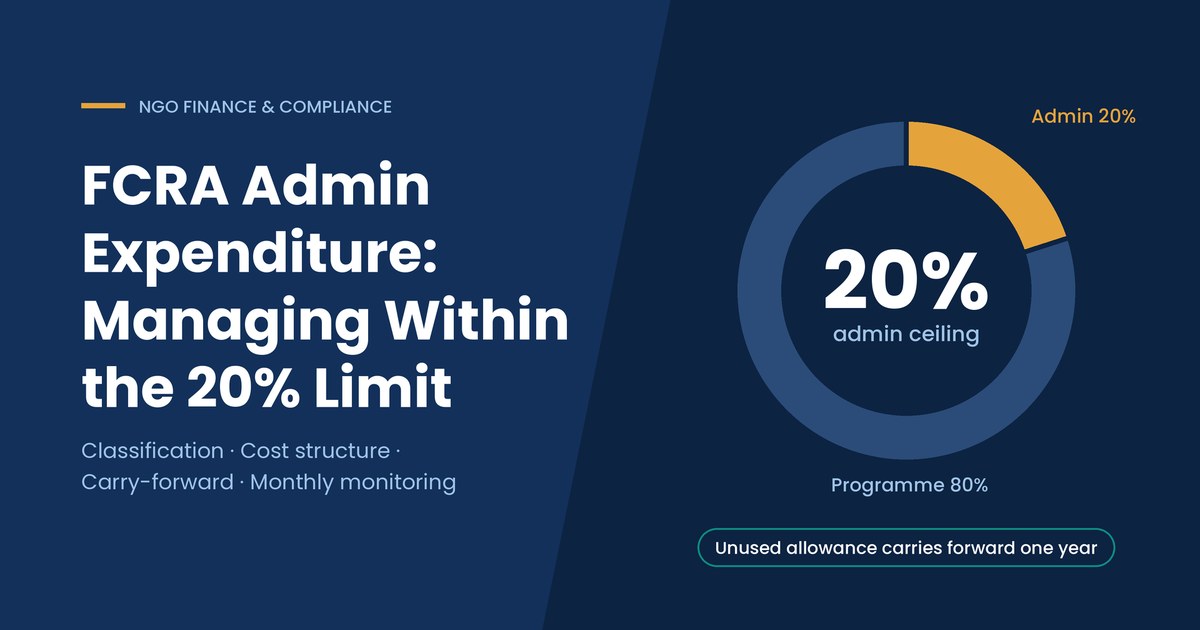
An FCRA-registered organisation must not use more than 20% of the foreign contribution received in a financial year for administrative expenses, unless it first obtains approval from the Central Government. That is Section 8(1)(b) of the Foreign Contribution (Regulation) Act, 2010, as tightened from 50% by the 2020 amendment.
For NGOs with several projects and real finance, HR, compliance and governance costs, the limit is hard to meet. The answer is not a year-end adjustment to be within 20% on 31 March. It is a year-round system of correct classification, efficient delivery, fair cost allocation, domestic funding for overheads and monthly monitoring.
The PDF includes a carry-forward schedule (Annexure A) and a monthly MIS template (Annexure B).
The rules that apply
| Provision | What it does |
|---|---|
| Section 8(1)(b), FCRA 2010, as amended in 2020 (effective 29 September 2020) | Administrative expenses capped at 20% of FC received in the year; more only with prior Central Government approval |
| Rule 5, FCRA Rules 2011 | Defines what counts as administrative expenses |
| FCRA (Amendment) Rules 2024 (effective 1 January 2025) | Unspent allowable administrative expenses may be carried forward to the immediately succeeding year, with reasons in Form FC-4; the CA certificate must report any FCRA violation |
| FCRA (Amendment) Rules 2025 (effective 26 May 2025) | Prior-permission applicants file a project report with an expense breakup and a declaration that administrative expenses will not exceed 20% |
| FCRA Amendment Rules 2026 (22 June 2026) | The FC-4 activity report now shows administrative expenditure for each project or activity (see what changed) |
1. Classify by nature, not by ledger head
Rule 5 decides what is administrative, based on the actual nature and purpose of each expense. Broadly, it covers salaries and travel of Executive Committee or Governing Council members, personnel hired to manage the organisation, office running costs, the cost of accounting for and administering FC (including audit and professional fees), and legal expenses.
The proviso excludes expenses incurred directly in furtherance of the stated objectives. Field staff, trainers and programme staff who deliver activities are programme cost. Office upkeep and accounting stay administrative even if described as supporting the objectives.
Be conservative but evidence-based: do not treat every doubtful item as administrative, and never label an expense "programme" just to avoid the ceiling. Put the agreed treatment in a Board-approved FCRA Administrative Expenditure and Overhead Policy, covering classification, shared-cost allocation, documentation, the calculation base (including interest on FC), carry-forward and the prior-approval procedure.
2. Reduce the need for administrative spend
- Redesign delivery. Defined services such as mobilisation, logistics, technology or data collection can be procured from genuine service providers, under arm's-length contracts, paid against verified deliverables. It must be procurement, not a sub-grant: a transfer of FC breaches Section 7.
- Cut avoidable costs. Review staffing, premises, travel, consultants, software and duplicated functions at least once a year, without weakening essential controls.
- Allocate shared costs fairly between FCRA and domestic funds, by timesheets, floor area or usage. Never move a cost just to avoid the ceiling, and never charge it twice.
3. Fund overheads properly
The 20% ceiling applies only to foreign contribution. Legitimate overheads above it can be met from unrestricted domestic donations, domestic grants or CSR funds, which is usually the most dependable long-term solution. At negotiation, show donors the full cost of delivery, budget direct costs as direct, and test the combined administrative impact of all grants together. Review capital expenditure separately by its actual purpose and use.
4. Use the one-year carry-forward, and plan the rest
Since 1 January 2025, the unspent part of a year's allowable administrative expenses may be carried forward to the immediately succeeding year only, with reasons disclosed in Form FC-4. Whatever is not used in that year lapses. It is a one-year bridge, not a reserve.
The Rules do not say whether the brought-forward amount is used before the current year's allowance. Agree the ordering method with your FCRA auditor, record it in the policy and apply it consistently. The PDF works through a three-year illustration.
Where a genuine excess is unavoidable, apply to the Ministry of Home Affairs for prior approval and do not incur the excess until it is granted. Do not draw funds early merely to inflate the base, and do not assume interest on FC raises the ceiling.
5. Avoid year-end fixes
Deferring administrative payments to April only consumes next year's allowance, still has to be recognised as a liability, and can look like an artificial arrangement to the certifying CA. Reclassifying expenses between heads just to stay within the limit is worse. Use the carry-forward first.
Exceeding the limit without approval is a contravention of Section 8. Since 2025 the CA certificate must say whether any FCRA provision was violated. Consequences can include compounding (the schedule sets ₹1 lakh or 5% of the excess, whichever is higher), restrictions on receiving or using FC, and difficulty at renewal.
6. Monitor monthly against the projected year-end
Measure projected year-end administrative expenditure against the total available allowance (20% of forecast receipts plus any carry-forward), not year-to-date spend against year-to-date receipts. Receipts are lumpy, so a year-to-date ratio gives false alarms and false comfort.
| Projected spend as % of available allowance | Suggested action (internal control, not a statutory threshold) |
|---|---|
| 75% | Finance head reviews classification and forecasts |
| 85% | Corrective action plan agreed with programme heads |
| 95% | Escalate to senior management; decide on domestic funding or a prior-approval application |
The governing body approves the policy and reviews compliance at least quarterly. FC-4, the CA certificate and the records behind them should agree with the policy and with what was actually spent.
Managing FCRA administrative expenditure is a year-round discipline, not a year-end accounting exercise. Correct classification comes first; efficiency, domestic funding, the carry-forward and, exceptionally, prior approval then provide the headroom.
This is a management and compliance framework, not legal or professional advice. Validate your policy and calculations against the current FCRA provisions, Form FC-4 and advice from your FCRA auditor or legal adviser. Position as at October 2026.
Related: FC-4 Annual Return 2025–26: 10 Checks Before 31 December and FCRA Amendment Rules 2026: What NGOs Need to Know.